

Devinder Kaur Johal, 89, a celebrated author and performer in Surrey, British Columbia, kept her passion for writing and singing a secret for decades.
Born in 1936 in Punjab, India, Devinder left school after Grade 7 and spent her youth preparing for marriage—handcrafting items for a dowry and living under strict gender norms. “We believed our futures belonged to our parents,” she recalls. “We put boys at the front ourselves too—because we didn’t know better.”
Her first poems were letters to a friend who moved away after marriage, quietly expressing her longing. The voice prompted by the longing of her friend would grow louder over time.
After immigrating to England in 1965, and later settling in Canada, Devinder juggled factory work, childcare, and household responsibilities. Her love for poetry and singing didn’t disappear, but she didn’t feel free to pursue it—until a tragic event in 1996 pushed her to write with a purpose.
A mass shooting in Vernon, BC, where a man killed nine people after his wife tried to divorce him, disturbed her deeply. “This tragedy compelled my mom to write about her thoughts and feelings about the role of women in Punjabi culture, how they are mistreated, and how they can be empowered.,” says her daughter Ravi Basi, librarian and manager of multicultural services at the Surrey Library.
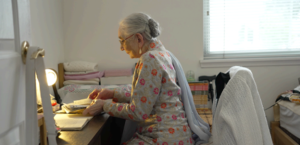
At an age when most people slow down, Devinder began using poetry to confront gender-based violence. Today, Devinder has written and published eight poetry books. Her writing reflects both personal struggle and broader calls for justice. She speaks openly about her experience with depression. During that time, her husband encouraged her to find community, and she joined the Indo-Canadian Senior Centre, where other women supported her creativity.
“They related to her poems,” Basi says. “She would perform her original poetry at the centre every week. The ladies would encourage and support her.”
This transformation from being an invisible older woman to a community voice is not common among Punjabi immigrant women in Canada. Older Punjabi women often experience social isolation, not only due to gender or age, but also because they grew up with limited educational and social opportunities—making them especially vulnerable in Canada. According to gerontologist Dr. Sharon Koehn, many also face neglect in multigenerational households and are made to feel invisible.
Devinder resists that erasure as she continues to write and perform. “If five out of a hundred women take inspiration from my books, I would say my purpose has been fulfilled,” she says.
From Artistic Expression to Systematic Change
Thamilini Jothilingam, digital archivist at the South Asian Canadian Digital Archive (SACDA), an initiative of the South Asian Studies Institute, is preserving Devinder’s poetry and performances as part of a new folk songs collection. “Her story offers a powerful role model—someone who embodies perseverance, passion, and purpose,” says Jothilingam. “The lived experiences of elderly Punjabi and South Asian women are essential—by documenting and preserving their stories, we challenge the structures that have rendered them invisible for too long.”
“I hope they’ll see in her a mirror, a guide, and a reminder that their voices matter. That their art matters. And that it’s never too late to dream, create, or begin anew.”
Systematic support for the women Devinder advocates for is critical. Meena Dhillon, lawyer and co-founder of the South Asian Legal Clinic of BC (SALCBC), works closely with South Asian women facing family violence. “A lot of the women we support have never done anything for themselves,” Dhillon says. “They grew up with no agency. Part of our work is showing them it’s okay to take space.”
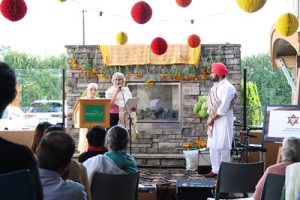
Meena co-hosts the Cha, Chaat and Chit Chat support circle with Ravi at the Surrey Library, where Devinder often attends and speaks. “The women love hearing her,” says Dhillon. “She reminds them of their mothers and grandmothers. Her poetry gives them hope—and agency.”
SALCBC is also fighting justice nationally. It recently gained intervenor status in Ahluwalia v. Ahluwalia, a Supreme Court of Canada case debating whether family violence should be recognized as a distinct legal tort. If successful, the case could mark a shift in how courts respond to intimate partner violence—an issue that disproportionately affects immigrant women.
Devinder’s poetry brings awareness to the very issues debated in court, while continuously encouraging women to speak out and leave family violence behind.
She has read her work at literary events, the South Asian Studies Institute, senior centers, and even won “Most Popular Vote” at the PICS Golden Glam-Ma Pageant. Her story is a reminder that dreams deferred are not dreams lost.
“No matter your age or your circumstances,” she says, “you all have something valuable to say, whether it is through writing, story-telling, poetry, dance, singing, or conversation. Don’t let your voice be stuck in your throat.” And to herself, she adds: “Devinder, you will reach the moon.”