
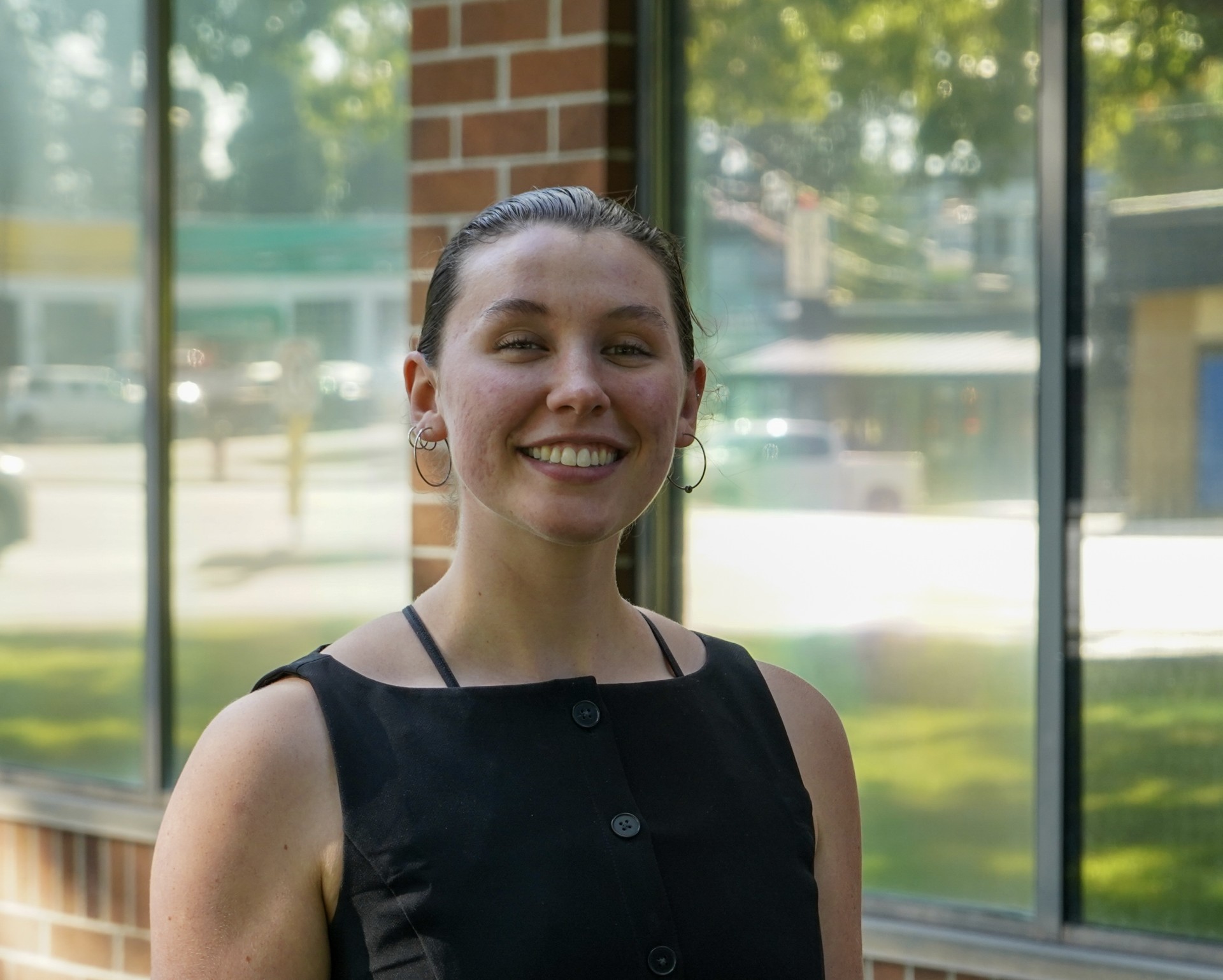
In Grade 12, Rebekah Stokes delivered a capstone project ambitiously focused on how humans can work to save the world. She looked at climate change with a critical eye, a moment that marked the beginning of a remarkable learning journey.
“That 17-year-old is still very much at the core of who I am,” says Rebekah. “But I’ve definitely learned some lessons about how change really happens since then. When I was looking at what university I wanted to go to, and the kind of work I wanted to do, I decided climate action seemed like a good old big problem to sink my teeth into.”
Rebekah graduated from UFV in June with a degree in Global Development Studies.
However, even before graduating, Rebekah was already making waves in the community through her work with the City of Abbotsford. Rebekah worked on Abbotsford’s newly minted Climate Resilience Strategy, an opportunity she gained through UFV’s Co-op program.
Released this summer, the City’s Climate Resilience Strategy outlines a number of actions to which the City of Abbotsford has committed to “reduce greenhouse gas emissions while also preparing for, adapting to, and reducing the risks from climate-related events” such as flooding and extreme heat.
“I’ve learned, especially through this process, to check my assumptions at the door.”
“My role focused on community engagement,” says Rebekah. “Often times that looked like loading up my car with materials and heading out into community just to chat with folks for a while.”
For Rebekah it meant learning what the community values when thinking about climate.
“I’ve learned, especially through this process, to check my assumptions at the door,” she says.
When discussing the recent floods, for instance, she found experiences and viewpoints varied by region. Some reactions were far less involved or passionate than she expected.
“We’d have folks coming up and saying, ‘I know the flooding has been bad for a lot of the farmers and folks in the Sumas Valley, but really, I wasn’t personally affected.’ We have a lot of different regions, because Abbotsford is so huge, so risks and experiences will vary depending on where someone lives, and that’s something we can keep in mind when developing solutions.” says Rebekah.
Rebekah also completed a directed research study supervised by professor Dr. Michael Batu that shared some common foundations with her work for the city.
Her paper, Waste to Wealth: The Business Case for Circularity in Abbotsford, BC, focused on how to make sustainability financially viable for businesses and governments. She describes circularity as a system that strives to keep materials and value within circulation for as long as possible. This contrasts with a more typical linear system, where products are made, used and then thrown away.
“Circularity means that from the beginning, we’re designing products for durability. But also, the production itself has less waste, less output. And then, at the end of the product’s useful life, we’re trying to insert that product or its components back into the system,” she explains.
To Rebekah, it’s about designing a circular system that makes sense for businesses, municipalities, and governments. An example of a circular program already in place is BC’s Return-It program for cans and bottles.
“It’s eye-opening to witness how the different systems, intersecting departments, and people in government get policy across the finish line.”
“The province has legislated that the producer has to take responsibility for their used cans and bottles,” says Rebekah. “So, when you as the consumer buy a pop, you drink it and then take the can back to the recycling depot to receive a deposit refund. But that recycling depot is actually supported by a group of pop producers who have been legislated to collect those cans and make sure they get recycled at the end of life.
“With ‘extended producer responsibility’ programs, producers have a responsibility not just for producing and selling the product, but for following through to the end of life as well.”
Though programs like extended producer responsibility tend to be implemented on a provincial level, while working on the Climate Resilience Strategy, Rebekah had the opportunity to experience how climate policy is made at a municipal level.
“I’ve worked with a lot of non-profits, advocating to the policy makers to make changes,” says Rebekah “But seeing how it works on the other side, it’s eye-opening to witness how the different systems, intersecting departments, and people in government get policy across the finish line. It was very informative and humbling to experience it from this perspective.”
Newly graduated, Rebekah is looking ahead. The summer provided her with a period of reflection on all the work she completed during her undergraduate degree. She hopes to continue her work in sustainability and gain more field experience before embarking on post-graduate studies.
“Dr. Geetanjali Gill, our Director of the School of Social Justice and Global Stewardship, is incredible at creating a community among us Global Development Studies alumni,” says Rebekah. “She sends us job postings and keeps us in the loop on opportunities in the field.”
The opportunities she’s been provided by her education at UFV with her work related to the circular economy, as well as climate resilience and policy at the City of Abbotsford, have given her tools to continue on a path of changemaking.
“I’m so grateful to everyone who has mentored me along the way, both at UFV and the City of Abbotsford.”