
“Study abroad is like a roller coaster – it looks scary but once you’ve tried it, it’s just really exciting, fun you know? The relationships you build in COIL – that’s the push you need to ride that coaster.” Ahmed Zammit
“We learned that patience, openness, and respect are not just ideal values in intercultural communication, they are required skills.” Priya Alamwala
Two years in, we’re getting our first glimpses of how Collaborative Online Intercultural Learning projects are impacting students.
The consensus?
While it can be difficult to navigate a “maze of schedules and time zones”, COIL projects make students feel connected. It gives them opportunities to appreciate different ways of communicating and gets them excited to pursue international experiences like study abroad or international internships.
 Victoria Surtees, TLC’s COIL coordinator, had chance to engage with students who participated in three different COIL projects in Intercultural Communication, Regional and Urban Planning, and Business.
To hear the full interview with Gabriella Wertheimer and Suwebah Shoaib, check out the most recent episode of Ekta, Learning Differently Together.
Contact Victoria.surtees@ufv.ca if you are curious about having COIL in your classroom.
What is COIL? What does it look like in practice?
COIL involves students from two classes in two different countries working collaboratively on project that addresses learning outcomes in both courses. Students work virtually in global teams to solve problems, create projects, and pitch solutions.
Project showcase: A culturally responsive public relations campaign
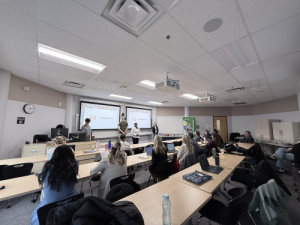
Dr. Joy Enyinnaya’s Advanced Intercultural Communication class hosted a COIL showcase featuring collaborative work between UFV students and UniMAC students in Ghana. Together, the teams developed four public-relations campaigns for Ruth and Naomi’s Mission.
A big part of this project was asking students to create campaigns that showed they understood both Canadian and Ghanaian cultural perspectives. By working with their Ghanaian partners under the guidance of Dr. Lawrencia Agyepong at UniMac, they learned how values, daily experiences, and community needs can differ, and how those differences shape communication. Their final campaigns showed respect, cultural awareness, and strong intercultural understanding.
During the event, Tracy Rahn, Ruth and Naomi’s Director of Development, offered glowing feedback. She praised the students’ ingenuity, thoughtfulness, and intentionality, noting that their work reflected deep learning and a broadened global social perspective.
What students are saying
Building Intercultural communication skills
Across different classes students said the same thing: the differences and the difficulties were important learning moments… if students were humble and curious enough to move them.
 In her final reflection on her COIL in Joy’s class, Priya Alamwala highlighted the differences she experienced and the impact it had: “Our Ghanaian teammates often communicated in ways that were warm, expressive, and relationship-focused. They saw emotional connection as an essential part of our project and our meetings. In contrast, our Canadian approach tended to be more direct, structured, and task-oriented. Instead of these differences creating tension, they actually helped us create a balance in creating our campaign.”
Suwebah Shoaib was part of a COIL collaboration lead by Dr. Cherie Enns in the Urban and Regional Planning Program. She collaborated with Egyptian students from Helwan University exploring sustainable water practices. For her, a defining moment was during Zoom meetings when her Egyptian partner often interrupted her. I didn’t get it at first, she explained and had felt a bit offended. On reflection, she realized that her teammate just needed a bit of time to process and form her thoughts in English and was trying to contribute meaningfully to the conversation. It reminded Suwebah to be humble and respect the tenacity of her teammates. She is grateful to Dr. Cherie, who encouraged the students to approach collaboration with an open mind.
Authentic Relationships
One of the most surprising outcomes of COIL projects for students was relationships – real, authentic connections. The kinds they had been craving but hadn’t previously experienced in group projects with only UFV students.
Gabriella Wertheimer, who participated in Joy’s COIL explained that as an international student from Brazil, she had been missing the warm relationship-focused style communication from her home country. When she met Moses, her Ghanaian teammate, it was connection at first sight. His cool under pressure, his warmth and his genuine excitement to connect with their team made a huge impression.
They’ve kept in touch.
A Pathway to Study Abroad
 In 2024, Ahmed Zammit participated in UFV’s first ever COIL collaboration as part of Mark Breedveld’s class on professional selling. Mark’s class collaborated with students in Morrocco at Al Akhawayn University on a project exploring different perspectives on accepting cash payments in local businesses. “The project was a lot. The expectations were different between our Moroccan counterparts and us and time zones make connecting difficult. But talking to them, getting to know them, that was the best part. It really opened my eyes and got me excited about studying abroad. Knowing someone there made all the difference, like you’re not just landing in the dark.” While he had originally planned to go to England, after the COIL, Ahmed made the choice to do a semester abroad in Morrocco. “After being there, I had a way better understanding of why the Moroccan students were so detail-oriented on their tasks. It’s way stricter there.” While abroad, he met up with his COIL partners and even the Moroccan COIL instructor. When asked how instructors support students in engaging with COIL, he explained: “You need to be curious and know they will do things differently – instructors could help students understand that before they meet with their COIL teams. It’s also helpful to have time to talk about the difficulties.” While it felt hard at the time, Ahmed has since realized that negotiating time zones, different cultures, and different work styles is something he will have to do in future. “I’ve caught the travel bug. I know I’ll be working in international teams a lot more from now on.” Now back from his semester abroad, he has landed in Financial Management with Dr. Felicia Chong, who is doing a COIL project with Universiti Tunku Abdul Rahman, Malaysia.
This time, he knows what to expect. And he’s excited.
Curious about COIL for your class or program?
Contact Victoria.surtees@ufv.ca