
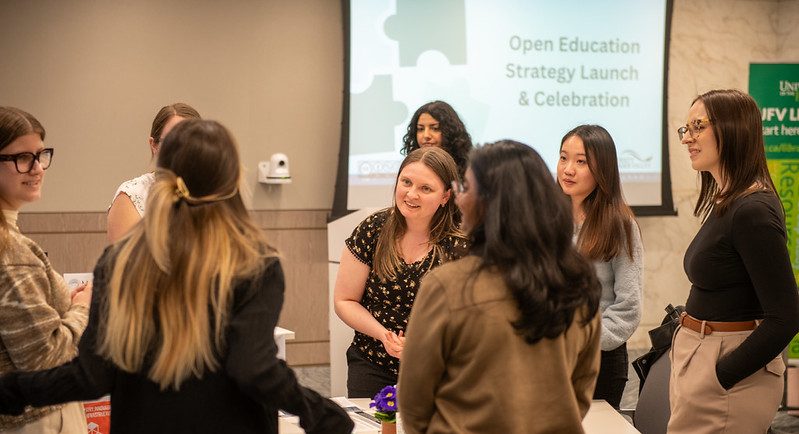
 After 10 years of grassroots advocacy and 8 months of extensive consultation, UFV launched its first Open Education Strategy on 5 March 2026 during Open Education Week 2026. Funded by a BCcampus Open Education Institutional Grant and support from the Office of the Provost and Vice President, Academic this strategy formalizes open education at UFV. Open Education activities at UFV are managed through a collaboration between UFV Library and Teaching and Learning departments.
Open education is an educational movement grounded in the principle that knowledge is a public good. It advocates for the use of open licenses, open practices, technologies, and collaboration to expand access to learning worldwide (OEGlobal. nd).
The Open Education Celebration and Strategy Launch brought together faculty engaged in open education activities, students working on open education projects, administrators supporting this work, BCcampus representatives, and the project team to formally launch the Open Education Strategy but also celebrate the successes of open education at UFV. This event showcased faculty open education projects and the successful launch of UFV’s Zero Textbook Cost initiative. It launched open education into the future.
UFV’s Open Education Strategy
The University of the Fraser Valley, located on Stó:lō Temexw, the traditional and contemporary lands of the Stó:lō people, commits to the principles of open education including accessibility, openness, collaboration and sharing, learner-centredness, inclusivity and equity, and flexibility and sustainability to support student learning.
 UFV commits to these principles by:
- Supporting engagement in open educational practices in academic and non-academic areas across UFV.
- Enhancing the adoption, adaptation, and creation of high-quality open educational resources that reflect professional and disciplinary expectations.
- Building awareness and community around open educational practices through effective communication at department, faculty, and institutional levels.
- Recognizing open educational practices as teaching, research & scholarship, and service; and/or professional practice where they align with department and faculty standards.
- Encouraging students as partners in open educational practices, including open educational resource creation and related experiential learning opportunities.
- Advancing UFV’s Zero Textbook Cost initiative by using open educational resources and other no cost materials to support equitable access, enhance inclusivity, and reduce financial barriers for students.
- Identifying funding opportunities and partnerships to support a sustainable open education initiative at UFV.
The Open Education Strategy report can be viewed online.
Institutional Support
 UFV’s Open Education Strategy enhances access to learning and knowledge by reducing barriers. In a letter of endorsement, UFV President and Vice Chancellor, Dr. James Mandigo writes:
“I am pleased to endorse UFV’s Open Education Strategy, which represents both a natural evolution of our teaching culture and an important step forward in how we share knowledge, reduce barriers, and create opportunity. Grounded in the principles of accessibility, collaboration, learner-centredness, and equity, this strategy aligns closely with UFV’s identity as a regional, community-engaged, and teaching-intensive university located on Stó:lō Temexw.
Open education is fundamentally about more than textbooks or digital resources – it is about who has access to learning, who gets to contribute, and how knowledge is created and shared. By advancing open educational practices, UFV is reaffirming that knowledge is a public good, and that education should be accessible, inclusive, and responsive to the communities we serve.
I am particularly proud of how this strategy advances UFV’s Zero Textbook Cost (ZTC) initiative. Reducing financial barriers to learning is a powerful equity measure that directly supports student success, retention, and belonging.
Equally important is the way open education invites students to be partners in knowledge creation – an approach that reflects UFV’s commitment to experiential learning.
This strategy also reflects UFV’s role as an Ashoka Changemaker Campus. Open education is strongly aligned with our Changemaking ethos by fostering collaboration, shared solutions, and community impact, and by encouraging us to adopt more accessible and adaptable teaching and publishing approaches”.
 UFV’s Open Education Strategy is also supported by UFV-SUS President, Bilal Faisal Faheem who writes:
“The UFV Student Union Society is proud to offer its full support for UFV’s Open Education Strategy. For students, open education is not an abstract principle. It affects them in numerous ways directly impacting their learning, academic success and overall well-being. The cost of textbooks and required materials remains a significant barrier for many students, influencing course selection, retention, and the ability to fully engage from the first day of class.
The Student Union Society has consistently advocated for reducing financial barriers and increasing transparency in course material costs. The advancement of open educational resources and the institutional commitment outlined in UFV’s Open Education Strategy represent meaningful progress toward a more equitable and inclusive learning environment.
By embedding accessibility, collaboration, learner-centredness, inclusivity, and sustainability into institutional practice, UFV affirms that education must remain responsive to the diverse realities students face. Strengthening the Zero Textbook Cost initiative and expanding the adoption and creation of open educational resources will support student success while reinforcing UFV’s mission to engage learners, transform lives, and build community.
The strategy’s recognition of open educational practices as meaningful scholarly and professional contributions, as well as its commitment to student partnership in knowledge creation, reflects a collaborative model of teaching and learning that benefits the entire UFV community.”
Support for UFV’s Zero Textbook Cost Initiative
 The Open Education Strategy also formalizes the Zero Textbook Cost Initiative that was launched in Fall 2025 providing students with transparent information on courses that do not require course materials and textbooks to be purchased in the UFV Timetable. While many courses have used no-cost materials for a number of years, identifying these courses as ZTC in the timetable provides students with important information to support their educational journey. In Fall 2025, 14% of course sections were identified as ZTC; in Winter 2026 this increased to 25% sections. We hope that UFV’s Open Education Strategy will encourage growth in ZTC. You can learn more about ZTC at UFV in this video.
Open Education Team members
The work in creating UFV’s Open Education Strategy has been a collaboration between many people and departments. In addition to the team members listed here, we acknowledge Open Education Working Group members, faculty, staff, students and administrators who engaged in consultation events and BCcampus for financial support.
The Open Education Team are:
- Claire Hay, Learning Specialist (Curriculum and Assessment)
- Janelle Sztuhar, Scholarly Communications and Copyright Librarian
- Shaun Zheng Sun, Associate Professor (Math/Stats) and temporary Open Education Strategist
- Aashima Marwaha, Open Education Student Assistant

For more information, please contact: openeducation@ufv.ca


