
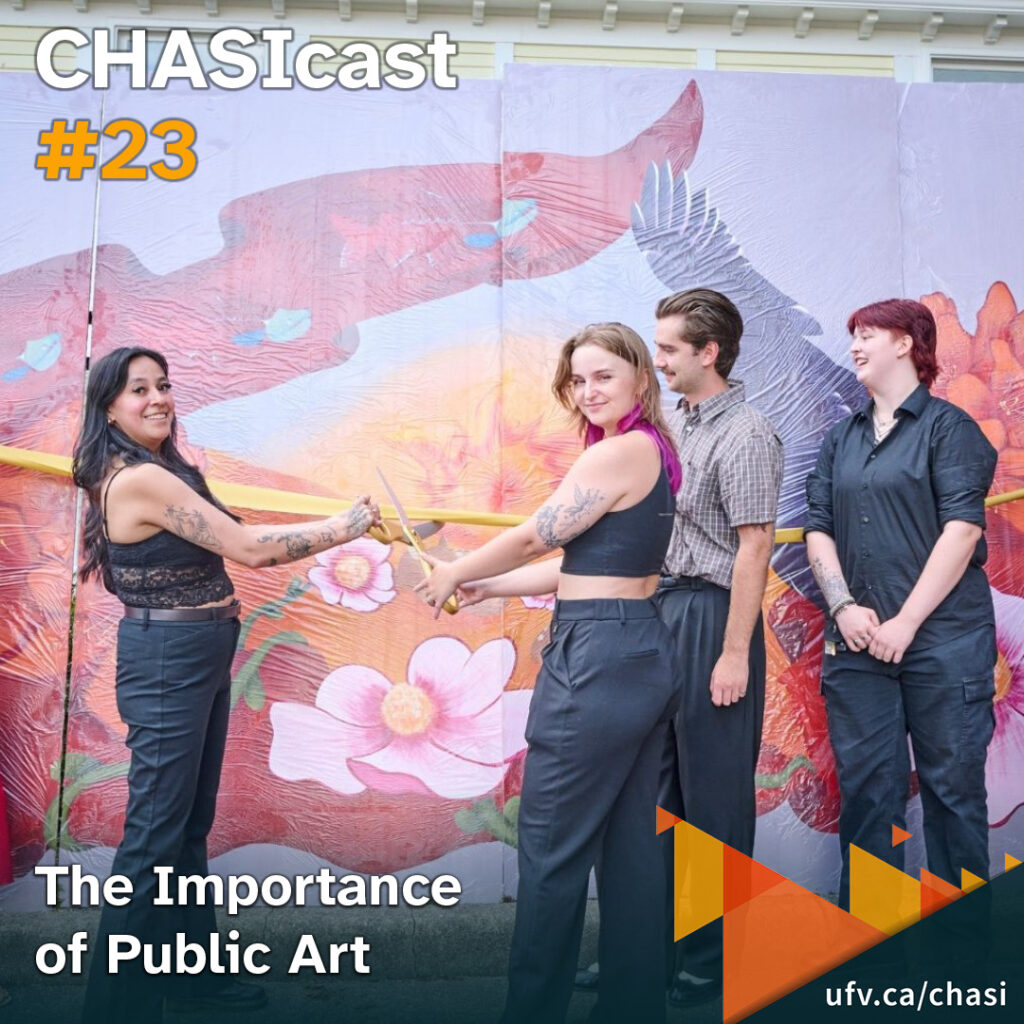
 The CHASIcast is pleased to welcome Melissa Kendzierski, Arts & Culture Coordinator for the City of Mission and UFV alumni. She joins us today to speak about the 2026 public art partnership between UFV students and the City of Mission’s Arts & Culture division, her changemaking journey, and the importance of the arts in these times.
The CHASIcast is also available to stream on your favourite podcast services – including Spotify, Apple Podcasts, Amazon Music/Audible, and more.
Powered by RedCircle
Transcript
CHASIcast voice-over 00:01
Coming up on the CHASIcast,
Melissa Kendzierski 00:04
Knowing that these students are transformed through the learning opportunities that they’re given just elevates the value that is being given to the community because it’s, you know, giving back to these students.
CHASIcast voice-over 00:21
From UFV’s Community Health and Social Innovation Hub, this is the CHASIcast. A program dedicated to bringing experts and insights to the issues that shape our lives, because words have to matter.
CHASIcast voice-over 00:34
Now, here’s your host, CHASI director, Dr. Martha Dow.
Martha Dow 00:41
It’s my pleasure to welcome Melissa Kendzierski here to the CHASIcast. And Melissa, it’s been our good fortune to work with you in the past. Melissa is the Arts and Culture Coordinator for the City of Mission, a UFV alumni.
Martha Dow 00:55
And again, it was such a pleasure working with you around the graphic facilitation. And I know you talked about it as graphic recording, but to me, you did such an amazing job navigating us through that process and created such a powerful piece that has guided so many conversations here at UFV. So thank you for that, and it’s such a joy to have you here to talk about the work you’re engaged in right now with UFV.
Melissa Kendzierski 01:17
Yeah, thank you for having me. It’s always really exciting to come back to the university that I like to call home. It’s been a really special place for me, obviously very transformative as any university experience should be. But now being on the other side and seeing my education being able to work and feed into the future and give back is also really cool to see, and it’s been really exciting to be involved in the UFV public art course. My understanding is that it’s like one of its kind across Canada, and that there’s not any other course that’s offered where students are applying their visual art skills in a public art setting so—
Martha Dow 02:05
Oh, wonderful!
Melissa Kendzierski 02:07
Yeah.
Martha Dow 02:07
I didn’t know that.
Melissa Kendzierski 02:08
This is what Chris Friesen tells me. So, we’ll have to check the veracity of that. But all I know is that it’s been a really wonderful partnership, and I see both sides of the table where we have the students that are benefiting from the real world learning opportunity, and then we have the community that’s benefiting from the output of their incredible creativity and artistic talent, and it’s just been so incredible to see the pride that they have when they see their work.
Melissa Kendzierski 02:31
You know, you’re not going to be painting a small painting, and they created an 111 step mural along the stairs on Second Avenue in Mission, and it’s like a breathtaking piece. Can you imagine like coming off the West Coast Express and you look up on along Welton [Street] and you just see this massive mural, and it’s gotten a lot of rave reviews. So it’s been pretty cool.
Martha Dow 03:02
Fantastic! Can I take you back a step? Yeah, just love to hear, I think, you know, how did you get to that amazing piece of art? You know what what did that all look like?
Melissa Kendzierski 03:11
What the process is?
Martha Dow 03:13
Yeah.
Melissa Kendzierski 03:13
So for the students, it all starts with a course offering. My understanding is there’s not, there’s maybe one prerequisite to go into this public art course, and so we, with that, we’re able to get a huge background of students from different disciplines that apply. We had a [Kinesiology] student this year. We had a [Psychology] student. We have obviously a lot of Visual Art students, a lot of those that are pursuing education, and we had a full course this year, and Chris Friesen, who’s the instructor, pulls it all together.
Melissa Kendzierski 03:47
The course starts, so we started in May. They start with like just an interview. What is—or an overview. What is public art? You know, it’s something that’s learning about the accessibility of art, doing it in the public sphere, that tension between the community, the space, what that means, how you introduce, you do your research, and then you design a piece accordingly, getting feedback from the public, getting feedback from the different sources, obviously infusing it with your own creativity and your own talent, and then from there, that’s where the whole project launches from.
Melissa Kendzierski 04:24
So, the students they take that, and then we hosted two like learning opportunities where they met with archivists, and they met with Mission Community Services, which is quite proximal to the site, and we had conversations about culture in the area. So they really get an immersion of like, what does that space look like? What is the culture of the community? I believe we only had one student this year that actually lived in Mission. So, you know, it’s really important that we familiarize the students with the space in the community so that they know that the work that they’re designing is appropriate for that space and is suitable, and will be accepted and embraced.
Martha Dow 05:05
I’m curious a bit about the interdisciplinary, like the students. I’m thinking about myself, and if I saw a public art course, I mean, I’m so interested in the power of public art, but I think I also might be intimidated because I don’t see myself as an artist.
Melissa Kendzierski 05:20
Yeah.
Martha Dow 05:20
Can you talk a bit about that?
Melissa Kendzierski 05:22
Well, so kind of from there, they design. They come up with their project proposals. They work in groups and they design different ideas according to the space and what the group determines is the direction that they want to go in. And we had one group, for example, that definitely influenced by the [Kinesiology] student who had like some sort of wellness gym proposal that had art infused in it, and so that you know that was reflected in their proposal.
Melissa Kendzierski 05:52
We had a couple students that have Indigenous ancestry. That definitely came up in the art pieces that were produced and really pulled upon, specifically the mural, which is really quite a powerful piece. Yeah, it’s hard to say. Like you have to really know each individual student to know how each piece is infused with like their own personal flavour. But I’m certain that their fingerprints are all over the work.
Martha Dow 06:22
Yeah, wonderful.
Melissa Kendzierski 06:23
Yeah.
Martha Dow 06:24
So, how will the community continue to be introduced and socialized to this amazing, you know, piece of art?
Melissa Kendzierski 06:31
Yeah, so, I mean, we did have an unveiling event on [August 19th, 2026] where we you know did our our thank yous and our praises and celebrated the hard work of the students, and it’s not just the students that are doing the work. Public art also has this real world component, which is really exciting to introduce the students to. And that’s, so for example, that 111-step mural is a series of 111 signs.
Melissa Kendzierski 06:58
So they took their piece, they painted it in the studio, and then they photographed it in such a way that they could then send it to the printers. And the printer was like, “it’s too pixelated,” so then they had to send it back, and then they had to wrestle with that real world problem of how do we scale this now for the size that we’re we’re working with and still maintain the integrity of the work that we’re doing without it looking too digitized or too cleaned up. They really wanted to maintain the brushstrokes that they put into the work.
Melissa Kendzierski 07:35
So you know, with the support of Alex Duff, who is the studio manager support person in the Visual Arts program who was able to provide some of that technological piece that helped them to, you know, we printed off prototypes. We even had one student that like was really into the digital media stuff, and they made like a rendering of the digitized stairs. I know I’m going kind of off course here from that question, but you know, reflecting on the student’s fingerprints, like that was one thing that student was like super into, like 3D animation, and they found a way to like really infuse themselves into that work.
Melissa Kendzierski 08:16
But bringing it back to talking about the the stair piece and working with the vendors that we were working with like, you know, they had to call and get quotes. They were dealing with the fact that one of the vendors that was providing us with a quote had a family emergency and so couldn’t, you know, follow through. These are all like real world things—and we’re working on a tight timeline here—that you don’t really get when you’re in a classroom, and I encounter them in my work. So you know this is old news to me, but to them, I’m sure it’s something like, “oh my gosh,” like, and being able to support them in that experience is really rewarding.
Martha Dow 08:59
It’s one of the things as you were talking, I think CHASI can really relate to that. It’s one of the things that both, you know, our community partners and also students talk about is, you know, you’re pivoting. These are projects that, you know, your community partners are needing. They’re deliverables that they’re needing, and sometimes you have to, “oh!” pivot for one reason or another, or respond to timelines in a different way, and work collaboratively as a team with different sort of disciplines. So it’s exciting, certainly, to hear. Am I right? Like Mission has done this partnership before?
Melissa Kendzierski 09:30
Yeah, this is the third year. So following COVID—there’s a huge mural on Highway Seven that was done following COVID because we had some public art money and that’s kind of what launched this partnership. And then when we got our arts and culture manager, we met with I think [Candace Couse] was the director at the time, and they expressed how important this partnership was and that they’d like to continue.
Melissa Kendzierski 09:56
So as a result, we partnered with them to do the Gaudin Creek Trail project, which was last year’s project, and like we dedicate staff time and budget to it to make this possible, and it’s just the output, and maybe it’s because I work so closely, but it just feels so much bigger than just the projects that the public are seeing. You know, like knowing that these students are transformed through the learning opportunities that they’re given just elevates the value that is being given to the community because it’s, you know, giving back to these students.
Martha Dow 10:35
It’s interesting, you know, you worked with us as the university and our president was navigating, you know, what does changemaking look like? How do we center changemaking here at UFV? And as you’re talking about transformation and students, I wonder if you could, because you were part of that, you know, that initial thinking at UFV, and now with this public art, could you talk a little bit about, you know, changemaking and higher education and our responsibilities around that connecting to community?
Melissa Kendzierski 11:01
Yeah, and this will connect a little bit to my own personal story too. So, you know, back in, I think it was like 2008, so that’s when I walked the grounds here in Abbotsford, and I was in Dr. Michelle Rhodes’ environmental issues class, and she challenged us to approach an environmental issue, you know. And at this point in time, I thought, “oh yeah, I want to go in the safe education stream and, you know, become a teacher.”
Melissa Kendzierski 11:29
That project we compelled the UFV bookstore to bring in green office supplies, and I mean it sounds very straightforward, but it wasn’t because we had initially picked a very ambitious project that flopped, and we had to pivot, and then we had to meet with vendors, and we had to talk to the bookstore, and we had somebody supporting us and giving us ideas and helping us navigate these systems, and it was like my mind like just opened up, and kind of that was like a launch point for myself as a changemaker here at the university, and really how I wanted to emulate my career moving forward.
Melissa Kendzierski 12:07
It also is like, you know, I thought, “oh, I want to be a city planner” because I’m really passionate about people’s voices being seen in the spaces that they walk in, you know, and because that was a very, you know, going into the bookstore, seeing these office supplies, like how cool is that? Seeing the work that you’re doing in the spaces that you walk is very empowering. From there, you know, it just set a foundation for the the work that I do, and even a little bit of why I do the graphic recording work because somebody also said “you’re too creative to be a city planner.”
Martha Dow 12:43
Respect to all the city planners.
Melissa Kendzierski 12:45
This is true, and it’s very important work. But it’s also quite technical, and I do think that my work does intersect with planning in many many ways. But it’s that consultation process. It’s the voices that are heard, being you know, put on the wall, being seen when I do that graphic facilitation work, and then being able to see that work then come to life years later is very, very powerful. So being able to work with students and see their work be transformative for themselves personally.
Melissa Kendzierski 13:23
Sadly, we’ve already seen a little bit of graffiti on the pieces. I mean, that is to be expected. And we had students that were like out there that same day, like scrubbing it, you know. And not that that’s their responsibility, but that just demonstrates the amount of pride and care that they have in the work, and I don’t, I’m sure that there’s pride and care put into writing a paper, but you can see that, you know, they’re not going to go back and fix that mistake in that paper, in the same way that they are going to go back to that public art piece and you know buff it up to make it presentable to the community again.And then you can kind of just like leverage the art a little bit further, right? And we had this conversation about how, when I first came in here, about how you know art has the ability to be provocative in a really subtle way. One of the pieces, the mural, reflects the story of a student who shared and even had a little bit of a had some photos in her presentation about her family’s history and connection to the residential schools here in Canada, and together, based on that story, they created this incredible mural that has so much symbolism attached to it, from like a red ribbon flowing through it, that is symbolic of you know the red dress date. These fawns that are symbolic of the children that have lost their lives in residential school. There’s a raven in this mural that is symbolic of the need to preserve and honor indigenous storytelling and. You know the orange rhododendron as a as a nod to mission, and this piece is you know when you see it and you understand the symbology is it’s yeah is quite provocative and has the ability to get people to think and get people to talk and already through certain encounters that I’ve had it’s you know raised those conversations.
Melissa Kendzierski 14:00
And then you can kind of just like leverage the art a little bit further, right? And we had this conversation about how, when I first came in here, about how you know art has the ability to be provocative in a really subtle way. One of the pieces, the mural, reflects the story of a student who shared and even had a little bit of a, had some photos in her presentation about her family’s history and connection to the residential schools here in Canada, and together, based on that story, they created this incredible mural that has so much symbolism attached to it, from like a red ribbon flowing through it that is symbolic of you know the red dress day. These fawns that are symbolic of the children that have lost their lives in residential school. There’s a raven in this mural that is symbolic of the need to preserve and honor indigenous storytelling and. You know the orange rhododendron as a as a nod to Mission, and this piece is, you know, when you see it and you understand the symbology, it’s, yeah, it is quite provocative and has the ability to get people to think and get people to talk and already through certain encounters that I’ve had it’s you know raised those conversations.
Melissa Kendzierski 15:22
I mean, we all know the political climate right now is, you know, putting DRIPA into question, and there’s a lot of discourse around the validity, or people are provoking those kinds of questions. I think it’s really important that works like this come forward attached to those personal stories, as heartbreaking as it is, and like wow, that student was quite vulnerable sharing that.
Melissa Kendzierski 15:48
And so, this piece, for example, we’re contemplating like putting it in the Mission Leisure Centre lobby for Truth and Reconciliation Day as a means to, you know, start those conversations and bring it forward to the community as an opportunity for them to, yeah, really contemplate what did happen in Mission and the history there, and what all of these symbols mean to our current day and age, and what we’re dealing with today.
Martha Dow 16:16
Yeah, incredibly powerful. I I wonder as you talk about conversations and art, do you have, does Mission… Will you do some more events where you’re bringing the public, giving them opportunities to walk? You know, look at the stairs, engage with the stairs, look at the art, but then have maybe guided conversations. Or I mean, I don’t know what. It just, as I’m listening to you, it’s just like you want everybody to experience it. So yeah, I just wondered about sort of what’s what goes on from now on around that particular installation.
Melissa Kendzierski 16:49
Well, I mean, I did mention Truth and Reconciliation Day, and programming. There’s always the opportunity for programming around the pieces of work that we have. We also, you know, the stair mural has a plaque that’s beside it, just as a means to explain it. We have a, on the website, we have an explainer that just like documents the pieces that we have available for the public. So there is always that opportunity without, you know, hands-on guiding of it, and there’s always also the opportunity for other people to, you know, take that on and include it in..
Melissa Kendzierski 17:27
I know that the Mission Museum, for example, has started doing heritage walks, so you know maybe this is a piece that could be included in there. So as much as like I would love to continue to engage in these pieces, there’s just so much work to be done, right? The opportunities are endless, and they’re there. I’m excited to see kind of what the community does with it as well. It’s not that the piece is going to be static and forgotten. It’s just that yeah, we just don’t know. The possibilities are endless.
Martha Dow 17:56
So what is it about Mission that, right, so it’s a partnership with Mission. My guess is that, you know, you’ve got, gonna do anot—does Chris do this course every year?
Melissa Kendzierski 18:04
Well, he did this year, so we’ll see if he… He’s got his heart set on doing a plein air painting class, and so perhaps that’s gonna be in his future. But and maybe it’s another instructor that takes this on. But yeah, the intention is that we continue this partnership every year, or you know, every other year. This year, it was threatened by some of the budget cuts that were going around. So there’s always the unknown, but there’s definitely intention to continue on with this. The value that everybody receives from it is just too great to abandon, in my opinion.
Martha Dow 18:38
So what is that about? I mean, every municipality is wrestling, but clearly, Mission has decided this is important enough to protect as much as possible and to have an ongoing relationship. What do you think, you know, for other communities, what are some of the key drivers that allows for that?
Melissa Kendzierski 18:55
That word relationship is really important, you know, and it’s not… When you start working with somebody, it’s about the person-to-person interaction, right? Like, I loved working with Chris. It was super fun. I loved working with the students. That was super fun. And kind of, you know, you build these relationships, and you kind of keep, you know, you kind of re-examine them year to year. But it’s that relationship piece I think that keeps us anchored and tethered, or at least continue to be invested.
Martha Dow 19:24
I’d love to get your take a bit about, you know, in these days, just as you talked about city and budget… Universities, you know, across Canada, certainly people are sort of wrestling with priorities, access, all those things, and we know that the arts in all of their, you know, forms, and not just, you know, the creative arts, but, you know, certainly social sciences and others are easier targets in some cases because people look for the direct line from, you know, that university degree and that employment, and yet I think you and I absolutely agree that these are founding. To being, you know, educated citizens in the political, economic, and social spheres, so I wonder if you could talk a little bit about, you know, the potential for these kinds of projects, courses to try to generate more appreciation, celebration, nurturing of the importance of the arts, particularly in these times.
Melissa Kendzierski 20:21
Yeah. Well, I mean, this is the thing too about public art is that it’s accessible, right? You don’t have to pay to go to an art gallery to experience something that moves you and something that makes you think. And so, investing in the public art and being able to provide that free foundational educated citizen opportunity, just like we have like [StrongStart BC] programs for families with, you know, it’s part of the social fabric that… It shouldn’t be privileged, you know, it shouldn’t be something where you know economics is the driver to determine whether you can, you know, have a thought-provoking experience or learn your—it’s like education, you know, fthe foundations.
Martha Dow 21:10
I wonder if there’s anything more you’d say about sort of the need to protect the creative arts in university. We talk a lot about it in the university, but I think a critical piece of that will be citizens and you know community members, residents really celebrating, and it feels like this partnership with the city of Mission sort of drives a community appreciation for the creative arts. And so, yeah, I wonder if you have thoughts on other ways that we can motivate that.
Melissa Kendzierski 21:39
Yeah, well, I mean, what comes to mind is I was like thinking about like how sterile an environment would be without the arts. You know, like what would it look like to not have arts and culture in a community? And like, yes, it is like economic to go from point A to point B and you know get an education and then get a career, but like that’s not really how life works, right? It’s messy and it’s complicated.
Melissa Kendzierski 22:09
As much as we would like it to be straightforward, like there’s a diversity of opinions, there’s a diversity of ways that people celebrate and express themselves, and you can’t really force it all into a channel. It’s not really how the real world works, and I think it’s really about embracing that and acknowledging that as being a real thing, not denying it and working with it. I mean, you could go that route and channel it, but I mean, as we see, because the pendulum will always swing back. You might as well just like continue to bring in that diversity, bring in that discourse and that thought, and continue to work with it to yield a brighter, more beautiful, more fruitful future for everybody to enjoy and take part in, right?
Martha Dow 23:01
As you say that too, I wanted to come back to your… You mentioned about the graffiti already, and I wonder if I could get—because I’m always intrigued by this discussion of you know graffiti, street art, public art, and that sort of continuum in thinking about it. And to some extent, you know, sort of that graffiti makes me think there’s some effort to engage.
Martha Dow 23:21
Maybe that’s my optimistic side with the art in some way. But maybe that’s more street art as opposed to… Do you have thoughts on varied expressions? This is a more structured and formal partnership. Yeah. Any thoughts on you know an ability to channel some of that other work that appears on buildings.
Melissa Kendzierski 23:41
Oh yeah, well I mean, one of the tactics that’s used professionally is like “let’s wrap everything with things that are colorful” because if you put art places, then people won’t graffiti it. And yes, indeed, that probably… There is evidence that shows that places that have art have a greater appreciation and less people, you know, vandalizing or tagging, and there is a lot—but underneath the surface, there’s social issues, right? There’s a need to express the pain or the pleasure or whatever it is that is is trying to come out. You know, and even the graffiti. It’s like somebody wrote something stupid about somebody else, or they said like somebody loves somebody, you know, like yes, it shouldn’t be on that piece, but that is in itself an expression of something. And I think there’s two things.
Melissa Kendzierski 24:32
Number one, like different social agencies can recognize this. This is happening. This is part of that real world, and let’s like harness that to do like art therapy or to provide spaces and experiences for that expression. So one of the other unique things that we did this year was from some of the proposals, the students expressed that they were interested in participating in Canada Day, and community engaged art is like another opportunity for people to get in there, get hands-on, and express themselves in ways that are channeled and you know fit the fabric and the landscape of whatever you’re trying to curate. Whether it’s an experience that just lives and dies for that one day, or whether it’s something that lives on and is a preserved piece that’s shared.
Melissa Kendzierski 25:20
The students on Canada Day, they created two art, two little paintings, one of a sturgeon and one of a cedar bough, and they had the community do, you know, thumbprints as a part of like coloring it in, and then we had this giant like four foot by six foot postcard that said “to Canada, with love from Mission,” and then the community came and they like wrote their, whatever was on their mind, and you know everything from like honoring Canada’s sovereignty to, you know, the kids saying “six seven” and like so it’s like a snapshot of, you know, what people want to express and what they want to give as serious or as irreverent or as silly as as they need to be, so.
Martha Dow 26:08
Wonder if we could talk a bit more about sort of UFV and you being an alumni and and changemaking. We’re in a really interesting time as we think about where we are now and where we’re going. You have an interesting perspective, you have an ongoing partnership with UFV and your work, and you were a student who had a really, you know, positive experience here. What would be your hope? What would you imagine if you, you know, you’re in the room and we’re we’re trying to reflect on some of these really tough questions that universities across Canada are grappling with?
Melissa Kendzierski 26:41
I think this like thread of empowerment is really really important to kind of keep that flame alive of the educational seeds that are planted within the university, and I think that empowerment piece is, you know, something that faculty members and staff have the ability to continue to foster and provoke, and it’s really exciting to see the changemaking direction that the university is really harnessed here.
Melissa Kendzierski 27:09
And I know I kind of forged my own way when I was a student, but it was very much supported by students and staff, and emulated what you guys are doing in a more formal sense, and it made for a very very meaningful experience for me. And I think that, you know, being able to offer that to more students through different avenues, whether it’s co-op or interactions with CHASI, or you know, student learning, service learning opportunities, or field work that’s being done, just allows students to see the power of their education in the real world, and then from there, seeing them have careers that continue to dive deeper.
Melissa Kendzierski 27:51
I think it’s been just very exciting, and I think that as like a word of encouragement and appreciation for the people that invested in my education is that I am seeing those seeds that were planted take place. Like there are people that are in my cohort that I graduated with that are making the differences, that are tackling serious issues like climate change, that are invested in you know social justice work, that are bringing those ideas that were seeded in the classroom, coupled with their own innovation and their own talents and their own interests, and they’re now in positions of leadership where they can affect the change in a real meaningful way.
Melissa Kendzierski 28:35
And so I think that leadership, that empowerment piece, that education, it does all come together, and it does make an impact down the road. And so, I think, you know, when universities are grappling with these bigger questions about, like, well, “what what do we invest in?” Like, what you invest in is what you will see down the road. So, it’s so important that, you know, when we are looking at these real world issues—social justice, climate change—that we don’t take for granted what is being done here today. It might not yield the impact immediately, but you will see things down the road.
Melissa Kendzierski 29:14
And you know, I think too about my work as a graphic recorder. I’m oftentimes in these spaces where these, there’s you know thought leaders talking about “okay well what are we going to do this year?” or “what are we going to do in the next five years with our strategic plan?” I’ve worked in a lot of these, you know, different spaces and then you see like three years later, four years later, oh my goodness like this is actually taken root and this is the direction, and this is why we’re seeing what we’re seeing today. I think I just like want to encourage educators to continue to be bold and to continue to invest and to continue to empower in order to be able to yield the future that everybody wants. Whether it’s for the future generations or for, you know, what you want to experience down the road.
Martha Dow 30:06
That’s a perfect place to leave it. So thank you so much for sharing this time. Thank you for the work that you do in community, and I’m looking forward to more partnership opportunities.
Melissa Kendzierski 30:14
Thank you for having me, Martha.
Martha Dow 30:16
Our pleasure.