

This article is part of a series of posts led by CHASI Research Associate Len Garis, who has been a long-time partner of CHASI through his work with the National Indigenous Fire Safety Council. His guest blog posts explore a wide range of topics related to firefighting and firefighters in Canada. You can read all of his guest articles at this link.
CHASI’s collaborations with the NIFSC, and many of their other research works, can be found on our NIFSC Publications page. For questions about the NIFSC and their work, please visit their contact page.
Wildfire Resilient Futures: Taking Stock at the Mid-Term
The National Indigenous Fire Safety Council and the University of Waterloo are advancing WUI Fire Safety in Indigenous communities in Canada, through a research project within the broader Wildfire Resilient Futures initiative. This four-year initiative focuses on building safer, more wildfire-resilient Indigenous communities through community-led preparedness, Indigenous fire stewardship, and western fire science, with funding from NRCan’s Build and Mobilize Foundational Wildland Fire Knowledge program. Here is what has been learned, who has been heard, and what comes next.
By Len Garis and Mandy Desautels
| PROJECT SNAPSHOT | ||||
| 62 Voices Heard |
19 Communities |
13 Friendship Centres |
3 Sharing Circles |
4 Tools in Progress* |
| *Includes one performance tool. Funded by NRCan at $1.5 million, with in-kind contributions from partners. | ||||
A Partnership Rooted in Community
Canada’s wildfire landscape has changed dramatically in the last decade. Longer fire seasons, drier forests, and unprecedented fire behaviour have made it clear that the country faces a structural challenge, not a seasonal inconvenience. For Indigenous and remote communities, the threat is especially acute. Many are accessible only by air or winter road. Evacuation orders arrive with little notice and fewer resources. Emergency management systems tend to prioritize reactive suppression over proactive, community-led preparedness. The result is a persistent gap between the wildfire policies that exist on paper and the lived reality of communities.
It was this gap that brought the National Indigenous Fire Safety Council (NIFSC) and the University of Waterloo together. In 2024, the two organizations launched the four-year Wildfire Resilient Futures initiative, a multi-year program aimed at strengthening community wildfire resilience through Indigenous fire stewardship, co-developed tools, and sustained engagement with the people and places most affected. Within this broader initiative, this project, WUI Fire Safety in Indigenous communities in Canada, provides the research focus on wildfire safety in the wildland–urban interface. The initiative received $1.5 million through NRCan’s Build and Mobilize Foundational Wildland Fire Knowledge program and in-kind contributions from partners, bringing together researchers, community members, knowledge holders, and fire safety professionals under a single, community-directed umbrella.
Now at its mid-term, the initiative has reached a point of meaningful reflection. The first half of the program was designed to listen before prescribing, to travel before mapping, and to understand before building. The work set out to do several things at once: document how communities experience wildfire risk, identify where existing programs fall short, establish trust-based research relationships, and begin co-developing tools that reflect Indigenous knowledge systems alongside western fire science. What has emerged is not a single deliverable but a growing body of evidence, relationships, and shared understanding that will shape everything that follows.
The pages that follow offer a detailed look at where the initiative stands, what communities have said, and how the program intends to translate listening into action during the second half of its mandate.
WHERE WE’RE HEARING FROM — COMMENTS BY REGION
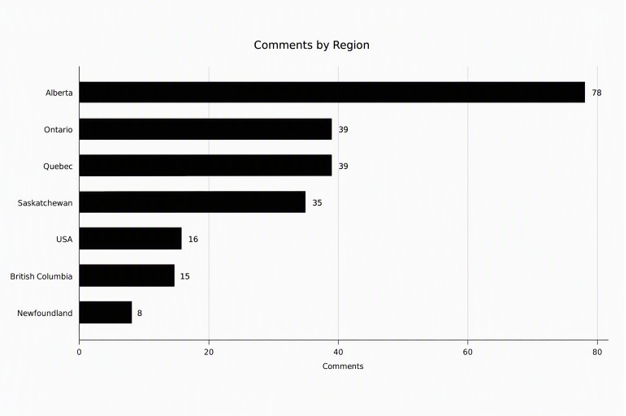
Where engagement comments originated, by region, across the NIFSC consultation process.
Building the Program
The Wildfire Resilient Futures initiative is organised around four interconnected work streams, each designed to reinforce the others. The first centres on community preparedness and FireSmart programming co-developed with Indigenous nations. Rather than importing existing frameworks wholesale, the initiative has worked with communities to assess which elements of FireSmart are useful, which need adaptation, and where gaps remain. This has meant sitting with community leaders, fire departments, and Elders to understand how wildfire risk is experienced locally, where vegetation management intersects with cultural land use, and how evacuation planning can better account for the realities of remote and fly-in communities. The goal is not to replace FireSmart but to reshape it so that it reflects the knowledge, priorities, and governance structures of the communities it is intended to serve.
The second work stream focuses on knowledge mobilisation. This includes workshops, knowledge products, and community dialogues that bring together fire safety professionals, researchers, and community members. These are not conferences in the traditional sense. They are structured conversations designed to surface local knowledge, share findings from the research program, and create space for the kind of relational exchange that written reports cannot replicate. The initiative has found that the most valuable insights often emerge not from formal presentations but from the informal exchanges that happen around them.
The third stream is the research partnership with the University of Waterloo. The Fire Research Group, housed within the Department of Mechanical and Mechatronics Engineering, has been analysing engagement data, reviewing existing literature on wildfire risk in Indigenous contexts, and developing analytical tools that can support community-level decision-making. This is applied research in the fullest sense: every question the team pursues originates from a community need or a gap identified through the engagement process.
The fourth work stream involves connecting with national and regional wildfire networks, including Natural Resources Canada, provincial emergency management agencies, and Indigenous governance bodies. These relationships are essential for ensuring that the initiative’s findings reach the institutions with the authority and resources to act on them. The program has been deliberate about building bridges between community-level insights and the policy environments that shape wildfire management across the country.
Voices Heard Across the Country
From the outset, the Wildfire Resilient Futures initiative was designed as a listening exercise before it became a building exercise. Engagement reached communities across Canada, drawing in Indigenous nations, Friendship Centres, community members, and allied organizations from coast to coast. The conversations were not structured as consultations in the bureaucratic sense. They were designed with and by Indigenous knowledge holders, ensuring that the process itself reflected the values the initiative is trying to embed in its outcomes. This meant creating space for stories as well as data, for concerns as well as recommendations, and for silence as well as speech.
By the mid-term mark, the initiative had heard 62 voices across 19 communities and 13 Friendship Centres. Three sharing circles were hosted, each bringing together participants in a format grounded in Indigenous relational protocols. The geographic reach of the engagement has been broad, with comments originating from Alberta, British Columbia, Newfoundland, Ontario, Quebec, Saskatchewan, and even the United States, reflecting the cross-border nature of both wildfire risk and Indigenous kinship networks.
What has come through most clearly is that communities want proactive, locally led risk reduction, not just reactive response. There is a deep frustration with the current model, in which communities are often treated as passive recipients of emergency services rather than active agents in their own safety. People spoke about wanting to be involved in planning, not just evacuating. They described the importance of having trained community members who understand both the land and the fire, rather than relying solely on external crews who may not know the terrain, the people, or the cultural significance of the places they are asked to protect. The engagement has confirmed what many already knew: resilience is built from the inside out, and it starts with listening.
CONVERSATION SUMMARY
| Source | Comments |
| Conversations with Community | 133 |
| Sharing Circles | 95 |
| Friendship Centres | 40 |
| Total | 268 |
Summary of all engagement comments collected across the consultation process. Sources: Friendship Centres · Community members · Allied organizations.
WHAT WE’RE HEARING — COMMENTS BY CODED THEME
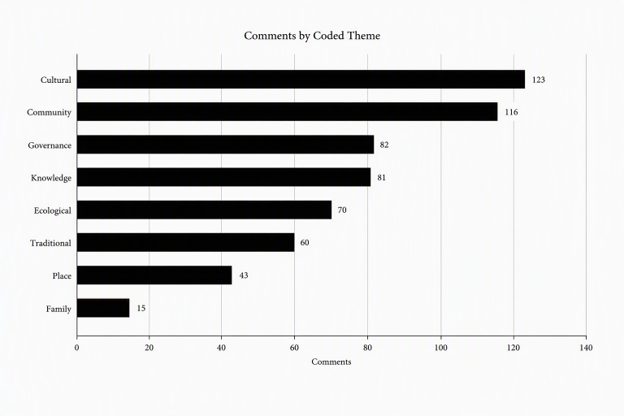
Number of comments coded to each of the eight engagement themes during community sessions.
What Communities Are Saying
Across every region and every format of engagement, certain themes emerged with a consistency that cannot be attributed to coincidence. They represent the collective signal of 268 comments from people who live with wildfire risk every day and who have been thinking about these issues long before any formal consultation began. Seven narrative themes have been identified from the engagement process, and together they form a practical framework for understanding what communities need and what the initiative must deliver in its second half.
The most pervasive theme is Mother Earth — changes on the land and harvesting seasons are being felt across the country. Participants described shifts in berry seasons, changes in animal behaviour, and unfamiliar fire patterns in places that had not burned in living memory. These observations are not anecdotal; they are grounded in generations of careful attention to the land, and they align with what climate science has documented about boreal and sub-boreal ecosystem change. Closely related is the theme of Community Capability, which carries a strong “utilize our own people” sentiment. Communities expressed a clear desire to train and deploy their own members as wildfire responders, prevention specialists, and land managers, rather than depending on external agencies that arrive late and leave early.
The theme of Fire and Cultural Practices surfaced repeatedly and with considerable urgency. Fire bans restrict cultural and traditional fire practices, creating a tension between provincial emergency measures and the longstanding role of fire as a land management tool in Indigenous cultures. Participants spoke about prescribed burning, berry patch renewal, and ceremony, all of which depend on the controlled use of fire and all of which are curtailed by blanket prohibitions that do not distinguish between reckless ignition and purposeful stewardship. Meanwhile, Lived Experiences revealed that cultural support should be at the forefront during community evacuations. People described the trauma of being separated from their communities, housed in unfamiliar urban centres, and cut off from cultural supports during the most stressful moments of their lives. The emotional and spiritual dimensions of evacuation are as significant as the logistical ones, and they are almost entirely absent from current emergency management protocols.
The theme of Knowledge and Learning pointed to a generational disconnect in land-based knowledge. Elders carry deep understanding of fire behaviour, weather patterns, and landscape resilience, but the structures for passing that knowledge to younger generations have been weakened by residential schools, urbanization, and the erosion of on-the-land programming. The initiative heard calls for knowledge revitalisation that is not merely archival but active and experiential. The theme of Relationships highlighted the misalignment between community needs and bureaucratic realities. Funding cycles, reporting requirements, and jurisdictional silos create friction that slows the flow of resources and erodes trust. Communities described feeling caught between multiple levels of government, none of which seem to communicate with each other or with the people they are supposed to serve.
Finally, the theme of Future and Youth carried both urgency and hope. Engage our youth and revitalise our land-based knowledge and practices — this was not a suggestion but a directive. Participants were clear that the long-term resilience of their communities depends on whether young people have the opportunity to learn from the land, from Elders, and from each other. The initiative’s challenge now is to ensure that these seven themes are not merely recorded but actively shape every tool, training module, and policy recommendation that emerges in the months ahead.
| SEVEN NARRATIVE THEMES | |
| 1 Mother Earth
Changes on the land and harvesting seasons are being felt across the country. |
2 Community Capability
Strong “utilize our own people” sentiments. |
| 3 Fire and Cultural Practices
Fire bans restrict cultural and traditional fire practices. |
4 Lived Experiences
Cultural support should be at the forefront during community evacuations. |
| 5 Knowledge and Learning
There is a generational disconnect in land-based knowledge. |
6 Relationships
Misalignment between community needs and bureaucratic realities. |
|
7 Future and Youth Engage our youth and revitalise our land-based knowledge and practices. |
|
Tools Taking Shape
With four tools currently in progress, the initiative is moving from engagement into development. The work is guided by a principle that emerged directly from the consultation process: tools must serve communities, not the other way around. Community risk assessment platforms are being designed to allow Indigenous communities to evaluate their own wildfire exposure using locally relevant indicators, rather than relying solely on provincial or federal risk models that may not account for cultural infrastructure, traditional land use areas, or the specific vulnerabilities of remote settlements.
Updated fuel type mapping is being co-developed with Indigenous land managers who bring generations of knowledge about how landscapes burn, recover, and change over time. This work complements the University of Waterloo’s research on historical fire weather indices by grounding scientific data in the lived experience of people who have watched these landscapes across seasons and decades. At the same time, the initiative is exploring AI-assisted fire spread modelling tailored to Indigenous community contexts, where terrain, access routes, and settlement patterns differ significantly from the urban-interface scenarios that dominate conventional modelling.
Perhaps the most culturally significant development is the creation of Indigenous fire knowledge platforms — community-controlled digital repositories where oral histories, land-based observations, and traditional fire management practices can be recorded, stored, and accessed on community terms. These platforms are being designed with robust data sovereignty protections to ensure that communities retain full control over their knowledge. Alongside these platforms, FireSmart standards are being adapted for Indigenous communities, and training modules are being co-developed with University of Waterloo researchers to ensure that fire safety education reflects both western fire science and Indigenous knowledge systems. The result will be a suite of tools that are technically sound and culturally grounded.
COMPLETED DELIVERABLES
| Year | Title | Authors | Institution | Prepared For |
| 2025 | Preliminary Literature Review: Wildfires | H. Odia & E. Weckman | University of Waterloo — Fire Research Group, Dept. of Mechanical & Mechatronics Engineering | S. Lefebvre, L. Garis (NIFSC) |
| 2026 | Historical Fire Weather Index Report | L. Townsend & E. Weckman | University of Waterloo — Fire Research Group | NRCan: WRFIFK-NIFSC |
Completed knowledge products produced by the University of Waterloo Fire Research Group for the NIFSC Wildfire Resilient Futures initiative.
What Comes Next
The remaining period of the four-year initiative will focus on scaling FireSmart programming adapted for Indigenous communities, deploying the tools currently in development, and deepening the co-governance structures that have made the program’s work possible. The mid-term assessment has produced a clear signal from communities: reduce administrative friction and get resources to the ground faster. Too much time and energy are lost navigating reporting requirements, funding applications, and jurisdictional boundaries that serve institutional needs rather than community safety.
The initiative’s leadership at NIFSC and the University of Waterloo intend to use the second half of the program to demonstrate that a different approach is possible — one in which communities set the priorities, researchers provide technical support, and governance structures are flexible enough to respond to the realities of wildfire risk as it is actually experienced. For those who wish to follow the initiative’s progress, connect, or contribute, information is available through NIFSC and University of Waterloo channels. The work is open to allies, and the invitation to listen and to act remains standing.
A Shared Path Forward
The Wildfire Resilient Futures initiative stands at an inflection point. The groundwork has been laid, relationships have been built, data has been gathered, themes have been identified, and tools are taking shape. What remains is the harder work of translation — turning engagement into action, turning themes into programs, and turning prototypes into resources that communities can use when the next fire season arrives. The seven narrative themes that emerged from the consultation process are not abstract principles. They are a practical agenda; drawn directly from the words and experiences of the people the initiative exists to serve.
The partnership between NRCan, NIFSC and the University of Waterloo has demonstrated something that is often asserted but rarely proven: that community engagement and academic research are not competing priorities but mutually reinforcing activities. The research is better because it is informed by community knowledge. The engagement is more productive because it is supported by rigorous analysis. Neither could achieve alone what the partnership has achieved together, and the value of that collaboration will only increase as the initiative moves into its implementation phase.
Canada’s wildfire future will be shaped by the choices made now. The landscapes are changing. The climate is changing. The question is whether institutions, policies, and programs will change with them, or whether communities will continue to bear the burden of a system that was not designed with them in mind. The Wildfire Resilient Futures initiative is a demonstration that resilience can be locally grounded, culturally respectful, and technically rigorous. It is proof that the path forward does not require choosing between Indigenous knowledge and western science, between community values and institutional capacity. It requires both — and there is a deep and genuine joy in seeing that convergence made real. This is Two-Eyed Seeing, Etuaptmumk, as taught by Mi’kmaw Elder Albert Marshall: learning to see from one eye with the strengths of Indigenous knowledge, and from the other with the strengths of western science, and using both together for the benefit of all. In this work, that principle is practice. It is held together by trust and sustained by the commitment to listen before building, and to build only what communities have asked for.
Authors
Len Garis is director of research for the National Indigenous Fire Safety Council, Ret. Fire Chief for the city of Surrey, B.C., Research Associate – University of the Fraser Valley associate scientist emeritus with the B.C. Injury Research and Prevention Unit. Contact him at lwgaris@outlook.com.
Mandy Desautels is Chief Administrative Officer at the National Indigenous Fire Safety Council. Prior to joining NIFSC, she worked for BC Emergency Health Services and prominent NGOs. Contact her at mandy.desautels@indigenousfiresafety.ca.
References:
National Indigenous Fire Safety Council. (2026). Wildfire Resilient Futures Initiative.
Natural Resources Canada. (2026). Wildfire Resilient Futures Initiative.
University of Waterloo Engineering. (2025, August 12). Researchers awarded $322K for Indigenous wildfire project.
Parks Canada. (2026). Indigenous fire stewardship.
Bartlett, C., Marshall, M., & Marshall, A. (2012). Two-eyed seeing and other lessons learned within a co-learning journey of bringing together Indigenous and mainstream knowledges and ways of knowing. Journal of Environmental Studies and Sciences, 2, 331–340.