
“It Is Good That You Are Here”: Bonny Graham and the Language of Belonging
By María Eugenia De Luna, PhD
This past Winter semester, I taught LING 210: Language, Culture, and Society for the first time at UFV. In this course, students reflect on how language shapes identities in diverse communities, including Indigenous groups and migrants, and explore societal dynamics related to gender, ethnicity, class, sexual orientation, and religion, fostering critical awareness of power structures.
One of the central concepts we explore is the linguistic landscape, the public signs, banners, storefronts, and plaques that surround us. These everyday texts are not neutral. They quietly encode whose voices are visible and whose are erased. Which languages appear large, and which appear small, or not at all? Who is welcomed, and who is rendered invisible?
With support from UFV’s TIPP Fund, which focuses on regenerative sustainability, I designed a semester-long project around this question. Students documented the linguistic landscape of sites across the Fraser Valley, from Highstreet Mall to Leq’á:mel, analyzed which languages were present and absent, and then redesigned those signs. The goal was not just critique, but repair: to imagine public language that is more equitable, caring, and inclusive.
Halfway through the semester, we were joined by someone who does not just study language; she lives it. Her visit did not transform my students overnight. But she gave them something no text could: a living example of language revitalization led by artists, Elders, and community.
Who is Bonny Graham?
Bonny Graham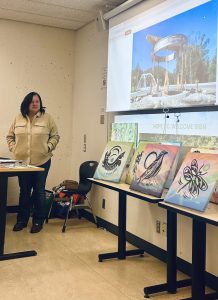 (B.Wyse) is a Coast Salish artist and graphic designer from the Stó:lō community of Hope, with ancestral roots in the Snuneymuxw First Nation. She describes herself as “a Coast Salish artist, as opposed to a solo artist”, because her work is never just her own. It is grounded in territory, family, and the Elders who guide her.
For over 25 years, she has created art that makes Halq’eméylem visible in public spaces, from the Vedder Road roundabout in Chilliwack to the “Ey kw’as ey emi” welcome sign in Hope. She has even developed her own Coast Salish–inspired font to visually celebrate the language, working closely with fluent speakers and Elders. Her work is an act of regenerative sustainability: repairing the erasure of Indigenous language and actively restoring it to the public landscape.
What Happened in Our Classroom
Bonny told us how she began, not with a grand plan, but with a tattoo design for her niece. She found the Halq’eméylem word for “spirit, sacred, special,” hand-drew the letters, and felt something tell her: “Stay on this path.” Over two years, she created all 18 letters of the Halq’eméylem alphabet. When she finally showed her work to someone, the woman flipped through it and asked, “Who are you?”
That question connected Bonny to Elders, including Siyamiyateliot (Elizabeth Phillips), who had survived residential school by silently saying Halq’eméylem words with her back turned so no one would see. “That is how she ended up preserving the language,” Bonny told us. Together, they developed Ey kw’as ey emi, “It is good that you are here”, now visible on the Vedder Roundabout, on school banners, and across the Fraser Valley. It is Bonny’s font, Elizabeth’s words, and a collaboration across generations.
What Students Learned
Before Bonny’s visit, students had documented that English dominates public signage, while Halq’eméylem and Punjabi are largely invisible. After her visit, their understanding deepened. One student wrote: “Language in public spaces is not neutral; it shows identity and power.” Another reflected: “Before this project, we didn’t really notice signs. Now it’s something we see automatically.”
Bonny gave us hope that change is possible not through top-down policy alone, but through art, relationship, and care. One student, redesigning a sign at Leq’á:mel, learned that some Halq’eméylem names carry family histories and should not be translated. That kind of care, asking rather than assuming, is what Bonny’s work embodies.
Why This Course and This Fund Matter
LING 210 is new to UFV’s curriculum. I designed LING 210 to help students see how language shapes identity, power, and belonging, and to ask what could be different. The TIPP Fund made it possible to bring Bonny into our classroom — paying her an honorarium and providing food for our sharing session. Without that support, especially under current budget constraints, this visit would not have happened. The fund also gave me a framework, regenerative sustainability, to name and deepen the work I was already doing, breaking classroom walls, bringing the outside in, and sending students out to reimagine their communities.
Bonny’s visit was the heart of that project. She did not just talk about language revitalization. She is doing it. One sign, one banner, one font at a time. My students will carry her example with them, not because of a grade, but because they met someone who is quietly, persistently, beautifully changing the walls around us.