
From Classroom to Community: SPAN 301 and our iHub CEWIL Community Service-Learning Project
By María Eugenia De Luna
 In Fall 2025, students in SPAN 301, Advanced Oral Spanish, took their Spanish far beyond the classroom. Thanks to funding from CEWIL Canada’s iHub program, supported by the Government of Canada’s Innovative Work Integrated Learning Program, we reimagined SPAN 301. With guidance from UFV’s Centre for Experiential and Career Education (CECE), the course became a community service-learning experience that connected language practice with real community needs in the Fraser Valley.
Instead of only practicing conversation in a classroom setting, students used Spanish with community partners, reflected on the role of language in our region, and began to see their skills as tools for future work and community engagement.
What did students do?
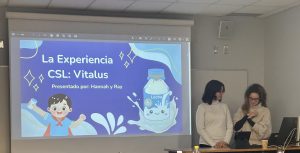
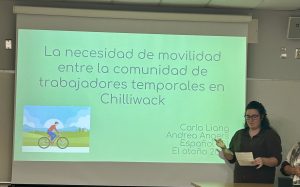
Over the semester, 13 students worked with local organizations serving Spanish-speaking communities, including Mexican seasonal agricultural workers in the Fraser Valley. Mainly working in groups, they
- supported events and activities where Spanish-speaking community members were present
- helped create Spanish-language materials
- worked on translation tasks, including content that partners could use beyond the course
 SPAN 301 is, above all, an advanced conversation course. This term, students used films, short texts, podcasts, and their own experiences as starting points for critical conversations in Spanish about language, identity, media, and power.
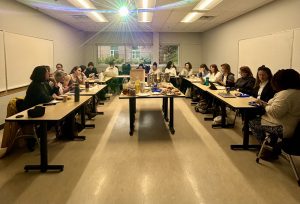
Within this broader structure, we added a community service-learning component supported by the CEWIL iHub. We dedicated some class time to helping students prepare for their work with partners, revisiting the vocabulary and structures they would need for interpretation and translation tasks, and discussing ethics, power, and responsibility when working with multilingual and migrant communities. When students came back from their community activities, we made space in class to share experiences, debrief key moments, and connect what happened in the community with our course themes.
What did students learn?
 For many students, this was the first time they had used Spanish extensively outside the classroom in Canada. They had to listen to different accents, adapt to real-time interactions, and make themselves understood when situations did not go as planned.
Several students mentioned that, before this course, Spanish felt like “just homework”. After the project, they saw it as something they could use to support migrant workers, to contribute to community organizations, or to open doors in future jobs and volunteer roles.
Students also had a first taste of professional tasks such as translation and revision of materials, communication with community members, and collaborating with staff in bilingual environments. These experiences helped them imagine careers where Spanish, and language skills in general, are concrete assets.
Why does this matter?
This project showed that a Spanish conversation course can also serve as a space for community-engaged learning, not just for grammar and vocabulary practice. It made more visible the presence and needs of Spanish-speaking communities in the Fraser Valley, including Mexican agricultural workers, and showed students that their language skills can support migrant and multilingual communities locally and beyond. It also gave the Spanish program a concrete example of how community service learning can be woven into an advanced course and used to build relationships with local partners.
Looking ahead
This experience has given us a model we can draw on in future offerings of SPAN 301 and in related courses, when partnerships and funding make it possible. The enthusiasm of students and community partners shows that language learning is not only about words and structures, but also about relationships, justice, and making the voices that are often unheard visible. We are grateful to CEWIL Canada and the Government of Canada for supporting this project, and to UFV’s Centre for Experiential and Career Education (CECE) for their guidance and support.
Our community partners and students contributed time, energy, and care to this shared work, and the course would not have been the same without them. If you are a UFV student interested in Spanish, community engagement, or both, we invite you to keep an eye on future offerings of SPAN 301 and other MOLA courses that connect language learning with real-world experiences.