

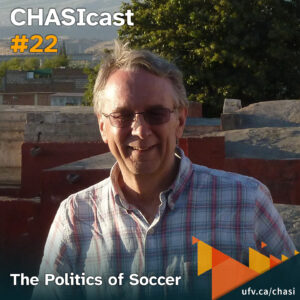
 The CHASIcast is pleased to welcome Dr. Geoffrey Spurling, professor emeritus in the history department at the University of the Fraser Valley. Join guest host Chelsea Klassen and Dr. Spurling as they discuss his experience teaching Latin American history through soccer and song, FIFA’s political history, and the 2026 World Cup.
Please note, this episode was recorded on June 29th and further noteworthy developments we would have otherwise addressed have occurred since the time of recording.
Powered by RedCircle
Resources
- Feitlowitz, Marguerite. A Lexicon of Terror: Argentina and the Legacies of Torture. Revised and Updated ed. New York: Oxford University Press, 2011.
- Foer, Franklin. How Soccer Explains the World: An Unlikely Theory of Globalization. New York: HarperCollins, 2004.
- Galeano, Eduardo. Soccer in Sun and Shadow. Translated by Mark Fried. Revised and Updated ed. New York: Nation Books, 2013.
- Goldblatt, David. Futebol Nation: A Footballing History of Brazil. London: Penguin Books, 2014.
- Nadel, Joshua H. Fútbol! Why Soccer Matters in Latin America. Gainesville: University Press of Florida, 2014.
The CHASIcast is also available to stream on your favourite podcast services – including Spotify, Apple Podcasts, Amazon Music/Audible, and more.
Transcript
CHASIcast voice-over 0:02
Coming up on the CHASIcast,
Dr. Geoffrey Spurling 0:04
It’s actually difficult to select a World Cup where politics hasn’t been an important element. I think it’s ever present, and despite the assurances of neutrality and the statements that politics have no business in sport, politics are a fundamental aspect of sport
CHASIcast voice-over 0:22
From UFV’s Community Health and Social Innovation Hub., this is the CHASIcast, a program dedicated to bringing experts and insights to the issues that shape our lives, because words have to matter.
CHASIcast voice-over 0:34
Now here’s your guest host, CHASI lead researcher, Chelsea Klassen.
Chelsea Klassen 0:42
Well, we’re excited to have on the CHASIcast today, Dr. Geoffrey Spurling, and Dr. Spurling is a professor emeritus in the History Department at the University of the Fraser Valley, and I had the pleasure of having Dr. Spurling a couple years ago when I took a class in Latin American Studies at UFV, and it was a class that focused on soccer and song, and we thought, given FIFA is in Canada this year, it would be great to have him on the podcast to talk a bit about his experience teaching on that topic, and what are some of his thoughts around the FIFA World Cup this year and from years past, and what we can learn, and so welcome to the CHASIcast, Dr. Spurling.
Dr. Geoffrey Spurling 1:26
Oh, thank you, and thanks very much for the invitation. Yeah, I’m delighted to be here.
Chelsea Klassen 1:31
Great. So, just to start us off, what got you interested in soccer, and in particular, teaching on soccer and song on that course at UFV?
Dr. Geoffrey Spurling 1:42
Well, I have always been interested in soccer, beginning as a kid. I mean, I think, like many people, I played soccer. I wasn’t particularly good, but I always enjoyed the game, and I followed soccer in the 1970s–North American Soccer League, Whitecaps, of course, were an important team–and Champions League soccer later on, and of course, the World Cup. Our daughter, as well, played soccer as a child, and still does in her mid 30s. So we were involved in that. And, you know, being/as a Latin Americanist, of course, I was very aware of the importance of football or soccer within Latin America. And of course globally; it is the most popular sport, and one could argue therefore the most important sport played in the world today.
Dr. Geoffrey Spurling 2:35
With regards to the course, I thought about redesigning the classic lower level Latin American history offerings, which typically were the colonial period and the national period. And for the national period I was thinking that it would be a good draw for students and interesting for students if I kind of bent it around popular culture. So the idea was to teach Latin American history, 19th century to the present, through the lens of popular culture. And I chose soccer and music in particular because of their importance globally and also to the region, and because I knew that there would be really good sources–written as well as film–that I could use in class.
Dr. Geoffrey Spurling 3:25
And so I designed the course, the course that you took Chelsea, with that in mind. And I think one of the advantages to teaching a course like that and using those forms of popular culture is that I could address in the course all of these issues, from nationalism, national identity, to immigration in the 19th century, economic changes, political developments, race, class, ethnicity, gender, sexuality, corruption, globalization and development, and, of course, politics. All of which were critically important, and you know, were major themes within any course that would be taught in Latin American history, but could certainly be approached through looking at them through football and music. And so that was kind of the genesis of that reworking of the National Period survey, the traditional survey.
Chelsea Klassen 4:27
Yeah, and definitely one of my favorite classes I took at UFV as an undergrad here. So I’ve, yeah, opened my eyes, like you said, to so many topics that can be intersected with sports, and so you know, sports are often an area or arena, literally, where political issues can be highlighted and heightened. Can you share some of the, you know, maybe the top historical examples that come to mind for you from prior World Cups, where politics has played a key part in that tournament?
Dr. Geoffrey Spurling 4:58
For sure. It’s actually difficult to select a World Cup where politics hasn’t been an important element. I think it’s ever present, and despite the assurances of neutrality, and you know, the statements that politics have no business in sport, politics are a fundamental aspect of sport, and you can see that right even from the beginning. I mean the first World Cup was played in Uruguay in 1930, and Uruguay won that World Cup, but in preparation for the World Cup, the Uruguayan government had a stadium especially built. The whole idea of the World Cup was to promote in part, you know, the nation of Uruguay, especially with regards to Europe, but also their major rivals across the Rio de la Plata, Argentina. And so there’s a political context to that World Cup, and the following one, 1934 in Italy, that was after the rise of fascism, so Mussolini was particularly interested in associating with that World Cup.
Dr. Geoffrey Spurling 6:02
I think, for Latin America, probably in some ways, the most telling World Cups, and the ones that were most directly involved in politics in a really complex way, took place during the period of military rule in many countries in Latin America during the Cold War. In Brazil, for example, the Brazilian military seized power in 1964 and ruled until 1985. And in 1958 Brazil won its first World Cup, second in 1962, and then in 1970 won its third, playing in Mexico City. And this was really the height of Brazilian futebol arte, you know, the beautiful game, football art as played by Brazil, and Pele, as the, named the, footballer of the century, and the Brazilian military were very keen to associate themselves with the team, and in very complicated ways, really draw Pele himself into politics, even if he was somewhat reluctant.
Dr. Geoffrey Spurling 7:10
In Chile…in 1974 there was another World Cup, and the qualification process for that World Cup, which was held in Germany, involved the Chileans playing the Soviet Union, and they were to play in November 1973 in back to back games, one in the Soviet Union, one in Chile. In November 1973 they were to play in Santiago, in the national stadium. Now, in September of 1973 the military, under the leadership of Augusto Pinochet, seized power in a bloody military coup and began a very repressive regime in which they incarcerated, tortured, and executed a large number of people, closed down Congress, et cetera. And especially in the first months of the military regime, all of this was quite open, and yet FIFA stated that, or argued that, the game should go on, and the Soviet Union refused to play in the national stadium. And FIFA, an organization that almost never fails to disappoint, sent a delegation to Santiago to see if the national stadium indeed was fit for a soccer game, and what the military regime did was clean out all the political prisoners.
Dr. Geoffrey Spurling 8:32
The stadium had been used as a place to incarcerate people, and also as a torture centre in the dressing rooms. They cleaned up everything. The FIFA delegation arrived, looked around, all looked good, said it was fine, and moved on. And the Soviet Union still refused to play, so the Chilean team actually played a game without an opposition. They took the ball, dribbled it down to the far end of the field, and scored a goal, and that was it. And I think, you know, one of the things about, you know, thinking about the politics is to think not just about kind of the broader politics of leaders being involved, but also the impact that this has on fans, but also on the players. Many within the Chilean team were not in favour of the military government. Some of them refused, for instance, to shake the hand of Pinochet when the government was, of course, making a big deal about Chile qualifying for the World Cup.
Dr. Geoffrey Spurling 9:32
Just to give one more case, and one that I think is perhaps most telling of all, was the Argentine victory in the World Cup of 1978. Argentina had been chosen years before to be the host, and in 1976 the military in Argentina, a military junta, or ruling group, seized power. They began, again, an incredibly repressive regime, one that would see the incarceration of 10s of 1000s of people, the execution of perhaps up to 30,000. Many of those who were incarcerated were kept in secret detention centres without any knowledge of their arrest, any acknowledgement that they had been taken. They were referred to as people who had been disappeared. The military was interested in eradicating, essentially, the left in transforming Argentina in the process, and by eradicating you can take that for the worst meaning that it would imply.
Dr. Geoffrey Spurling 10:37
With all this going on, the World Cup was, of course, set to be played, and the military was interested in promoting the World Cup. Through promoting the World Cup, they had this image that they would show their organizational skill, their administrative skill, they could appeal, and this is probably most important, to the nationalism of Argentines, and hence they hoped gain support from them. Their repressive policies meant that, you know, they could keep protests to a minimum. That was the goal of the military. There were many protests globally, and many argued that FIFA should postpone the World Cup or shift to another venue, but again they insisted that it go on.
Dr. Geoffrey Spurling 11:24
Within Argentina, there were many different people who were impacted by this. First of all, there were those who resisted the military. One set of groups in particular were the mothers and grandmothers of the Plaza de Mayo, women who would protest each week, and continue to protest actually, in front of the Presidential Palace in the Plaza de Mayo, searching for their lost children and grandchildren, and demanding answers from the military. And they used the World Cup as a venue for talking to the international press for making what was going on in Argentina globally known.
Dr. Geoffrey Spurling 12:03
There was also, of course, the players, and the coach himself was on the left politically, but the Argentine military, of course, didn’t want to mess with team success. There are limits to ideology, after all. And so he was kept in power within the team, but he told the team that they were not to play for the junta, that they were playing for the Argentine people. And there was always this confusion, and this is what politics does, between the nation state, the rulers of the nation state, and the people within the nation state. For Argentines in general, there was a great deal of ambivalence, because on the one hand, at least for those who opposed the military regime, on the one hand they wanted to support the team, obviously, and ultimately the team was successful–Argentina won its first World Cup–but on the other hand, they didn’t want to promote or in any way legitimize the military regime, so this put people in a very difficult position.
Dr. Geoffrey Spurling 13:07
And, finally, we actually have testimony of people who were incarcerated during the World Cup. In a very powerful book by Marguerite Feitlowitz, called The Lexicon of Terror, she interviewed an Argentine physicist, Mario Villani, who was really a remarkable person and a very astute and thoughtful observer. He was detained by the military in the Naval Mechanics School, or ESMA, which is located only a few kilometers from the National Stadium in Buenos Aires. He was detained, tortured. He himself survived the experience of several different detention centres. And he talks about, in his interview with Feitlowitz, about watching the World Cup. And he talks very articulately about how there was what he calls a palette of greys that characterized the relationship between those who were captured and held and those who were the captors, in the relationship between torturers and tortured, and how this was a really complicated relationship. One of the things about the World Cup is that even though the captors regarded those that they held in detention–you know they dehumanized and characterized them as subversives–some of them would later be executed, they still thought of them as Argentines, and that it was important that they watch the team play the final. And so there was this bizarre scene, which to me really exemplifies all of the tensions around the complex politics, and the desire to be part of a national victory, and that sense of victory and power, and at the same time have it be experienced by people in such different circumstances.
Dr. Geoffrey Spurling 15:00
So Villani talks about being in these little isolation tubes that they were kept in, watching the World Cup on a television set that the Argentine military had looted, because when they picked people up, they often looted the apartments they were in, but the television set was broken, so because he was a physicist and knew electronics, he had repaired it, and the torturers were there, egging them on to cheer for the team. So Argentina achieved this victory in a national stadium just blocks away from one of hundreds of secret detention centres, and as a result, that victory of Argentina has often been one that came with all sorts of concerns and an ambivalent view on the part of Argentines, unlike their win in 1986.
[An additional, clarifying note–GS: For Argentina, by 1986 the political context had changed dramatically. The military had given up power in 1983. The newly elected civilian government had initiated a major Truth Commission, one that would become a global model, and the junta leaders had been put on trial for crimes against humanity.]
Dr. Geoffrey Spurling 15:55
There are so many [examples]. I mean, in 1986 one could talk about, you know that was the second Argentine victory, played in Mexico. What was really significant about that one, perhaps apart from the victory itself, was Argentina’s win over England in the quarterfinals, where they beat England 2-1. Maradona scored his famous two goals, one the hand of God, put in by his hand, and the other one a goal where he literally dribbled past half of the English squad before putting the ball into the net. And because England and Argentina had fought a war over the Falklands/Malvinas Islands four years before, there was a great deal of politics behind that. And those are just, you know, a few examples. I mean, I think every World Cup has, you know, its politics behind it, but particularly in the case where you’re dealing with regimes that were repressive and had a great deal of stake in hosting the World Cup, and in some cases, in being successful at it, at football.
Chelsea Klassen 17:05
Yeah, wow, that now I think everybody who’s listening can tell why your class was so engaging, because there’s no shortage of, of course, your delivery is just fascinating, but there’s no shortage of intersection between politics and soccer, and I thought it was really striking, what you said, you know, about particularly the Soviet Union, you know, not not wanting to play against the Chileans, and just get on with the game, right? This idea that this sports is kind of like, you know, a separate entity, and I think it also connects to what you were saying about the Argentine, you know, tortures and the tortured, it’s kind of this realm, it’s kind of inexplicably sacred in a way, and yet so much politics happens in that space.
Dr. Geoffrey Spurling 17:47
Of course, there are ironies. The Soviet Union itself was not exactly a state free from repression, and Russia, of course, would later, you know, after the annexation of Crimea, and of course, recently the invasion of Ukraine, be on the other side of questions about whether or not they should host international sporting events, whether it was the World Cup or their participation in later events, like the Olympics, that kind of thing. So yeah, you can have states on either side that are, you know, involved in that, but I think it’s always important to think about, yeah, how it impacts, you know, at the governmental level, but also at the individual level, and at the level of the teams. I mean for someone who plays on a team, this is really the ultimate opportunity to represent your country–you know, one could argue back and forth whether Champions League soccer, for instance, is more entertaining, perhaps sometimes, than World Cup, but those are league teams, as opposed to teams playing for themselves, but also for the nation. And so you know, to be kind of subject to the politics of the era makes it incredibly difficult, puts them in an incredibly difficult position; and some, of course, seize that opportunity and are more than comfortable with aligning themselves with individual political figures, whereas others are much more reluctant and careful.
Chelsea Klassen 19:24
Yeah, so speaking of aligning with political figures, the current FIFA president, Gianni Infantino, once observed “it’s very clear that politics should stay out of football and football should stay out of politics.” So, in an article by Steven Bank, he refers to FIFA as more politically fluid than politically neutral, so just thinking about FIFA and that statement, what are some of your thoughts on on FIFA and, yeah, being politically fluid or politically neutral?
Dr. Geoffrey Spurling 19:52
Well, yeah, I looked at that article, it was very good, and he, I think he makes a very good point that, well, first of all, with regards to Infantino, that he’s hardly politically neutral, you know. Recently, you know, he’s come across in support of Trump’s policies in the United States. He was a lobbyist for Trump to get the Nobel Peace Prize, which is tragicomic, and you know, then FIFA came out with that silly created peace prize in order to mollify Trump and appeal to his endless capacity for flattery, so [Infantino] is hardly neutral himself. But it is an interesting question around whether neutrality is even possible, and where the line should be drawn when it comes to boycotting or restricting nation states from participating. And you see that in that he does a review of past major sporting events, looking at the Olympics, and of course we already mentioned the Russian invasion of Ukraine and the annexation of Crimea, but we could also, you know, refer to other events in the past.
Dr. Geoffrey Spurling 21:10
The Soviet Union, for instance, was banned from the Olympics after the invasion of Afghanistan. There are, you know, any number of examples, but equally there are examples where the conditions within a particular country are overlooked, and the examples he gives, of course, most recent ones being Qatar in 2022 looking at the buildings of stadiums and other things, and the, you know, the position of migrant workers and human rights concerns that were raised. And I’m sure these will continue as Saudi Arabia is to post the World Cup of, I think it is 2036, and that will raise, no 2034, that would raise all sorts of questions too about, you know, human rights conditions within that country.
Dr. Geoffrey Spurling 22:08
Yeah, FIFA has a long history, and one thing we haven’t talked about with this, as an aside, is, you know, questions of women’s football. I would suggest watching this very good documentary that came out just a couple of years ago, called Copa 71, which is about a women’s World Cup that was held in Mexico City in 1971, not FIFA organized, but sponsored privately. And the final was watched by more people than have ever watched a women’s sporting event, over 110,000 people in the Estadio Azteca in Mexico City. The documentary, by the way, is available on CBC Gem and Knowledge for anyone who wants to check it out. But it’s interesting to look at FIFA’s relationship to women’s soccer as well, and of course, in 1971, not just FIFA, but many soccer federations under FIFA, really disparaged women’s soccer, and it’s taken decades for that to at least begin to evolve and to change.
Dr. Geoffrey Spurling 23:13
The other thing that Bank, of course, comments on is corruption, and both at the level of football confederations and FIFA in general. And that one of his central arguments is the need for a shift in governance and for an imposition of a strengthening of their code of ethics as a way of trying to rectify those ongoing problems. Latin American soccer is not without its problems with corruption. There’s some very good work–Foer’s book, How Soccer Explains the World, which I think is really well written. It’s a great book, a bit dated now, I guess, but still well worth it. And he devotes an entire chapter to looking at corruption within Brazilian soccer, and how in the late 90s and early 2000s how money moved from, you know, all those commercials–that famous 1998 Nike commercial with the Brazilian team playing in an airport, was a wonderful commercial, but I think they paid something like $250 or $300 million, and you know where that money went, into whose pockets. Those are questions that are, have always been, raised.
Chelsea Klassen 24:25
Yeah, that’s so interesting. And yeah, thank you for bringing up some of those fascinating, you know, concerns around corruption, because I think that’s such a world people associate with FIFA now. I don’t think that FIFA likes that very much, but I think they associate it with that, but yeah, just to close us off, I’d love to know what some of the highlights have been for you with the 2026 World Cup this far, and if you have any predictions or any hopes that you kind of see as we are in this round of 32 now, as the time of the taping of this, but yeah, what have been some highlights or hopes you want to see?
Dr. Geoffrey Spurling 25:00
Well, I mean, it would be hard not to pick Eustáquio’s goal last night, in extra time, to put Canada into the round of 32. I mean that was, you know, that was a highlight goal; it was an excellent goal, first of all, and you know, you could tell from the response, right, of his team of the fans across the country and everywhere, that was a real high point. And actually the Canadian games so far, I think, have been, you know, even the one that they lost, I mean, that was an excellent goal that Promise David scored against Switzerland, and of course you know the goal that Cyle Larin scored to tie the game against Bosnia-Herzegovina, and the Qatar game, I thought the most powerful part of that was the goal scored and then holding up the jersey of Koné, you know. And one could say there were politics involved in that in the end, because Mark Carney, the Prime Minister, went into the dressing room, but I actually thought that what he said seemed very sincere, and I don’t think he was, I mean, it’s always hard to separate those things, but what he said about, you know, the team, I thought was appropriate, and yeah.
Dr. Geoffrey Spurling 26:20
But I would have to say that this World Cup has been really good. You know, there were so many concerns early on, given that they expanded the number of teams to 48 and there were concerns, worries that this would lead to a World Cup with watered-down competition, and that the first round would be kind of pointless, and, and you know, what are these teams doing here, and all of that kind of thing. And, in fact, that hasn’t been the case. There have been some excellent games, a lot of goals scored, all the stars have kind of showed up, Messi, Mbappe, Dembele, right, Haaland, they’ve all scored multiple goals. There have been some real cliffhangers, and there have been, as well, some great scoreless draws that normally you don’t think of in that way. And in involving some of those small countries, I mean, I think everyone likes the idea that Cabo Verde is, you know, got through its tough group with three ties, and you know, the games were, were really, well, for one thing, amazing goaltending, but they were really gripping. And in the same way, I saw the Ecuador-Curaçao game at the PNE fan zone, and you know, even though it ended up, it was frustrating, you know, hoping that Ecuador would score, but at the other hand, it was a really exciting game, and you know, eventually they went through anyway.
Dr. Geoffrey Spurling 27:53
So I think there have been a lot of highlights, and I think the quality of the soccer has been really good. And it’s also, you know, I think a lot of World Cups, there is the politics that we’ve talked about, and many World Cups are often preceded by protest. That was true if we go back to Latin American examples; for instance when Brazil hosted the World Cup in 2014, the year before there was a FIFA organized Confederations Cup. This kind of lead into the World Cup, and that saw the most massive demonstrations in Brazilian history protesting against the money that was being put into the stadiums, and in a country with marked inequality, and that kind of thing, but once the tournaments begin, it’s not like the issues go away, they’re still there, they’re still critically important, but the tournament itself takes over. And you know, the participation of, you know, their fans, the teams, the quality of play, that has its own dynamic. And I think this year, as well, that, you know, there have been all sorts of controversies, particularly regarding, you know, the position of the Iranian team.
Dr. Geoffrey Spurling 29:09
I mean, talk about, you know, going back to looking at complex politics, imagine how those players must feel, those who perhaps were in opposition to the Iranian regime, which, after all, violently repressed 10s [of thousands], you know, the Iranian population, just a few months ago, and then to have the country invaded by the United States, or not invaded, but attacked by the United States and Israel, and then to have all the restrictions on its movements, so those players are obviously clearly placed in a very difficult position. But I think that you know there is, in general, a kind of a celebratory feel at the moment about the World Cup, and it’s not to say that there aren’t things again that aren’t more broadly going on. I kind of wish there was some recognition, for instance, of the earthquake disaster in Venezuela, you know, given the importance of football to Latin America, and it really is unfolding, and it’s really catastrophic.
Dr. Geoffrey Spurling 30:14
But there is that kind of celebratory feel, and I have to say that, you know, I’ve been watching it largely just on TV, but I did go to the fan zone at the PNE, and it was really relaxed. And FIFA had all sets of silly rules, which I’m sure were kind of security related. You couldn’t take a blanket in, and that kind of thing, which I don’t know what you do with a blanket. But you know food, but it wasn’t, you know, the costs weren’t that high, and everything is very relaxed, and the people who are there, it’s very family friendly, were clearly having a good time. And so I think, so far, the, you know, the event is, you know, the events have gone on really well; that’s not to say that there isn’t concern about the what, what it cost, $700 million to a billion dollars to host seven games in Canada, and you know all these questions about whether or not that they will be paid for, but for the moment those things are kind of, I think, set aside and people are enjoying the games that are being played, and there are some incredible games.
Dr. Geoffrey Spurling 31:19
I just saw Brazil beat Japan 2-1, another cliffhanger. This evening, the Netherlands are going to play Morocco; that should be an excellent game. You know, Mexico-Ecuador coming up tomorrow, Côte d’Ivoire and Norway. I mean, all of these are, you know, will be well worth watching. So, yeah, I’m looking forward to it. And as for who’s going to win, who knows? I mean, you know, I know the pundits are saying France, Argentina, they, you know, going back to the last World Cup, and they both look very good. But you know, World Cups have a way of, sometimes, a way of, a degree of unpredictability, although, you know, if we look at World Cups past, there is a huge concentration of winners amongst only a few teams. I know the English would love England to win, first time since 1966, and it would be great to see Canada move further than you know the round of 16, but that is a tall task, for sure.
Chelsea Klassen 32:24
Yeah. Well, thank you so much, Geof, for joining us today. We really enjoyed talking to you and learning so much more about FIFA than I think, I mean, I know I learned so much in your class, and I’m always learning more from you all the time, every time we get to speak. So, thank you so much for sharing your time with us today on the CHASIcast.
Dr. Geoffrey Spurling 32:41
Oh, you’re welcome, Chelsea. Yeah, take care. And yeah, and I hope everyone, you know, enjoys the rest of the, you know, the World Cup as it’s being played globally. And I was listening to some commentary today, for instance, and they were pointing out that Canada’s game yesterday was the sole World Cup game, so its global audience was, you know, perhaps a half a billion people who normally would not have any exposure to, people think of Canada and hockey obviously, but the association of Canadian soccer is another thing altogether, so.
Chelsea Klassen 33:15
Yeah, that’s so true. That’s great. Thank you.