
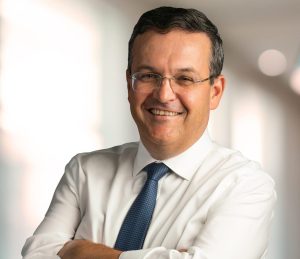
The Faculty of Business and Computing (FBC) is proud to welcome Byng Giraud as UFV’s first Executive-in-Residence.
Chris Schinckus, Dean of FBC, says, “The creation of an Executive-in-Residence related to ‘Reconcili-action’ marks a pivotal step in our mission to integrate ethical economic development into the heart of UFV. Through this initiative, FBC is proud to provide our community with direct access to expertise in economic reconciliation, promoting better practices for better sustainability of non-Indigenous and Indigenous businesses.”
As UFV transitions from reconciliation as a concept to a tangible reality, support from experienced leaders such as Byng will be critical.
Byng’s role will include:
- Providing office hours for students, faculty, and alumni to discuss project de-risking, Indigenous procurement, and ethical economic development. Byng will be ‘In Residence’ twice per semester, maintaining a consistent presence that enables deep relationship-building.
- Advising UFV leadership on initiatives that support economic reconciliation (e.g., land use, partnerships, and Indigenous-led environmental assessments).
- Acting as a neutral table for external industry leaders, Indigenous communities, and government officials to explore collaborative economic models.
Industry Leadership and Economic Reconciliation
Byng is a natural fit for the role. He is a founding member of the BC Assembly of First Nations-BC Business Council Champion’s Table, a body dedicated to breaking new ground in economic reconciliation.
He is also president of the Vancouver-based Sedgewick Strategies, a company he founded in 2019, which specializes in risk management and securing approvals for major projects in the industrial, natural resources, and infrastructure sectors, with a focus on those involving Indigenous partnerships.
Notable aspects of his work at Sedgewick include:
- Mobilizing 38 First Nations in BC to jointly invest $715 million in Enbridge’s Westcoast natural gas pipeline. Through this historic partnership, the Stonlasec8 Indigenous Alliance Limited Partnership now owns 12.5 percent of the pipeline.
- Obtaining federal, provincial, and Indigenous approval of the Woodfibre liquefied natural gas (LNG) exporting facility in Squamish.
- Supporting the Squamish Nation in implementing Canada’s first Indigenous environmental assessment process.
- Negotiating agreements between operating mines and First Nations in British Columbia, including agreements with five First Nations at two separate projects.
- Heading the corporate affairs and Indigenous consultation processes that led to the 2012 re-opening of the Huckleberry Mine in northern British Columbia.
- Leading the Northwest Powerline Coalition, a coalition of companies, Indigenous groups and individuals that successfully lobbied the BC government to build the Northwest Transmission line along Highway 37 – thereby opening the region to mining and power projects which have been key to empowering local First Nations.
In recognition of his work in Indigenous economic reconciliation, and following nominations by three First Nations Chiefs, the province awarded him the Order of British Columbia in 2023.
From Experience to the Classroom
At UFV, Byng’s focus will be on turning this real-world experience into practical guidance for students, faculty, and local organizations entering this space for the first time.
Byng loves working with young people and employs many at Sedgewick. He laughs when he talks about his love of whiteboards, and a teaching style that has proven to be very effective. “Every room in my office has to have a whiteboard,” he says. “We start with a problem and use it to map out all the risks and potential solutions.”
Byng believes it’s essential to have several solutions for one issue. As he explains, “I don’t actually know ahead of time which solutions are going to work, but you need to develop lots of methods and pathways, because one of them is likely to succeed. Nothing’s guaranteed. But if you analyze each one of the risks and develop plans to address those risks – like chapters in a book – eventually you’ll get to the end of the story.”