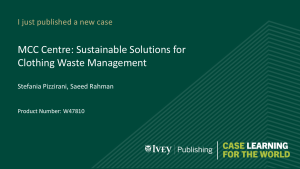
New Ivey Case: MCC Centre: Sustainable Solutions for Clothing Waste
A new Ivey Business School case, MCC Centre: Sustainable Solutions for Clothing Waste Management, examines a challenge unfolding right here in Abbotsford, British Columbia.
The case follows the Social Enterprise Director of the Mennonite Central Committee (MCC) Centre Thrift Shop as she confronts a growing and complex issue: what to do with unsalable donated clothing. While thrifting continues to rise in popularity, the volume of donations – particularly low-quality or unsalable items – has created significant downstream consequences, including landfilling and exporting textiles.
At its core, the case centres on a difficult balancing act: reducing clothing waste while preserving donation flows, maintaining strong financial performance, and staying aligned with the organization’s mission and community commitments.
Authors
Developed by Dr. Saeed Rahman, Associate Professor in the School of Business at the University of the Fraser Valley (UFV), alongside Dr. Stefania Pizzirani of UFV’s Environmental Studies program, the case reflects an interdisciplinary approach to a complex operational and sustainability challenge.
Dr. Rahman’s research focuses on how organizations adapt to environmental constraints – particularly how businesses respond to ecosystem degradation and resource limitations without undermining long-term resilience. That perspective is evident throughout the case, which treats clothing waste not just as an operational issue, but as part of a broader system of interdependencies.
Dr. Pizzirani brings complementary expertise in environmental systems, resource management, and community-engaged research, strengthening the case’s grounding in ecological realities and stakeholder complexity.
Teaching Application
Designed for both undergraduate and graduate classrooms, the case is well suited for courses in sustainability, strategy, operations, innovation, and social enterprise.
Students working through the case are asked to evaluate trade-offs and develop actionable approaches. In doing so, they will:
- Examine how the thrifting model both supports and falls short of triple-bottom-line sustainability
- Assess the strengths and limitations of pursuing a zero-waste target
- Build a deeper understanding of sustainability as a multi-dimensional concept
- Identify and apply the core principles of the circular economy
- Analyze the operational and strategic implications of sustainability-driven change
Why This Case Matters
Textile waste is often discussed at a global level, but its impacts are managed locally – in organizations, in communities, and in systems like the one here in Abbotsford.
This case brings that reality into focus, showing that extending the life of clothing is not simply about good intentions; it requires systems thinking, process redesign, and difficult decisions about what can and cannot be sustained.
Ultimately, it asks the question: how can organizations create meaningful value from what is currently treated as waste – and what does it take to do that in practice?
Congratulations to Dr. Rahman and Dr. Pizzirani on the publication of this case!
#UFV #goUFV #SchoolofBusiness #EnvironmentalStudies #NewIveyCase and #JustPublishedwithIvey #MCC