
Honorary degree 2026: Stó:lō matriarch Pat Charlie honoured for leadership and knowledge sharing

“Know yourself and know where you came from. It’s as simple as that.”
Sel Ya:al – Nancy Patricia Charlie — known throughout Stó:lō communities as Auntie Pat — speaks softly about family, language, hard work, and ceremony. Beside her daughter Jolie, Pat fills in the spaces with memories, laughter, and stories of watching her mother lead. For Jolie, the lessons started long before she understood she was being taught.
“She’s the one who always wants to keep our teachings straight,” Jolie said. “Everything that I learned, I watched her do.”
This year, the University of the Fraser Valley will recognize those contributions with an honorary degree.
Inside the Charlie family, the honour feels less like a personal achievement and more like a continuation of responsibility.
“I look at my grandchildren and think, they’re going to know what I know,” Pat said. “We’re teaching them right from birth.”
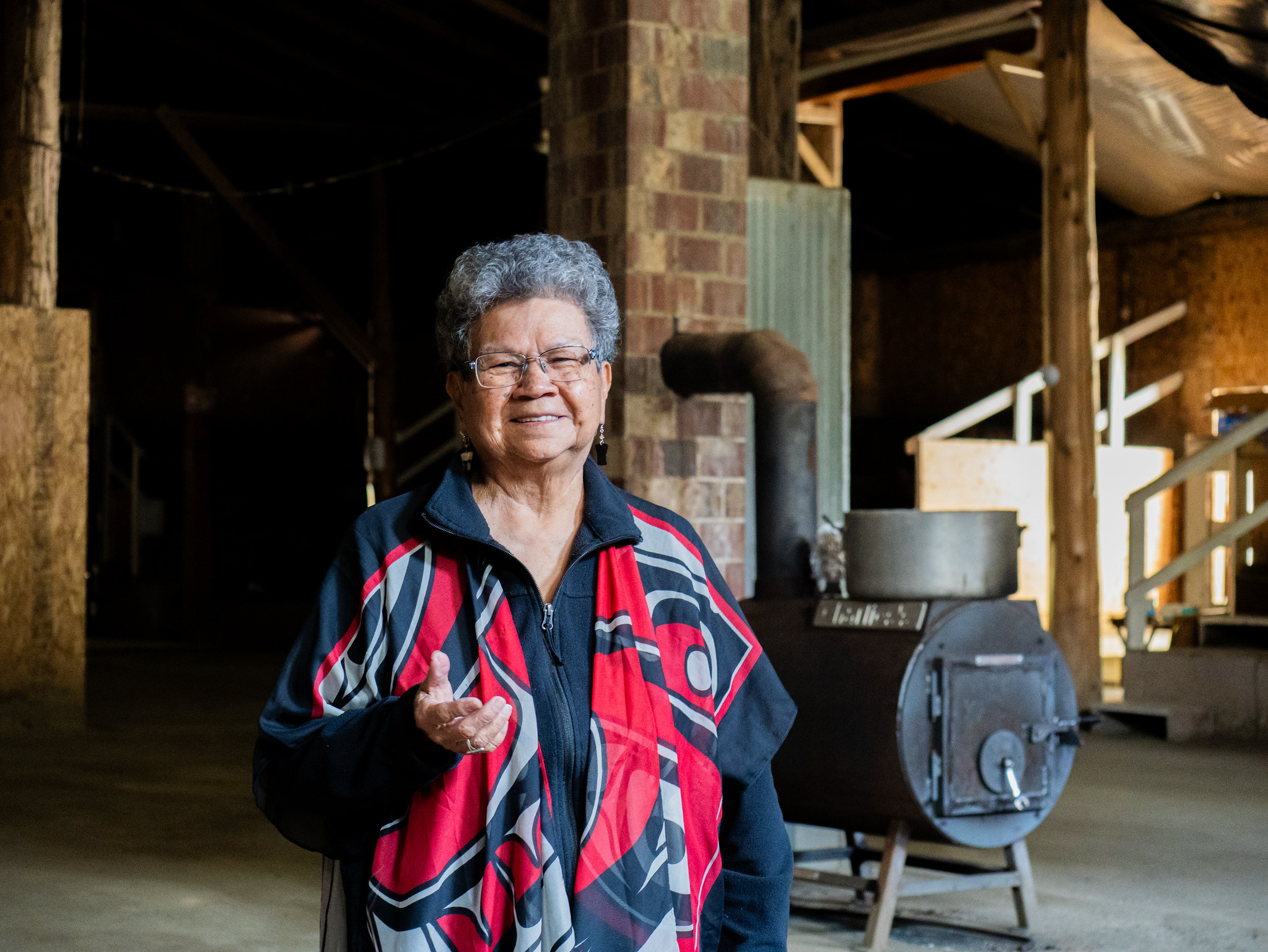
Growing up in Sts’ailes, Pat learned early about survival, resilience, and collective responsibility.
She remembers families travelling by barges down the Harrison River and in open truck beds past Hatzic each summer to strawberry-picking camps near Tacoma, where adults and children worked long days in the fields under punishing heat.
“We had to stay in shacks, and they were made from cardboard. We had to cook on wood stoves. We all had to learn how to work in the fields too, so we could eat.”
At the same time, Indigenous languages and ceremonies were being actively suppressed.
“My parents always talked Stó:lō (Halq’eméylem), but we were not allowed to,” Pat recalls. “We didn’t know drumming or singing because none of that was allowed.”
Yet even through those years, seeds of cultural resurgence were being planted.
Pat describes the women in her family — especially her mother and sisters — as determined to bring cultural practices back into community life.
“When it came about for us to try to bring it back into the community, a lot of our Elders didn’t want to do it,” she says. “They said, ‘It’s better you just carry on quiet.’ But we had five Elders who supported and encouraged us.”
Jolie grew up watching that quiet determination turn into action.
“My mom was hungry enough for the culture that we were really lucky as children,” she said. “She was always actively looking for that culture, bringing it back to life and sharing it with us.”
Mother and daughter eventually worked side-by-side in child and family wellness programs, including residential homes and Indigenous jurisdiction work focused on keeping children connected to family, community, and culture.

Jolie remembers seeing her mother navigate emotionally charged meetings between parents, social workers, lawyers, and extended families with honesty and calm.
“She’s the master of disaster,” Jolie says. “If there was something that needed to be ironed out, she could work the room.”
For Pat, the work has always been rooted in relationship.
People come to her for guidance, teachings, ceremony, or simply someone willing to listen.
“I do it because old people always took time to talk to me,” she says. “They never turned me away.”
“She knows who everybody is,” Jolie said. “That’s how she does a lot of her work — by knowing who you are.”
That deep understanding of kinship and belonging continues to guide how the family approaches community care.
Pat believes many of the struggles Indigenous communities continue to face are connected to the lasting impacts of residential schools and generations of disconnection from language and culture.
“Our people were falling apart not knowing. That’s because of all the effects of residential schools and everything that happened.”
In response, she spent decades helping rebuild what was nearly lost — songs, language, ceremony, governance, and traditional ways of supporting one another.
“We started saying we must bring back our language. People need to hear the songs, understand the drum, understand what the dance is all about.”
Today, Jolie sees those teachings continuing through her own children and grandchildren.
“We’re lucky that our parents were strong and our grandparents were strong. That’s what we’re trying to carry forward.”
The family’s participation in canoe journeys along the coast has become one visible expression of that continuity. Together, multiple generations paddle long distances between Indigenous communities, sharing songs, meals, teachings, and ceremony.
On the most recent journey Pat took part in, she asked to paddle for just a couple kilometres. Jolie, concerned for her mother’s age and health, cautiously agreed to hand her the paddle. Forty-five kilometres later, Pat finally put it down: a testament to the power of her spirit and will.
“That paddle is such a beautiful thing,” Jolie says. “Rough waters, rough journeys — but you keep going.”
For Pat, the honorary degree from UFV represents recognition not only for herself, but for the generations of women who carried culture through difficult times.
“I feel honoured and respected,” she said. “My mom and dad would rejoice in seeing this.”
Even now, after decades of leadership, Pat remains deeply humble about the recognition.
“As Stó:lō people, you’re not supposed to brag,” Jolie says. “We’re all the same. But for something like this — a life accomplishment — it’s really something.”
The lessons Pat passes on are rarely delivered formally: she reveals them in how she carries herself. They emerge through stories shared around the table, conversations after ceremony, long meetings helping families through crisis, or moments spent travelling together on the water.
For Jolie, leadership was never something her mother claimed. It was something she practised.
“You can go get the education,” Jolie said, reflecting on her mother’s teachings, “but you always bring it back to your community.”