
UFV alumnus opens North America’s first mobile, modular soil-washing facility
By Amara Gelaude
Tomorrow’s infrastructure could be built with resources once considered waste. Whether the project is a hospital or a highway, construction requires soil to be excavated and managed. However, when that soil is contaminated, it is classified as waste. That is, until now: a new facility in Chilliwack is offering an alternative.
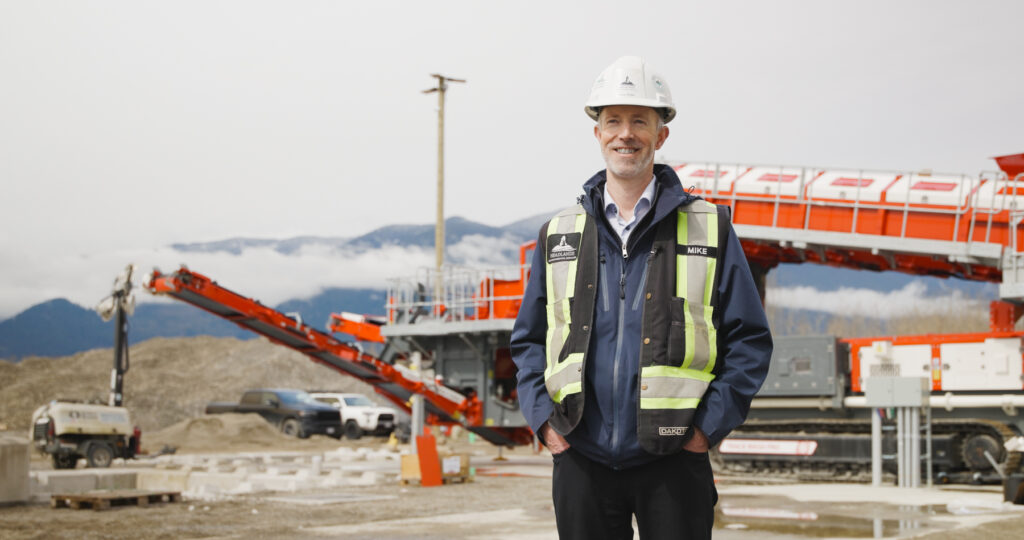
Four years ago, UFV alumnus Mike Hofer was looking down into a landfill filled with debris and excess soil and thought, “This is crazy. There’s got to be a better way to do this.”
As principal of Headlands Environmental Services, Mike, who earned a Bachelor of Arts with a physical geography major at UFV in 1998, set out to recover resources normally considered waste. In partnership with the local Indigenous community of Shxwhá:y Village, he brought North America’s first mobile, modular soil-washing facility to Chilliwack, BC.
What is soil washing?
Soil washing and thermal treatment of soil, remove contaminants such as metals, hydrocarbons, salt, invasive plants, and noxious weeds, allowing soil to be reused. The process reduces excess soil created from previous land uses such as gas stations, lumber mills, welding and fabrication entities, sandblasting, and shipbuilding. This has led to the environmental gentrification, repurposing and redevelopment of industrial lands into mixed commercial, retail, and residential land uses in some areas of Metro Vancouver and the Fraser Valley. It also reduces material hauling and eases demand for the finite gravel supplies from quarries.
In practice, soil arrives by truck from construction sites across the Lower Mainland and Metro Vancouver. Large rocks and debris are removed first. Water is added to the remaining soil, which then passes through screens and conveyor belts that separate it into coarse sand, fine sand, three specific types of aggregates and a clay-like “filter cake”. The wash water is treated and reused in the next batch.
Once contaminants are removed, recovered materials can be repurposed into other projects; cement for concrete structures, asphalt for roads, bedding material for utility infrastructure, rocks and gravels for landscaping projects, and providing impermeable materials that act as landfill liners to help prevent leaching into the environment. This creates opportunities for repurposing materials as a beneficial reuse in a circular economy for new development.
Along with its practical and circular-economy benefits, the facility could provide UFV students with valuable experiential learning.
“I see strong potential for collaboration between UFV and Headlands,” Mike says. “As a UFV alumnus and with the Chilliwack campus nearby, I believe there is a strong opportunity for a natural partnership.” The facility can offer invaluable learning opportunities for students in mechanical engineering, and those pursuing environmental science and environmental engineering.
That hands-on experience is one way UFV prepares students to enter the trades and environmental sectors with confidence and skill. Further collaboration between the university and Headlands Environmental Services is also being explored through upcoming projects with the UFV Community Health and Social Innovation Hub (CHASI).
Like CHASI, the Shxwhá:y Village Soil Management Facility has made community engagement central to its mission. Shxwhá:y Village’s Chief and Council, senior leadership, and Hofer wanted the Shxwha:y Village facility to create meaningful jobs and opportunities for learning and advancement. Their broader vision also included housing for elders, homes for the workers, opportunities for culture and education, health and wellness services, and, community and recreation.
“As we began reaching milestones, trust and belief in what we could achieve, grew,” Mike says of the facility’s early development with Shxwhá:y Village’s council. “We were then able to move beyond a landfill or soil-dumping facility and create a true soil-management facility, one that treats soil as a resource rather than waste, cleans it, and returns it to the economy and the environment.”
Mike describes the facility as “the pinnacle of environmental management systems”: a closed-loop operation with full water recirculation and no discharge into the environment. Even rainwater that falls on the surrounding asphalt is captured and returned to the system.
“You can make a real impact in waste management when it’s done properly,” Mike says. “Much of it comes down to changing how we view what people perceive as waste.” By prioritizing environmental health and community success, the Shxwhá:y Village Soil Management Facility, operated by Headlands Environmental Services, aims to create lasting benefits for generations to come.