
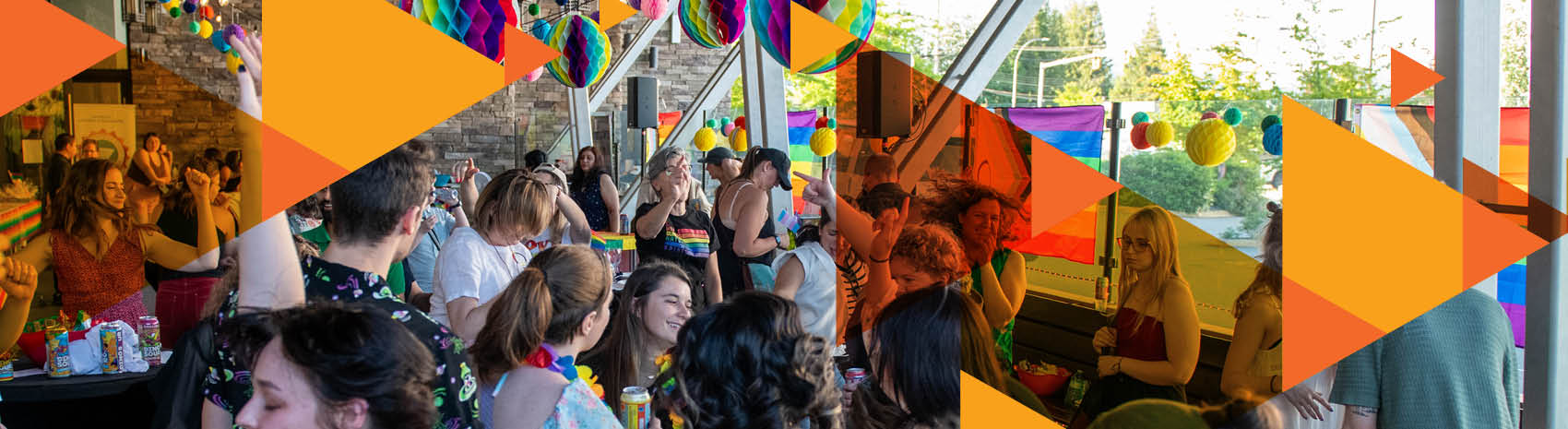
 The CHASIcast is pleased to welcome Dr. Craig Jennex, an associate professor of English at the Toronto Metropolitan University. Join host Dr. Martha Dow and Dr. Jennex as they discuss the widespread impact of collective social dance in queer history and how dance can inspire hope in the present day.
Resources
- Dykes, Dancing, & Politics by Joyce Rock, the 1976 article referenced in the podcast
- Dr. Jennex’s recent open access book, Liberation on the Dance Floor: Popular Music and the Promise of Plurality
The CHASIcast is also available to stream on your favourite podcast services – including Spotify, Apple Podcasts, Amazon Music/Audible, and more.
Powered by RedCircle
Transcript
CHASIcast voice-over 0:00
Coming up on the CHASIcast,
Craig Jennex 0:06
Even if we don’t recognize it when we’re together on a dance floor, I think we’re being situated as a collective in a really interesting way, and I think there’s a lot of potential for that.
CHASIcast voice-over 0:18
From UFV’s Community Health and Social Innovation Hub, this is the CHASIcast. A program dedicated to bringing experts and insights to the issues that shape our lives, because words have to matter. Now, here’s your host, CHASI director, Dr. Martha Dow.
Martha Dow 0:33
So, welcome to the CHASIcast. It’s my absolute pleasure today to have a conversation with Dr. Craig Jennex, associate professor of English at the Toronto Metropolitan University, and I’ve been so excited about this conversation, Craig, all week, particularly, obviously, happy Pride.
Craig Jennex 0:58
Happy Pride to you.
Martha Dow 1:00
And you know, as we approach our fourth annual tea dance, and quite frankly, everything going on the world, I’m just so excited to have this conversation with you. So, welcome.
Craig Jennex 1:09
Thank you very much. I’m really happy to be here.
Martha Dow 1:12
So I’d love to just start hearing about your work. As you know, we have our fourth annual tea dance coming up, and we’re very excited about that, and that’s when we looked at your work, and we thought, who better to have a conversation with?
Craig Jennex 1:22
Amazing, I appreciate that very much. And I’m so excited to hear about your tea dance history, and sort of how this one goes. I think tea dances are a really special kind of event that has like a real beautiful connection to queer histories, right, as like an opportunity to build collectives and to build political movements.
Craig Jennex 1:45
My work is on social dance, primarily in the 1970s and 1980s so like things that sort of become known as disco later in the 1970s but what I’m really interested in is the way that collective social dance can influence and inspire political formation, right? Because I think experiences on the dance floor are profoundly moving for us as individuals, but also for us as communities or collectives, right? When we get together on a dance floor, when we move our bodies to music, and we’re sort of like out of time together and moving our bodies to a new sense of time, I think there’s a real possibility for how we exist in this world and the types of worlds that we think of as possible in the future.
Martha Dow 2:33
When you think about that, how conscious or attentive do you think people are on the dance floor of that politicization of dance?
Craig Jennex 2:41
That’s a great question. I think it’s something that we can be aware of, but it’s something we can also, like, pretty easily not be aware of. But maybe we also have to think about, like, what it means, like what politics means, because I think us feeling really good on the dance floor, surrounded by others who we might think of as strangers, but we’re having this kind of like incredible, transformative, joyful, blissful experience together. I think even if we don’t recognize that as like a political foundation, I think it really works in that way.
Craig Jennex 3:13
I think when we’re on the dance floor, we’re like less attuned to the problems we face or the differences between us, and we’re more attuned to some sort of shared experience, shared existence, shared desires across forms of difference as well, and I think even if we don’t recognize that as, like, oh, this makes me want to go out and do some sort of political intervention, I think that it’s still a really productive experience, but now you’re making me think about some of this like history that I’ve been tracing in this research.
Craig Jennex 3:42
There’s all sorts of examples where you know, at the end of a big dance, a big social dance, I’m thinking of the Gay Activist Alliance in New York City, in particular, in the mid 1970s
Craig Jennex 3:54
I was reading all about this big dance party that was happening at their venue, it was called The Firehouse. It used to be an old firehouse, and then it turned into this like community space, dance floor space. After about three hours into the dance, so this would have been after midnight. Somebody got up and grabbed a microphone and said, you know, mere blocks from here, there’s this city councilor who is like holding all sorts of things up around access to housing, around discrimination policies in the city. What if we all just went there?
Craig Jennex 4:26
And so I love this moment, because you know, people had been dancing together for about three hours, they were like situated as a collective, and then that was able to translate immediately to them marching a few blocks away, holding an impromptu protest at Saul Sharison’s apartment building, condo building, eventually pissing off his neighbor so much that he gets kicked out of the apartment building, and then a few months later, there’s the first meeting to deal with some of these challenges that he had been holding up for so long. So that’s sort of a long winded example of how even if we don’t recognize it when we’re together on a dance floor, I think we’re being situated as a collective in a really interesting way, and I think there’s a lot of potential for that.
Martha Dow 5:12
It’s incredible. It makes me think about it, so many different things around protest and the recognition of the other, an insider/outsider status in terms of the protest. I think back to, you know, clubs in the 80s where, you know, you had these, you had Cher, you had Diana Ross, you had these icons, and I was always interested, even when I reflect back and sort of how there was an identification with those pop artists that felt transformative in terms of activist, even if you know, quite frankly, the intentionality of those artists was obviously not there necessarily, and so when you’re talking about that movement from the dance floor to the streets, I think that’s incredibly powerful, you know, when you think about Stonewall from the bar to the street, like that to the streets, if you will.
Craig Jennex 6:02
Yeah, and Stonewall is an interesting sort of historical moment that I think paying attention to dance music and dances actually allows us to better understand, because the Stonewall, during the months like of the riot, so we’re talking 1969 here, Stonewall had two jukeboxes, and the one in the front room was more sort of like psychedelia, rock music, that sort of thing. The one in the back room, and this room in the back, was sometimes called the Black or Puerto Rican room, because of the dance music that was on that jukebox.
Craig Jennex 6:33
So, in the back room is where people are, you know, dancing, moving their bodies, doing this improvisational sort of creative work with their bodies, and some of the activists that I have spoken to through this research were saying, like, oh, it was really the energy coming from that back room where people were dancing that really erupted that night of the riot, and so I think whether we’re talking about like divas or dance music, like both kind of give us something to convene around, and I think that can be a really powerful thing.
Craig Jennex 7:10
You mentioned earlier about this like sort of outsider/insider status, which made me think a lot of the people I interviewed for my research on social dance were saying, you know, part of the reason this history of dance is so important is because I was not able to enter the community in a different way, like “I didn’t want to go to a meeting because I didn’t understand how Robert’s Rules of Order worked,” or “I didn’t want to go to a protest or a march because I was scared about my safety,” and so throughout the 70s and 80s, and I think we can talk about this more, but I think this could continue now.
Craig Jennex 7:44
I think social dance is an accessible way to enter into a community as it’s forming. I think it’s a bit easier, perhaps a bit more welcoming than going to a big scary meeting or something like that, but also when you get into the dance floor, you’re sort of folded in, or you can be folded in, in a way that I think is really moving and productive, and so it’s about entering into this community, and then feeling, feeling like you’re part of this community, because of the experience on the dance floor, that for a lot of people was the spark for their politicization, sort of for them to think in radical ways, and so I think that’s what I’m trying to hold on to when I’m thinking about social dance, about dance parties, like what is possible through that moment when we get up together and start moving our bodies to music.
Martha Dow 8:35
I’d love to pick up on it, makes sense to me when you talk about it historically a bit, but I wondered, you know, we briefly touched on, you know, where we’re at now in terms of social dance. I wondered, you know, you talk about it as a possibility of bringing people back into that accessible way to enter into community. What does that look like in 2026, what does dance, social dance look like among young queer members of the community? What are your thoughts on that?
Craig Jennex 9:02
I think that it is maybe even more important now. I think I would argue, I think it’s really hard to access feelings of joy. I think it’s getting harder and harder to feel good, to feel like we’re part of something to feel like we have agency and power, and I think social dance experiences, at their best, offer us precisely that, and so I think there’s a reason that, for you know, many, many generations, like social dance has been the collectivizing experience, the collectivizing opportunity, and I think that there’s a lot of trepidation now around social dance.
Craig Jennex 9:47
I mean, you don’t know who has a cell phone, you don’t know how many cameras are pointed at you. It’s hard to like let loose and feel free in 2026 right? It’s hard, but I think it’s all the more important, I think that holding on to these potentials that we see throughout history can actually be kind of world making for us in the present as well.
Craig Jennex 10:10
I mean, feeling good on a dance floor has radically changed my life, like just accessing good feelings, like collective feelings of happiness and joy and bliss stick with me for a lot longer than you know, the length of a DJ set or the length of a dance. So, after I leave the dance floor, my world has been transformed. What I think of as possible in our present has been radically reshaped, because now I’m aware that it’s possible to feel good, and that that’s a feeling I want to chase, right.
Craig Jennex 10:45
So, what would life be like if we always felt this heightened level of embodied joy, this sort of heightened level of collective embodied bliss? And so, having that experience, even if it’s just fleeting, even if it’s just for one song on a dance floor, it’s not limited to that space or that time, it’s something that can change how we live in our every day, and so that’s why I think we can’t give up on the possibility of the dance floor, we can’t give up on this space as something that is really productive, if anything, it might be more productive now for us to get together and dance and feel good in a world where those things are often really hard to access.
Martha Dow 11:26
So how do we, how do we navigate this worry about surveillance, and it’s interesting too when you say that, because there was a time pre cell phones that the surveillance was simply worried about safety leaving the club, so you know, or, and to be honest, it wasn’t a worry that someone was coming in, because there was such a.. I don’t want to be afill—you know, such a fear around being affiliated in some way to queer community, but it was the surveillance outside, which also made, I think, the dance floor so interesting. Thoughts on how to grapple with that to get more people back to the dancefloor.
Craig Jennex 12:01
Yeah, I will, this is going to be a long way to get to where I’m going to try and get to, but the way you just phrased that made me think about this organization in Toronto that I researched. They were called the Gay Community Dance Committee, and it was this organization, this volunteer organization, that brought together all sorts of different lesbian and gay liberation organizations in the city of Toronto and further afield, and they would host these enormous dance parties that none of the groups could host on their own, so all these community groups would come together. There were usually like 12 to 16 participating groups for each dance, and what would happen is if we were to go to this dance party, on the back of our ticket would be a list of the participating groups, and so you could check where you wanted the funds from your ticket to go, and if you didn’t check one, then they were just split evenly among all participating groups.
Craig Jennex 12:54
So this becomes this huge thing in the history of Toronto. So throughout the 1980s these dance parties are funding lesbian and gay liberation movements in the city, but one of the reasons that these were so successful was because you couldn’t see the dance floor from the sidewalk, like the dance floor was hidden from public eyes walking by the venue, and so I think this gets to what you’re speaking about, like this sort of, we’ve always been concerned about surveillance, we’ve always been concerned about being watched, especially if we’re being, if we’re doing something queer, right, if we’re like being different, there’s always that that worry, and so maybe we have to think of creative ways to navigate this. We see examples throughout history where finding a way to navigate surveillance, to not be surveilled, has this like enormous effect on how we organize, right, and so that’s a bit of a cop out answer, because I’m not sure what to do in the present.
Craig Jennex 14:00
My students, for example, are really hesitant to dance. I think this is about not knowing where to go to access dances. This is also about, like, violence or harassment, especially young women might face, and young non-binary people might face on the dance floor. Like, there’s all sorts of reasons to be suspicious and to be concerned, but I wonder how we navigate this, so we don’t give up on this potential, right? Like, I don’t, I don’t want us to give up on dance and what it can make possible.
Craig Jennex 14:33
So, how do we find a way to navigate this that feels safe? Because if we’re not feeling safe, we’re not going to be able to access these transformative feelings of bliss. I think safety is a necessary component to that, like to access what I see as, like, the best parts of dance floor experiences I think requires a certain level of comfort and safety, so that you can kind of let loose, so that you can be silly, so that you can try moving your body in a way that you wouldn’t in everyday life, because who knows how that gesture might re-articulate things for you, or might make you think differently about what you can do.
Martha Dow 15:14
I wonder, you write, I think that it’s a nice time to kind of chat about this love-lust eroticism that you talk about and write about, and I think that’s really interesting, in terms of, and I also love that you, you just talked about being silly, and our willingness to, to not be perfect on the dance floor, whatever that would be.
Craig Jennex 15:34
Yeah, there’s a, there’s this great article from The Body Politic, which was this Canadian lesbian and gay liberation newspaper published out of Toronto, but had contributors from across Canada and around the world. But there’s this one article from 1976 and it’s called “Dykes Dancing and Politics,” and the author of this article says, you know, I just moved to Toronto, I have lived in Montreal and New York. When I was in Montreal, New York, it was so easy to access lesbian feminist collectives because there were dedicated spaces for lesbian feminists to dance, and she said, I’ve gotten to Toronto and there are no dance spaces, and this is making it really difficult for me to understand the community of which I am a part, and she ends her article with the question, “Can those who don’t play together ever politic together?”
Craig Jennex 16:28
And she’s framing dance as a form of play, and she’s saying, you know, if we don’t access these feelings of collective play, collective silliness, collective joy, it’s going to be difficult, if not impossible, to access feelings of collective political activism and agency, and so I just love that article, because she sort of flips it on its head, saying like we’re never going to be able to do politics together unless we can play together first, unless we can access those feelings of collective joy, but I should say that the author of”Dykes Dancing and Politics” is Joyce Rock.
Martha Dow 17:03
I love that.
Craig Jennex 17:04
Yeah, 1976 and still so important to think about.
Martha Dow 17:11
And I’d argue, as you argued earlier, even more now, I think, and you write a bit of, you know, about difference on the dance floor, and while it can melt away and also be reified in many ways as well. Thoughts with respect to, you know, back in the day, you know, as I talk about the 80s, you know, we kind of thought gay, lesbian, trans, like that’s how we thought about, you know, the letters, the acronym, all those things.
Martha Dow 17:39
How important is that now, as we, the rainbow of diversity within our communities is so much greater, and there’s and yet also so much resistance brewing in a way that I think many of us had hoped we had moved past in some ways.
Craig Jennex 17:54
Yeah, right, it’s like it’s complex, there’s tension here. My thinking around this is really informed by like women of color feminists, and so Audre Lorde has written a lot about difference, and I just, I still really hold on to her words from Sister Outsider in her chapter, “Age, Race, Class, and Sex: Women Redefining Difference,” where she talks about how, you know, difference is not the problem, like we are all different from one another, we are comprised of difference, like the way we understand ourselves and our identities is through different things.
Craig Jennex 18:26
She’s saying the problem is not difference, the problem is how we have been taught to understand difference. And I just think this is such a beautiful lesson, and I wonder.. I mean, I don’t want to suggest that dance floors are like wholly unproblematic or that bad things don’t happen on dance floors, because we know some of us probably know, like, all too, all too real that there are these issues, that there are problems, but I wonder if convening on a dance floor, emphasizing like embodied feelings of collective bliss and joy and happiness.
Craig Jennex 19:02
I wonder if that allows us an opportunity to work with and to embrace all of these differences that that we’re talking about, like we, we are all very different from one another. What does it mean that we can get together and feel really, really good? What does it mean to feel good in a way that is made possible by the fact that you’re hanging out with people who are different than you. Like, I just love this idea that, like, difference is not something that we should worry about. It’s actually the point. Like, hanging out with people who are different from us is the point of life. That’s where the richness of life comes in.
Craig Jennex 19:36
And I wonder if the dance floor allows us to access those feelings, because we’re held together really sort of tenuously, I guess, on the dance floor, like we could be dancing with someone and having the time of our life, and then later you find out all sorts of things about them that make you think, like, oh, I have nothing in common with this person, I don’t want anything to do with this person, I wonder if that moment in which we are feeling good across difference, and maybe sort of like bracketing off some of these more challenging forms of difference can provide a blueprint for how we interact with one another.
Craig Jennex 20:13
Maybe this is like too generous of a reading, like I am really kind of like a like hopeful about the possibility made available to us through dance floors, but I don’t want to suggest that they are like utopian spaces, those do not exist, but I think the possibility of feeling good and feeling in our bodies and connecting with our bodies and the bodies of others, I think there’s something really profound about that.
Martha Dow 20:42
I love that. I want to ask you about that, and then talk more about hope in a bit, and it’s as we start to get to the end of this, although I feel like I could, we could have this conversation all day, so I’m struck by, you know, every time we have pride and parades, irrespective of the city, I think often it seems to me, at least, there’s always a conversation about, you know, too gay or the drag queens or the, you know, Vancouver, there was a spider web at one point with the clubs going, and then, you know, you’ve got teachers or police marching behind and saying, you know, does it serve our community to have fill in the blank, and you know the argument is very clearly obviously it serves our community.
Martha Dow 21:26
And as you were talking about difference, the dance floor provides a different space where we’re not dividing up, in our best world, we’re not dividing up, we’re, you know, dancing beside and with and around that difference, and so it just brings me back to that, i you don’t, you know, the quote about playing and politics. Thoughts about that as a different space and a mobilizing space.
Craig Jennex 21:53
Yes, yeah, this is key, right? So, I think the dance floor is a unique space. What’s interesting is that if we sort of take a step back in history, like lesbian and gay liberation developed at the same time that new forms of social dance were developing, so like prior to what becomes known as disco in the 1970s, it was really common that when you entered a dance floor you needed to be in a monogamous, usually straight partnership, like you needed a partner with which, with whom you could enter the dance floor. Then these new forms of social dance come out of, like, soul and funk and R&B.
Craig Jennex 22:30
Eventually, they coalesce around what we call disco, but in this reality you can enter the dance floor as an individual, and so I think there’s something really unique about that, being like, okay, so we enter the dance floor as an individual, and we’re sucked up into this collective, right? We’re like, we’re folded into this collective, and it doesn’t have to be, we’re not, you know, internally focused on our partner. If we were dancing like, I don’t know, any other sort of form of partner dance, we’re externally focused on the broader collective, and so I think there’s something key there.
Craig Jennex 23:06
I think it also has to do with the way that time and temporality work in dance music, like when we get on the dance floor and start moving our bodies, we’re situated in a different time, like it’s different than the time of our everyday life, and we behave differently because of that, and so I think something that makes the dance floor really unique and promising is because it really does take us outside of our normal everyday life, in terms of time and temporality, but it also allows us this opportunity to play with the experience of entering a collective, right, of feeling like we have agency to enter onto the dance floor and enter this different time zone, we can do this sort of time travel with other people.
Craig Jennex 23:54
And I think there’s something really promising about that, right, like it matters that we’re doing this and feeling good and feeling different with other people.
Martha Dow 24:07
Love if we could close with you talking about hope a bit more in these times. I think it’s, it’s desperate that we have it. I think I certainly see in our classrooms it’s harder and harder for many of our students to find spaces that they feel hope and feel activated around being able to make a difference, and again, I think that’s, you know, the power of dance and spaces around dance to merge some of those. Could you talk a bit, you know, your thinking about hope and social dance?
Craig Jennex 24:40
Yes, yeah, I’m a big fan of hopefulness and generous readings of the world, because I think.. I don’t think, I know that sometimes we think of hope as being a bit naive, like if I’m hopeful, I’m like not taking things seriously, could be a critique made.
Craig Jennex 25:00
But I think hope is actually what gets us through, I think hope is what animates any sort of struggle we have. So hope is not a way of turning away from struggle, it’s a way of equipping ourselves to work through that struggle, to believe that something better is possible, and I think that’s so fundamental to queerness as a broader historical project, like the belief that the world in which we live is not enough.
Craig Jennex 25:28
And so this is informed a lot by, like, José Esteban Muñoz’s work in Cruising Utopia[: The Then and There of Queer Futurity], right, like thinking about queerness as this warm illumination on the horizon, something that we might never reach, but we want to always strive for, and the reason we won’t reach it is because it’s going to be changing as we are changing, so it is this kind of queerness, it’s it’s a way of understanding queerness as like a longing and a desire for something better, something always better, and so I think that’s key, and I think that dance floor experiences allow us to feel this in our bodies, like when else do we move our bodies in such strange ways as we do when we’re on the dance floor.
Craig Jennex 26:08
I think there’s something so worthwhile about that, in terms of understanding our bodies and what we’re capable of, and how our bodies can and cannot interact with and become productive alongside other bodies, so all this to say, I think my commitment to hope is because I’m worried about where the world is headed, like I’m worried about the world in which we are living right now, but my commitment to hope is also informed by the fact that all of this is socially constructed, like nothing about the way we live is is innate or inevitable. Being committed to the possibility of better worlds is the first step in building precisely those worlds.
Martha Dow 26:55
That’s a wonderful place to stop. And I want to thank you for the work that you do, I think your students must be incredibly lucky to be in your classroom spaces. So, thank you for that work. I would be remiss, though, if I did not ask you, what is your song, your go-to on the dance floor that fills you with joy? And yeah.
Craig Jennex 27:19
Hmm, there are so many. I think historically “Young Hearts Run Free” [by Candi Staton] is one of my favorites. Yeah, I’ll go with that one.
Martha Dow 27:30
Nice, lovely. We will make sure we celebrate you at the tea dance with that song. And thanks so, so very much.
Craig Jennex 27:37
Thank you very much. And maybe I could, I’ll send you a link, because this new book, Liberation on the Dance Floor, is available. It’s an open access book from Cambridge University Press, and so maybe, if you don’t mind spreading that around, it’s a really.. it’s trying to tell the story of some really beautiful histories.
Martha Dow 27:56
Yeah, it is beautiful. So, we’ll make sure we do that. Thank you.