

For many post-secondary students, transferring to a new institution is an exciting step. It can mean moving into a new program, finding a better academic fit, or continuing their education closer to home.
For students who use academic accommodations, however, transferring can come with an additional set of challenges.
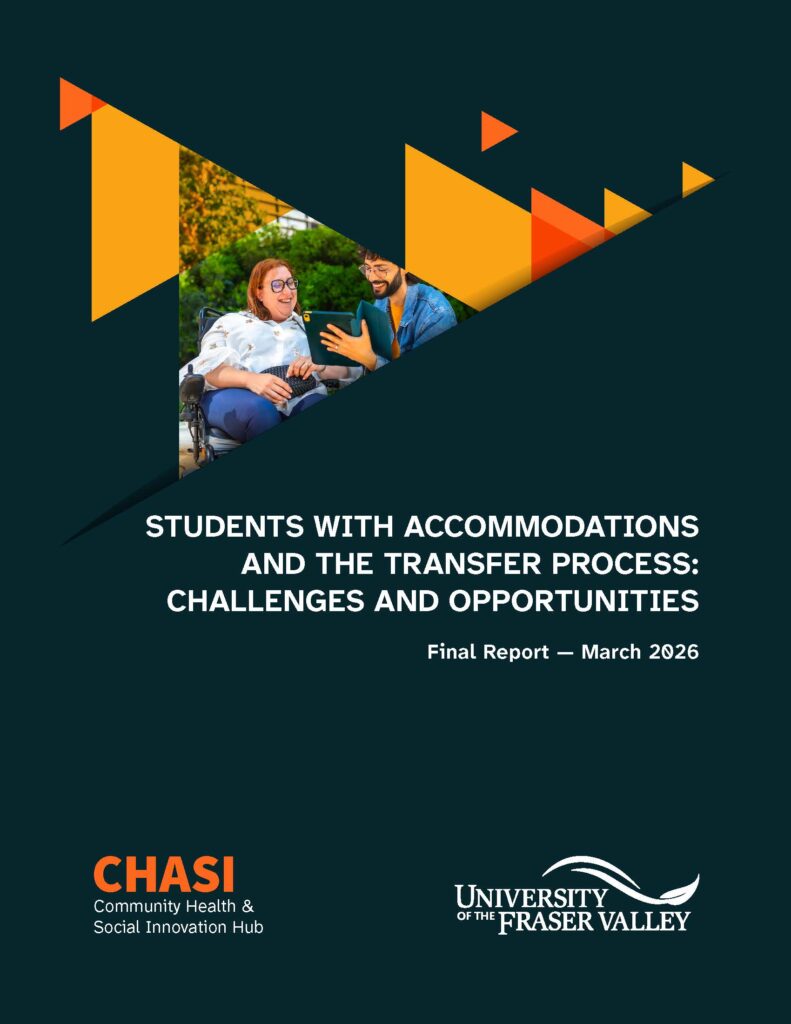
A new report from the University of the Fraser Valley’s Community Health and Social Innovation (CHASI) Hub examines what happens when students with disabilities transfer between post-secondary institutions in British Columbia. Funded by the British Columbia Council on Admissions and Transfers (BCCAT), the report, Students with Accommodations and the Transfer Process: Challenges and Opportunities, looks at the policies, practices and experiences that shape the accommodation transfer process.
The research found that while accommodations are an important part of creating equitable access to education, transferring between institutions can require students to navigate a complicated and inconsistent system.
Why does the transfer process matter?
Accommodations are intended to help students participate in their education on an equitable basis. But accessing those accommodations can already involve several steps, including registering with accessibility services, providing documentation and working with an institution to determine appropriate supports. When a student transfers, that process generally begins again.
In British Columbia, accommodations do not automatically transfer from one institution to another. The receiving institution must review the student’s documentation and determine accommodations based on the student’s needs, the new program and the institution’s own policies and practices.
While there are reasons for institutions to conduct their own assessments, repeating the process can add another layer of administrative work to an already significant transition. The report notes that students with disabilities already tend to experience longer and more complicated educational pathways, making the added work involved in transferring particularly important to consider.
What did the research look at?
To better understand the transfer process, the CHASI research team used three approaches: a review of existing literature, an analysis of institutional policies and procedures, and interviews with accessibility professionals.
The team reviewed 20 institutional policies and procedures across British Columbia. Four accessibility professionals representing different types of post-secondary institutions also participated in interviews.
Together, these sources helped researchers identify where the current system is working, where students may encounter barriers and where there may be opportunities to make transfers easier.
What does the literature tell us?
The existing research points to several barriers that can affect students with disabilities as they move through post-secondary education.
One of these is simply knowing where to start. Students may not always know what supports are available, what documentation they need or how the accommodation process works at a new institution. Even when students have gone through the process before, each institution may have different policies, procedures, technology, and ways of delivering accommodations. For example, an accommodation such as extra time on exams may remain similar from one institution to another, but the process for booking an exam or accessing the accommodation may be completely different.
The report also highlights the role of stigma. Previous negative experiences with disclosure can influence whether students feel comfortable approaching accessibility services at a new institution. For some students, transferring means having to explain their disability and accommodation needs all over again, which can bring back concerns about being misunderstood or judged.
This can be particularly challenging for students with invisible disabilities, who may already feel that their needs are questioned or misunderstood.
Another important issue is self-advocacy. Students are often expected to take the lead in navigating accommodation systems, collecting documentation, contacting accessibility offices and communicating their needs.
Self-advocacy can be empowering, but the report questions what happens when students are expected to carry too much of the responsibility for accessing a right they are entitled to. The transfer process can require significant time, knowledge and emotional energy, particularly for students who may already be managing health, financial, family, or academic pressures.
What did the policy review find?
One of the clearest findings came from the review of institutional policies. None of the 20 policies and procedures examined specifically addressed students with disabilities who are transferring between institutions. Instead, institutions generally rely on their existing accessibility or accommodation policies.
This means that a student transferring into a new institution may effectively be treated as a new student when it comes to accommodations, even if they have already been receiving supports elsewhere.
The review also found considerable variation between institutions in areas such as documentation requirements, how recent medical documentation must be, which professionals can provide documentation, and how policies and procedures are presented online. For students, this can mean that the requirements change depending on where they are studying.
The differences are not necessarily limited to the accommodation itself. Institutions may also use different exam booking systems, note-taking supports, software and physical spaces.
The report also identified differences in the resources available to institutions themselves. Larger institutions may have more dedicated staff and resources for accessibility, while accessibility responsibilities at smaller institutions may be part of a broader portfolio. These differences can influence how policies are developed and how services are delivered.
What did accessibility professionals say?
The interviews reinforced many of the findings from the literature and policy review. Participants described a system that is largely institutionally independent, highly student-driven and not well coordinated across the provincial transfer system.
A recurring issue was the lack of clear information for students. Students may assume that their accommodations will automatically move with them when they transfer. When they discover that they need to complete another intake process, the result can be frustration, delays and duplicated work.
At the same time, participants emphasized that accommodation decisions are individualized. A student’s previous accommodation plan can help inform the receiving institution’s assessment, but it cannot necessarily be used as the only basis for determining accommodations.
There are also positive practices happening across institutions. Participants described examples such as providing students with copies of accommodation letters, encouraging students to contact their new institution early, sharing documentation with student consent and providing information during the admissions process.
The challenge is that these practices are often informal. A student’s experience may depend on the institution they are transferring to, the resources available, or even the individual staff member helping them.
What could make transfers easier?
The report points toward several opportunities to improve the process. One recommendation is to develop clearer and more consistent guidance around medical documentation. This could include more consistent expectations around how recent documentation needs to be and who can provide it, while reducing unnecessary reliance on expensive or difficult to access assessments.
A centralized resource could help make this information easier to find across British Columbia.
The report also calls for reducing unnecessary administrative work for students. Rather than expecting students to manage every step of the process themselves, institutions could provide more support with documentation, appointments, onboarding, and activating accommodations at the new institution.
Finally, accessibility information should be easy to find online. The report recommends that institutions provide clear, public-facing information in plain language, ideally through a well-organized webpage where students can find the information they need without having to search through multiple policies and pages.
Looking ahead
Transferring to a new post-secondary institution should not mean starting from scratch. The research does not suggest that every institution should provide identical accommodations or follow exactly the same processes. Different programs and learning environments have different requirements, and accommodations need to reflect individual student needs. Instead, the findings point to the importance of making the path between institutions easier to navigate.
For students with disabilities, a transfer already represents a significant change. Reducing unnecessary paperwork, improving communication and making expectations clearer could help ensure that the transition does not create additional barriers to their education.
Ultimately, the report highlights an important question for British Columbia’s post-secondary system: How can institutions work together so that students can move between them without having to repeatedly overcome the same barriers to access?
Creating a more coordinated and transparent approach to accommodation transfers could help make post-secondary education more accessible, not only when students first enter an institution, but throughout their educational journey.