

This article is part of a series of posts led by CHASI Research Associate Len Garis, who has been a long-time partner of CHASI through his work with the National Indigenous Fire Safety Council. His guest blog posts explore a wide range of topics related to firefighting and firefighters in Canada. You can read all of his guest articles at this link.
CHASI’s collaborations with the NIFSC, and many of their other research works, can be found on our NIFSC Publications page. For questions about the NIFSC and their work, please visit their contact page.
Building Better Fire Safety Campaigns: Lessons from Youth-Focused Programs in Canada and the United States — and the Rise of Torch the Turtle
By Len Garis & Mandy Desautels
Fire departments across Canada continue to confront a persistent challenge: how to deliver fire‑safety education that resonates with children, influences household behaviour, and reflects the realities of diverse communities. For Indigenous communities, the stakes are even higher. As the National Indigenous Fire Safety Council (NIFSC) report notes, “Fire-related incidents pose a disproportionally high threat to Indigenous peoples in Canada,” and the loss of homes, cultural spaces, and community infrastructure can have generational impacts.
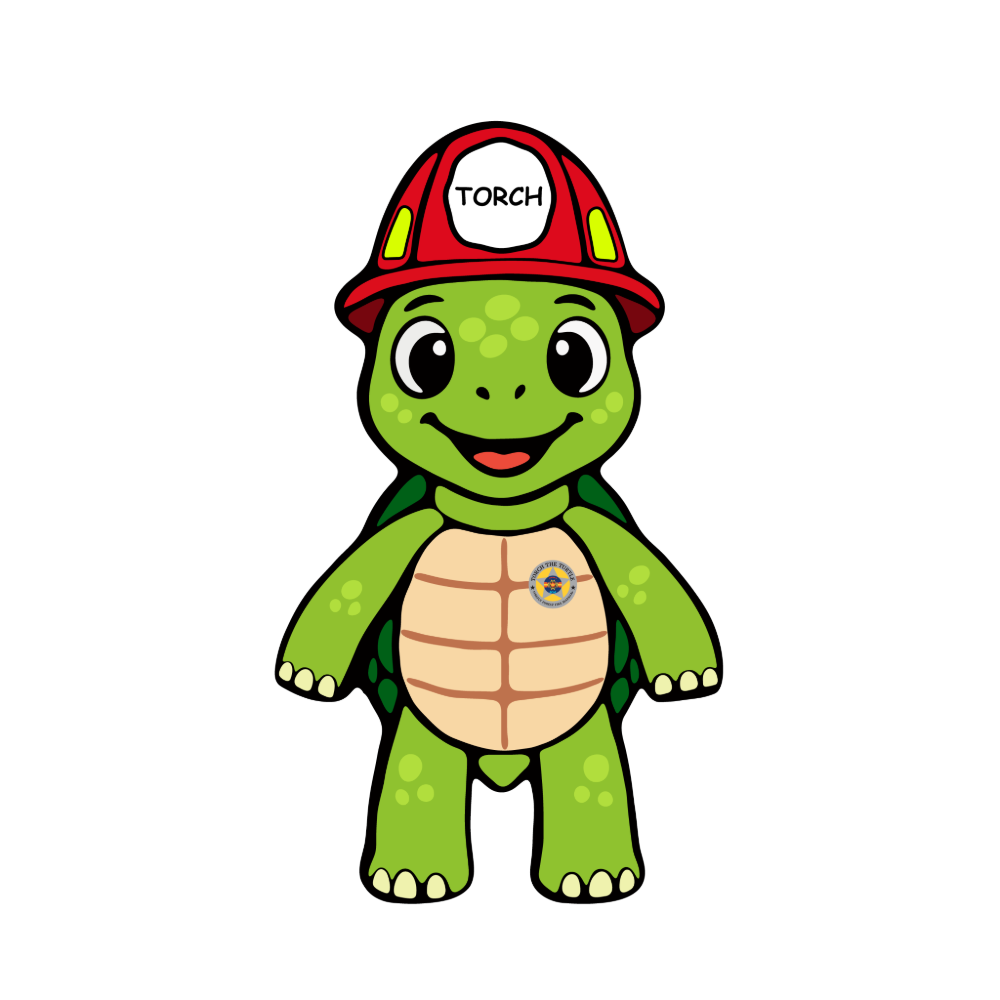 In 2024, the NIFSC introduced Torch the Turtle, the first national Indigenous youth fire‑safety mascot — a culturally grounded character created by Indigenous children and designed to anchor future youth programming.
Torch’s emergence comes at a pivotal moment. The NIFSC’s assessment of six major fire‑safety campaigns — Smokey Bear, Sparky the Fire Dog®, Ember™ the Fire-Smart Fox, Prepare with Pedro, Amber’s Fire Safety Campaign, and the Winter Home Safety Campaign — offers a roadmap for what works, what doesn’t, and what Canadian fire services should prioritize as they build the next generation of youth fire‑safety education.
Why Youth Fire Safety Campaigns Matter
Children aged 3–13 are among the most effective conduits for fire‑safety messaging. They absorb information quickly, share it at home, and influence household behaviour. As a recent report emphasizes, “educating young individuals is especially important given that they are at higher risk of fire-related incidents.”
When campaigns are designed well, they create a multiplier effect: children learn, families adapt, and communities benefit. But designing a campaign that works requires more than posters and colouring sheets. It demands sustained effort, clear objectives, and a deep understanding of the target demographic.
What the Best Campaigns Get Right
Across all six case studies, several themes emerged — themes that Torch the Turtle now embodies as Canada’s newest youth fire‑safety figure.
Mascots Matter — and Torch Represents a New Generation
Every successful youth campaign uses a mascot. Not just any mascot, but one that is approachable, memorable, culturally appropriate, and flexible enough to evolve over time.
Sparky the Fire Dog® remains the gold standard. Smokey Bear demonstrates the power of longevity. Ember™ the Fire-Smart Fox shows how modern wildfire realities require modern messaging.
But none of these mascots were created by Indigenous children for Indigenous communities.
Torch the Turtle changes that.
Created through the NIFSC’s national poster contest, Torch was created by Ms. Keeshig’s Kindergarten Class at Kikendaasogamig Elementary School in Neyaashiinigmiing, Ontario. His multi‑coloured shell symbolizes fire, diversity, pride, and cultural identity. Torch’s story emphasizes bravery, leadership, and community responsibility — themes deeply rooted in Indigenous teachings.
Torch is now the official national Indigenous youth fire‑safety mascot, with a French counterpart, Tison la Tortue. In October 2025, Torch the turtle was be formally introduced to the national fire‑service community during Fire Prevention Week on Parliament Hill — alongside Sparky the Fire Dog® — marking the first time Canada has launched a national Indigenous fire‑safety mascot with full federal visibility.
Longevity Requires Stable Funding
The campaigns with the highest scores — Sparky (91%) and Prepare with Pedro (85%) — share a critical trait: stable funding. The NFPA and American Red Cross have decades‑long revenue streams, merchandising strategies, and institutional support. This allows them to continuously update materials, invest in digital platforms, maintain national reach, and adapt to changing cultural expectations.
By contrast, Indigenous‑created campaigns such as Amber’s Fire Safety Campaign face fluctuating funding. Despite strong community relevance, limited resources constrain growth and long‑term sustainability.
Torch’s creation signals a shift: the NIFSC is now investing in a mascot with national reach, long‑term planning, and federal‑level visibility; but sustained funding will determine whether Torch becomes a Sparky‑level success or a short‑term initiative.
Modern Language, Modern Tone
Campaigns must evolve with society. Smokey Bear’s early materials — rooted in mid‑century American culture — now feels dated and, at times, culturally insensitive. As the report notes, “Smokey Bear materials did not start to meet the increasing diversity requirements of today’s society until quite late in the game.”
Prepare with Pedro excels at cultural inclusivity. Ember™ uses modern wildfire science. Torch brings Indigenous cultural grounding and youth‑driven storytelling.
For Canadian fire services, the lesson is clear: messaging must reflect Indigenous cultural realities, multilingual needs, modern family structures, trauma‑informed approaches, and community‑driven storytelling. Torch’s origin — created by Indigenous children — gives him authenticity that no external mascot can replicate.
Digital Delivery Is Now Mandatory
Children live online, and campaigns that fail to meet them there simply do not reach them.
Sparky’s digital ecosystem — videos, games, apps, interactive badges — is unmatched. Prepare with Pedro innovates with voice‑activated games through Alexa and Google Assistant.
Torch’s digital presence is still emerging, but the NIFSC has already begun integrating him into classroom materials, online resources, social media outreach, and youth‑focused fire‑safety content. To succeed, Torch will need a dedicated website, interactive games, mobile‑friendly tools, and downloadable lesson plans.
Demographic Clarity Drives Impact
The highest‑ranked campaigns — Sparky and Prepare with Pedro — are also the only ones with clearly defined age groups. Sparky targets preschool to Grade 4; Pedro focuses on Kindergarten to Grade 2.
Torch’s initial materials target Kindergarten to Grade 6 — a promising start — but future development should include age‑specific content streams. Demographic clarity allows curriculum alignment, age‑appropriate messaging, measurable outcomes, and focused resource development.
Torch’s Role in Closing the Indigenous Fire‑Safety Gap
Our report highlights a stark reality: “There are currently no known fire safety programs which specifically target Indigenous youth in Canada.”
Torch is the first national attempt to change that.
He is Indigenous‑created, culturally grounded, youth‑driven, nationally supported, and designed for long‑term use. Torch’s emergence positions the NIFSC to build a full youth fire‑safety ecosystem — one that reflects Indigenous housing realities, languages, cultural teachings, and community priorities.
The Path Forward — A Cohesive Blueprint for Canada
Torch’s introduction gives Canada something it has never had before: a culturally resonant mascot capable of anchoring a national Indigenous youth fire‑safety campaign, but Torch is only the beginning. His presence provides the foundation for a broader, modernized approach to youth fire‑safety education.
The strongest campaigns in North America show that success requires more than a memorable character. It demands multi‑year funding, curriculum‑aligned materials, digital accessibility, and community‑driven content. Torch embodies the cultural grounding and youth appeal needed to capture attention; now the campaign must be built around him.
A modern Canadian youth fire‑safety campaign must integrate Torch into a digital ecosystem that meets children where they are — online, interactive, and mobile. It must provide teachers with curriculum‑aligned lesson plans that make fire‑safety education easy to adopt. It must be shaped by Indigenous educators, Elders, youth, and fire personnel to ensure authenticity and relevance. It must also be supported by stable funding that allows for continuous growth, adaptation, and national reach.
Taken together, these elements form a cohesive blueprint — not a checklist, but a narrative arc. Torch is the spark. Around him, Canada can build a modern, culturally grounded, digitally accessible, curriculum‑aligned, community‑driven youth fire‑safety campaign with national reach and long‑term sustainability. The path forward is clear; the opportunity is now.
Authors
Len Garis is director of research for the National Indigenous Fire Safety Council, Ret. Fire Chief for the city of Surrey, B.C., Research Associate – University of the Fraser Valley, associate scientist emeritus with the B.C. Injury Research and Prevention Unit. Contact him at lwgaris@outlook.com.
Mandy Desautels is Chief Administrative Officer at the National Indigenous Fire Safety Council. Prior to joining NIFSC, she worked for BC Emergency Health Services and prominent NGOs. Contact her at mandy.desautels@indigenousfiresafety.ca.