
Appreciating Indigenous art on campus

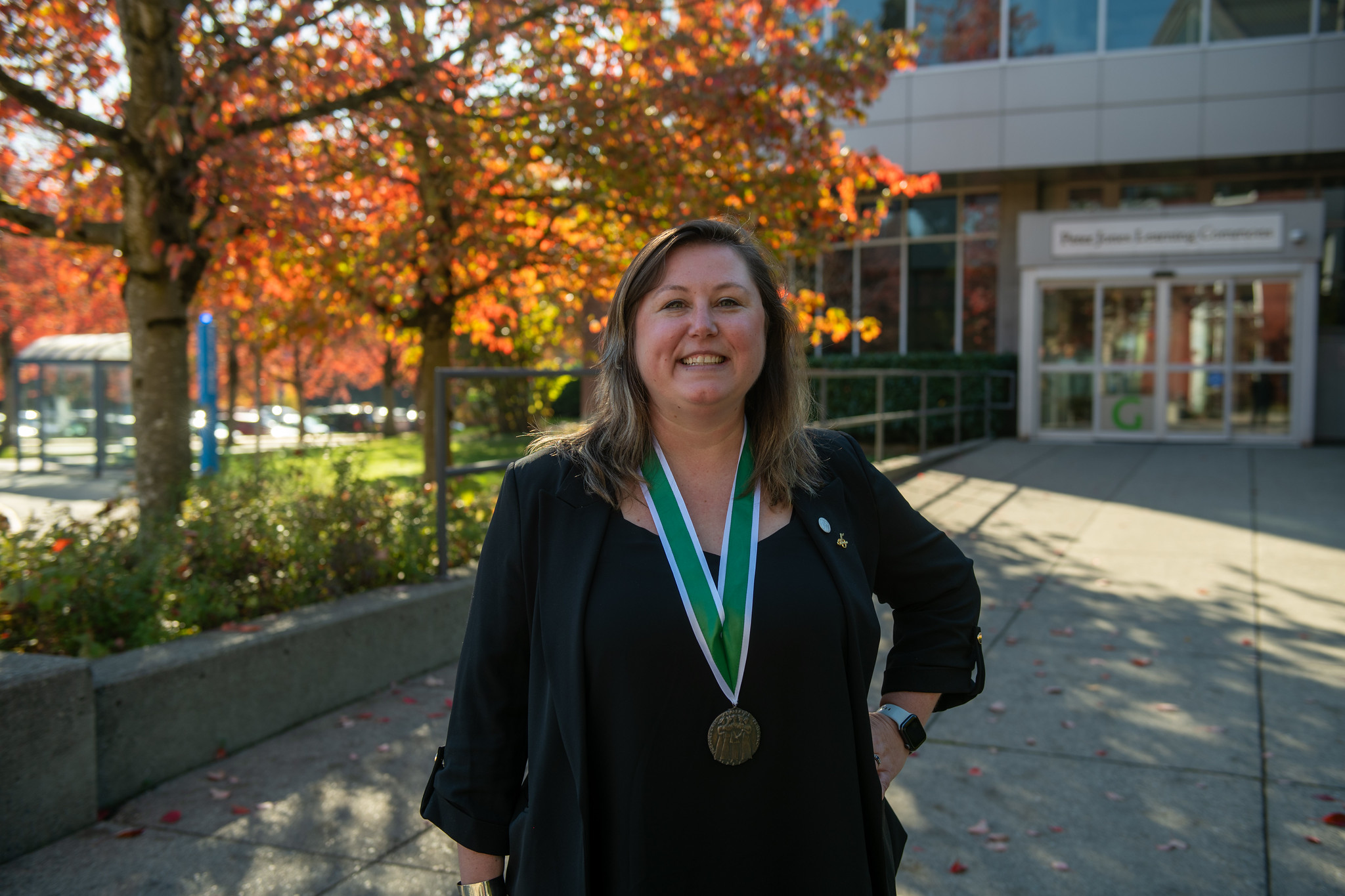
As you walk the halls and pathways of UFV’s campuses, you’ll encounter many pieces of Indigenous art, entrusted to this community by the artists who created them. Teresa Carlson, the university’s curator, collaborates with these creators to document and share their work with the world.
“Indigenous art isn’t just a picture or carving on the wall; it’s a representation of the artist’s worldview, and contains a piece of the artist themselves,” Teresa explains.
“I think that really speaks to the generosity of the Stó:lō. You think about all the trauma they’ve gone through in the past, and they’re still willing to share.”
Traditional artmaking was one of many cultural teachings that Indigenous children were separated from when they were taken to Residential Schools. And with that loss, they were robbed of the history, storytelling, and connection to past generations that’s embedded within the art.
With this in mind, reconciliation is a large part of Teresa’s work as Curator. By supporting and platforming local Indigenous artists, she lends her efforts to the reclamation and repatriation of traditional Stó:lō knowledge. She hopes this work will help Indigenous students, faculty, and employees see themselves represented at UFV, making it a safer and more welcoming place to be.
“Putting Stó:lō art up is a way for Stó:lō people to see parts of themselves at the university. You know, they see that reflected back at them. But it’s also a way for us to be able to see those things through their eyes.”
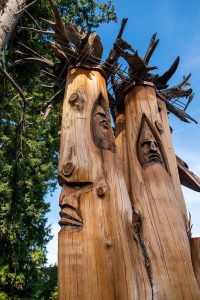
Every art piece at UFV has a story – like E’yies’lek Rocky LaRock’s wooden sculpture in the Indigenous Teaching Garden. It was built out of damaged cedar trees that were repurposed into something beautiful in the midst of the 2020 pandemic. (To see a video on how it came together, click here.)
Or like his daughter Nikki LaRock’s mural at Sthe’thiawt in Xwexwílmexwawt, which depicts the strength of matriarchs that ties generations together. Or the raven mask by Xótxwes Johnny William Shaw, which features abalone shell buttons given to him by a friend at the exact time the artist was pondering what he should use for the mask’s eyes.
“Stó:lō believe that each person has their own gift, and artists have that gift of bringing their stories and their culture out in their art,” says Teresa.
An art piece is a gift, and with that gift comes the responsibility to care for it. When a piece of public art was damaged last semester, it prompted important reflection within the UFV community. Teresa and the Xwexwílmexwawt department are now using that moment to deepen understanding of why these works are so significant, and how we can engage with them in respectful and meaningful ways.
“Stó:lō say that everything happens for a reason. And so that incident that started as something that was hurtful, that was disrespectful, has led to discussion, art walks, maps of the art pieces — it’s just blossomed into this super positive, wonderful way to continue that education now,” Teresa says. “I think that’s a positive outcome for what started as a really negative event: let’s use that as a way to reflect on what happened, foster that reconciliation and think about how we can do better in the future.”
Looking to enjoy Indigenous art on campus? Here’s how:
- Explore
One way to engage with art is by learning more about it. Check out the map on the back page of The Cascade newspaper to discover different displays around campus; each piece has a plaque nearby which explains who created it, and some information about why it was created. More information can be found by searching for the artist online, or by visiting https://www.stoloworks.com/. Remember that the art piece in front of you is the culmination of generations of love, hard work, and skill; behind every piece of art is a person worth getting to know.
2. Inquire
Good art inspires us to ask questions. While looking at a piece of Indigenous art, what questions or feelings come up for you? Try asking: How does this piece connect to the natural world around us? What teaching or lesson is this piece trying to share?
3. Connect

Public art installations are meant to be shared. It’s okay to take pictures of, or with, a piece of art, as long as the photo isn’t disrespectful to the artist. It’s not okay to damage, copy, adapt, or publish the piece of art without the artist’s permission. Use the map linked above to take an art walk with a friend. Take photos to share on Instagram (with credit to the creators); be sure to tag @goUFV to let us know your favourites.
Teresa appreciates how art brings people together — it connects us to the past, and to each other.
“Stó:lō are trying to connect with non-Indigenous people and fostering reconciliation by sharing that knowledge through their art. They’re sharing a piece of themselves. It’s a way for the viewers to understand and appreciate those teachings and those cultures,” she explains.
“UFV has been working hard to Indigenize the academy and foster reconciliation. I think these art pieces are a way for Stó:lō and other Indigenous artists to reach out to us. I hope we will meet them and show respect by appreciating their work at a deeper level.”