
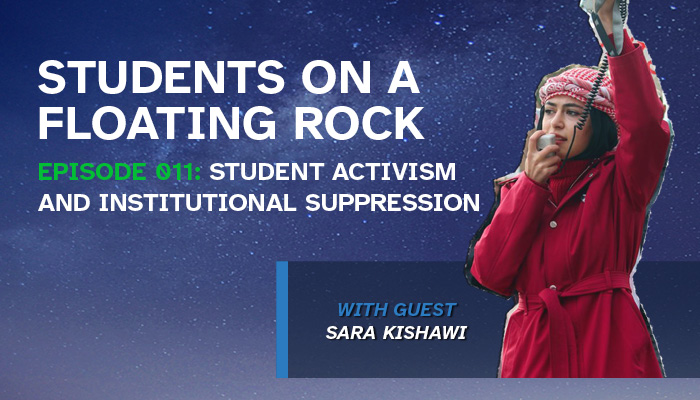
 On today’s episode we have Sara Kishawi, a Palestinian community organizer and Sociology graduate from Vancouver Island University. She’s joining us today to talk about student activism, institutional supression, and misconceptions to unpack in relation to the ongoing genocide in Palestine.
UFV’s Faculty and Staff Association welcomed Sara in October 2025 for their event, “Promoting Community Change on Campus in the Face of Institutional Resistance with Sara Kishawi” and we had the pleasure of hosting her for this podcast recording before the event. Due to this, some minor details may have changed since the time of recording.
Students on a Floating Rock is available to stream on your favourite podcast services — including Spotify, Apple Podcasts, Amazon Music/Audible, and more.
Powered by RedCircle
TRANSCRIPT
Students on a Floating Rock voice-over 0:01
From UFV’s changemaking hub, this is Students on a Floating Rock, a student-run podcast dedicated to—
Regan Smith 0:07
—um, I actually think I can take it from here.
Students on a Floating Rock voice-over 0:10
Umm, okay.
Regan Smith 0:11
So if I had to describe it, then it’s basically engaging with changemakers to learn about the skills and mindsets needed to navigate these horrific times on this floating rock, also known as Earth.
Amrit Mahal 0:25
I am your host for today’s episode, Amrit Mahal, and it’s a pleasure to have Sara joining us today. Thank you for taking the time out of your day to be here with us and to talk with us. To start, if you could please tell us a little bit about yourself and your story.
Sara Kishawi 0:41
So, my name is Sara. I’m from Gaza, Palestine, and I came to Canada in 2011 with my family. In the past few years, I was at Vancouver Island University. I was doing my degree in sociology, which I graduated from, and I was a big part of the activism on campus and in Nanaimo for Palestine, the Palestine movement, but also anti-genocide movement that has been going on in an escalated way in the past couple years. I think we’re coming up to the two year anniversary this week, and so big part of that on campus and off campus in attempt to raise awareness about what’s happening, but also in efforts to end Canadian complicity in the genocide, and ultimately end the genocide that is happening in Palestine.
Amrit Mahal 1:32
Thank you. I’d like to start off with what inspired you to become an activist and a student community organizer, especially focusing on issues like genocide in Gaza. So, what, what led you to becoming an activist?
Sara Kishawi 1:50
I would say nothing really led me to be an activist. It was more of how could we not do something about what’s happening. 2023 was not the first time we joined or were part of protests and movements for Palestine. I mean, the ethnic cleansing of Palestinians in the Nakba, that started in 1948 and even before then there were talks, and ever since then there has been a movement that centered around Israel’s actions in Palestine, the occupation of Palestine. Most of the time, you know, especially before it would center around Palestinians’ right to return or Israel’s escalation of bombing and attacks on Gaza, and so in 2018 was really the first time that I, no, my apologies. It’s 2021 when there was an 11 day escalation. 2018 is when I started university. There were other protests going on. There were more rallies and information tables rather than on the ground protests, but that was the first time I started to get into other movements.
Sara Kishawi 2:57
You know, there were things that were starting to pick up, truth and reconciliation was starting to make the talk, you know, just go around, missing and murdered indigenous women, the climate change protests, all of these were starting to really pick up for me in 2018 and in 2021 there was an escalation of Israeli attacks on Gaza, and that was in May, I believe, lasted for about 11 days, during which we first joined and helped lead a rally in Nanaimo.
Sara Kishawi 3:26
Now it wasn’t the first rally of its kind. Before then, for years there was a group of mostly seniors, it was, I think, it’s called the Mid Islanders for Peace and Justice in the Middle East, but they centered around talking about Palestine, and they would go out at the last Friday of every month to raise awareness about what’s happening in Gaza. I mean, Gaza is under siege, and there is always people being kidnapped by Israel, taken hostage. So, there were there would be people that would go out and raise awareness about that.
Sara Kishawi 3:55
And so, in 2021 we joined their rally to call for an immediate ceasefire, and it was 11 days, and you know, thankfully the escalation ended in 11 days. I mean, Gaza was still under siege, and there would still be times of attacks where it would happen, but at least the ongoing bombardment had stopped for the time being, and so during that time, it was in 2021 that 11 days, it was basic science, it was “free Palestine.” “Did you know there’s an occupation?” and such. We didn’t really get a lot of resistance, I guess, from the crowd.
Sara Kishawi 4:35
There would be a couple people that would come up and ask questions, or a couple people that would say, you know, “but in the Bible it says this,” and that’s like a usual argument that we see from people, but really there was nothing memorable of it, in terms of it being a huge movement in Nanaimo. We gone out, I believe, like two or three times during those 11 days, and the most escalating thing that happened in Nanaimo was, we had a boycott Israel sign, and that was very controversial at the time to say that something like that is a big sign, and at the time there were talks of it even being illegal to say something like that, and so that was the biggest thing.
Sara Kishawi 5:13
And yeah, after those 11 days I actually had the opportunity to go back to Gaza and see the effects that the escalation had had on the population and on the buildings, and how people were living after. And then we came back, and I was continuing my studies when October 7th happened, 2023, and we picked up pretty quickly. October 12th was when we had our first rally, which was quite well attended. We had about 50, over 50 people, which for Nanaimo was great, and especially for a first rally, and especially during that first week, where people were still unsure of where they stood. There was a lot of misinformation coming out, and people didn’t want to step on toes, and so it’s a very hopeful start to what is now a big movement, and it was our addition to the movement that is happening globally.
Sara Kishawi 6:09
And so to answer that question, is how could we not? I mean, we see atrocities coming out of Gaza now, we see it every hour, we see what, how Israel is treating not only Palestinians but other activists from all around the world, and the, you know, propaganda machine that they’re just constantly feeding in attempt to get everyone to just let them do this genocide by themselves. Before they escalated the genocide, there were still atrocities coming. They were just not making the news, right? I mean, now half the stuff doesn’t make the news, and then it was pretty much none of it made the news right, and so we took it on, because how could we not?
Amrit Mahal 6:48
Yeah, no, and I think there’s accumulation of things here from your personal lived experience in Palestine, and going back and to see the effects of what’s happened, that definitely is, you know has led to your position as, as an activist and a speaker. This is all very heavy. So, my next question is, is how do you maintain your motivation, your mental well-being, given the emotional weight of the issues you work on?
Sara Kishawi 7:15
I think that was a really interesting question, because my initial answer is, I don’t maintain it. There’s a genocide going on, and sometimes my biggest struggle is when we see that big resistance to our movement, which is in its foundation an anti genocide, anti ethnic cleansing, and anti occupation, anti apartheid movement. When you see that much resistance to it, it’s definitely a difficult thing to navigate, because it’s not like people are opposing it because they’re pro genocide, but they are opposing it because Palestinians have been so dehumanized, there is so much misinformation and propaganda that has gone out, and so there is that battle, but at the same time it does feel like they are going against the essential and the foundations of that movement, right?
Sara Kishawi 8:08
And this was something we had felt, especially after the encampment was dismantled, was this university that is supposed to be this ground for freedom of expression, for you know, grounds for political expression, this university went this far to remove something that they could have gotten removed by following a set of very basic and very bare minimum demands and standards, right?
Sara Kishawi 8:38
So right after that, especially was when we had the hardest time of grasping, like, what are we doing wrong, not in terms of what are we doing wrong within the movement, we’re always learning, you know, what works better and best for protests, but it’s like, what are we doing wrong morally as humans, like, what ethics are we reaching here that this university spent this much money and these people go this far to go against the movement, and you know that is something we try to navigate, but at the end of the day, we recognize that our, you know, positivity is not the priority here.
Sara Kishawi 9:11
We don’t have to be positive, we don’t have to be de-stressed to work in activism. We can be sad, we can be angry. Those are very healthy and normal emotions to have when we’re witnessing a genocide, and there shouldn’t be an expectation for us to be normal or to be okay, because what’s happening is not normal, it’s not okay. And so, as long as here we have homes over our heads, we have shelters, we have food, we have water, and we have all our emotions that we we can use and redirect to aid the movement rather than to bring it down or to use it as an excuse to not be part of this global movement.
Amrit Mahal 9:50
That’s very powerful. That’s very powerful how you’re able to use those emotions and those feelings that you feel to redirect that to, to you know, to push this forward. And very inspiring, which leads us to our next question. How do you engage and mobilize students and people who might not be initially aware or involved in these issues?
Sara Kishawi 10:14
I won’t lie and say from the beginning that we had a lot of student involvement in what’s happening. We had our first rally on campus, but at the same time we recognized that a lot of people that came, it was successful rally, but there were people that were already involved in activism for Palestine since before I was even born, right? And so recruiting people who did not know, while also navigating this huge influx of propaganda and misinformation about what actually happened was not the easiest thing, and we had to have a strategy, but at the same time we recognize that we had to have patience with this type of, you know, movement coming to campus, especially.
Sara Kishawi 10:56
I mean, all of us wanted to go on a roof and scream our lungs out because the genocide is happening, and people are not recognizing it, and we had to basically gentle parent people to be like, “hey, genocide is not okay,” let’s, yeah, you know, get on that page, right, but at the same time, we recognize that for the well-being of the movement, and for it to be long lasting, we needed to be patient and have that patience, so what we started with was very simple: ask us about Palestine tables, and that was a table we set up on campus, and we set it up every single day.
Sara Kishawi 11:32
A group of us would join, and first it was mainly Palestinian Muslim students that ran the table, and what it offered was an opportunity to have that discussion, to talk about October 7th, to talk about what happened, to talk about the occupation since 1948 and none of us were experts on the topic. However, as all of us being there, we could fill in the gaps for everybody, and at the same time learn, you know, we could get a question that we didn’t know the answer to, and that would be a learning opportunity for both the person that asked it and the person that was asked, right?
Sara Kishawi 12:08
And so we ran those tables every day for like a few months, both in the middle of the semester, the first fall semester, and well into the spring one, and during that time we would also do actions, we would do marches, so that at the table it wasn’t only discussion, it was here’s what you can do, here’s a petition that you can sign, here are, you know, boycott campaigns, for example, that you can, you can join in. And boycotts, for example, are very easy minimal step to start with, you know, it’s like an easy stepping stone into the movement, and so we would start with those.
Sara Kishawi 12:41
We’d tell people, “hey, maybe you’re not comfortable coming to a march or a rally, but you can start boycotting. You can come to the student walkout,” for example. We had a couple student walkouts on campus. We told people, “you can just walk out and go. You don’t have to come to the rally right afterwards.” Most people did. They stuck around because there’s groups.
Amrit Mahal 13:01
Yeah.
Sara Kishawi 13:01
And so that was something that was definitely very helpful, is for people to see a lot of a crowd there, because they, you know, safety and numbers and that whole thing, right? And so to kind of put it in a summarization, it wasn’t easy to get students involved, students just, they have their own lives, they’re focused on, you know, getting from school, most students work, and then school work, and then back to school, right? But at the same time, it was that gentle parenting and offering the alternatives of methods for being in the movement, rather than, you know, you don’t only have to march to be part of the movement, you can do all these other things, and recognizing the urgency of genocide, and I won’t lie, what helped was VIU’s reaction to us. Students like to see an administration that represents them very well, and when they see their administration going against students in a very just exaggerated way, an unprofessional way, they—
Amrit Mahal 14:04
—hostile way.
Sara Kishawi 14:05
Very hostile way. They start, you know, questioning what’s happening and why the university is doing that, right? That gave us, you know, some sort of spotlight, and so we would do that, we would take advantage of anything that we had access to, we would put posters up, of course. We had the Muslim Women Club, which was a club that I had co-founded with a group of students, and we would use the resources we had there in booking spaces, for example, to mobilize. We would use, we have an online homework thing that the university uses, and there was an option on there to, you know, email all your classrooms, and so we would encourage everybody to email your entire class list that there’s this thing happening.
Sara Kishawi 14:49
And while we’re also doing things that are actions, protest actions, like, you know, boycotts and rallies, we’d also do cultural events to show, you know, this is what Palestinian culture is like. This is an opportunity to learn about this specific thing, you know. Come taste Palestinian food, which sometimes I have a hard time with. That is like, do I have to babysit people and gentle parent them into recognizing genocide is urgent, but at the same time, from the at the very beginning of the movement, we recognize that that was a very strategic thing to do, so that people can know what’s happening, we don’t really have to do much of that anymore. People recognize the urgency, I think Israel has quite shown us it’s, you know, it’s true face, and so we don’t really have to convince people what they’re doing is, you know, being silent about it is wrong, and so it’s definitely got easier, and especially in Nanaimo, I would put it to that gentle parenting strategic things that we did at the beginning.
Amrit Mahal 15:47
Yes, and I think, yeah, those are those are some really great strategies that you talked about on on how to create awareness and how to how to engage a student and encourage students to use their voice on topics, no matter what that topic may be, to speak out when you feel about something, especially of this nature that is just so incredibly wrong.
Amrit Mahal 16:08
How do you navigate the complexities and sensitivities around discussing the genocide in Gaza, especially in diverse student communities? So, how do you enter that conversation?
Sara Kishawi 16:21
This is something I’ll definitely be touching on in my talk later. Probably the majority of it. There are a lot of barriers that go up for students, not just, you know, outside the movement, but within the movement. There is always the fear of being anti semitic, for example, and that is something that was used by the university to justify their lack of action, they don’t want to be seen as anti semitic, and my answer to recognizing that is it’s not like being anti semitic and pro Palestine are, you know, they don’t go hand in hand, and the fact that we’ve been taught that it does go hand in hand, or we’ve been led to believe that they do, is something that we need to unlearn, because it just doesn’t make any sense.
Sara Kishawi 17:04
I mean, my biggest thing is if someone is accusing you of something and your answer is that you didn’t do it, then you didn’t do it, right? And so, and I’m not saying you know, overlook things that you may not be aware of at all, but in a way that is, if you are at a pro Palestine march and you genuinely don’t think there’s anything anti semitic there, and someone accuses you of that, then the next question is, how? How is it anti semitic? And usually this conversation would end there. You know, we’ve obviously been accused of something like this multiple times. It’s something that is weaponized against Palestinians and people that participate in protests and such, right. But then, when you ask, okay, how is it anti semitic? Crickets, nothing.
Sara Kishawi 17:50
And so to navigate this type of thing, we obviously need to recognize that anti semitism, anti Palestinian racism, all these things exist, obviously, but we also need to be aware of how they may be weaponized within other movements, and what the goal of the accusation is, and if the accusation cannot be backed up by actual, you know, you did this, you said this, you said that, then it’s why are you scared of it? Who cares? I’ve been called anti semitic more times than I can count, and it’s just like, okay, “how, how am I being anti semitic? Tell me.” “Well, you’re advocating for Palestine.” Okay? Then, like, you know what? What are you backing up the statement with?
Sara Kishawi 18:35
And I think what people are so scared of, in terms of navigating that diverse crowd, is a conversation, and we shouldn’t be scared of conversations. They’re uncomfortable conversations. Obviously, they are, and we recognize that. However, so what? At the end of the day, maybe you would learn something. Maybe there is, you know, something that you are doing that there is racism in it, or there is any type of underlying, any type of underlying, you know, misogyny, racism, or any type of, you know, just some of these stuff is internalized, or we don’t realize that we’re doing it right, they’re microaggressions.
Sara Kishawi 19:10
And so by asking the question, you either stop the accusation in place because it’s not a valid one, or you have an opportunity to learn something, and so we’re so scared of the accusation being thrown at us before it’s even thrown, that we risk not standing up against genocide. That is simply ridiculous, I think. Of course, we recognize that there is anti semitism within platforms, just like there is anti Palestinian racism within platforms, and both are equally as harmful to the movement and towards people where they stand against all forms of racism and discrimination, because those have no places in the movement.
Amrit Mahal 19:52
You spoke a little bit about VIU and, and some of the ways why we believe that they have reacted in this hostile way. Speaking a little bit to your role as an activist, and in general speaking to activism, how have you come up against institutional resistance?
Sara Kishawi 20:13
For VIU, from the very beginning, we were very hopeful, we had witnessed and seen how VIU dealt with the hostilities between Russia and Ukraine, and that is something we got emails about. VIU sent fundraising links about it. They supported a professor who was running a campaign. They sent out Zoom link to watch President Zelensky of Ukraine speak, and then they put out a statement offering extra resources for Ukrainian students as well as anyone who’s affected by what’s happening, and in the statement the very first sentence is following the Russian occupation of Ukraine, and so we knew that VIU had the power to stand up for what’s right and to be a leader in the movement.
Sara Kishawi 21:01
It’s not expected that a university be neutral, because that’s not a very neutral stance to think, right? And nobody was condemning VIU for that, they didn’t face any backlash, and that’s normal, because you’re doing the right thing. So, you know, if there’s a.. there’s these types of events happening around the world, neutrality is not helping anyone. Neutrality, in fact, is siding with the oppressor, and that’s a very, very famous quote, right?
Sara Kishawi 21:27
And so we were very hopeful with VIU. We requested a meeting with them, with the president, with management, and we said “we could meet so that we could talk about what your students are going through.” We also recognized that escalations by Israel in Palestine, and the genocide were going to start very intense anti Palestinian sentiment and anti Muslim sentiments on campus. We recognize that we know what the political climate is like in Nanaimo. I mean, we went from electing NDP to now a Conservative MP, and you see this in platforms in on social media and such of that shift in political view, right?
Sara Kishawi 22:07
And that did make us feel a little fearful of what could happen on campus or even out on the road and so we had hoped to meet up with the university, the president, and to talk about what’s happening, to talk about what VIU could do, and then they also released a statement that said following the events in the Middle East. Didn’t name Palestine, didn’t name anywhere. It just seems like they were trying to find the perfect place on the fence to sit. To us that was harmful. To not name Palestine contributes to the dehumanization of Palestinians.
Amrit Mahal 22:45
Refusing to recognize where this is happening and not naming…
Sara Kishawi 22:49
Absolutely, and it also, it’s not like the Middle East has one trouble, there is, everywhere there’s something happening in the Middle East, or even in the world, right, so it’s like there’s so much happening.
Amrit Mahal 23:02
Yeah.
Sara Kishawi 23:02
And you need to recognize obviously every single one of those things that is happening, you’re a place of higher learning, but especially when your students come to you and say, “Hey, this could affect us on campus, this is something that has the entire global view on it right now, this is something that we could be complicit in, can we have a meeting?”
Sara Kishawi 23:22
So we were hopeful, and we ended up getting a meeting after we hosted a sit-in at the President’s office. That was the first time we got a meeting. It was, I think, seven minutes long. We were shoved in, like, right before lunch break or something, and that was only after they had given us a meeting that was three months in advance, and we said, “Do you recognize what a genocide is? Like, this is very urgent.” So we, we had that point had been doing the “Ask Us About Palestine table” for weeks. We had a petition that was signed by over 200 students and staff and employees of VIU, and so we wanted to present that.
Sara Kishawi 23:59
We went in, but as soon as we went into that meeting, it was very hostile. It was before we’d even spoken. We went with a group of students. We selected students that were already part of the movement on campus, and we had representation from a very diverse crowd, and we did that on purpose, because we thought, “hey, you can see how diverse the students are,” right? And so we picked our representation, and we went in, and I remember I walked in first, and I remember walking into the room, and I was looked at like I was like a terrorist coming in.
Sara Kishawi 24:35
The president of the university at the time just looked like she was scared, and it was very interesting way to start off a meeting, because that immediately put us on edge. What’s happening, right? And so we started the meeting, and we requested that we record the meeting, so we can refer to it, and immediately they said no, and for not to do that, and a couple times throughout the meeting they would ask to make sure that we’re not recording it. One, we could have recorded it without telling them that, it’s a one-party consent province. We could have done that. We gave them the courtesy of asking, because we wanted to have that conversation. We generally, we just wanted to refer to it, so that we could put out a proper, you know, post about or statements, you know, this is what the president said, this is what we’re working towards—
Amrit Mahal 25:21
—to pull a quote or something.
Sara Kishawi 25:23
Absolutely, and we have to recognize that a couple of us in that group, including myself, we’re watching atrocities happen to our friends and family. We’re navigating, we’re watching it, the genocide happen, and for us it was wake up in the morning, check, make sure people are alive, make sure you know, what’s happening, keeping update updates with the news, not just in a general, oh, I care about what’s happening here way, but in a, this is directly affecting people I know way, you know? And so they just, there was no recognition of that whatsoever.
Sara Kishawi 25:54
Throughout the meeting, it was basically that “we can’t do anything, we can’t do anything, we can’t do anything” over and over again, and we said to them, “Well, you did this for Ukraine, so why can you not do it for Palestine, you know? And we can work with you in making it a neutral statement, if you wish to remain neutral, but in a way that doesn’t directly harm Palestinians, because what your statement did, it’s not neutral, it’s harming Palestinians,” and we requested some sort of line of, you know, VIU stands against Islamophobia and anti Palestinian racism, and, you know, anti semitism.
Sara Kishawi 26:27
Put that in there, name it, because when you only name one type of racism and then say “and other discrimination,” you’re not really solving anything right here, and you’re putting a focus on something that you know affects people, but we’re asking you that there’s to talk about something that also affects us currently, and it’s happening. And when we had brought up Ukraine, I think this is when we froze, because the president of the, she was on her way out, she was like, “Okay, I’m done with the meeting. Okay,” and we said, “We will Ukraine, right?” And she’s like, “Well, maybe that was a mistake,” and left, that was that meeting. And so we were like, how do you respond to that, right?
Amrit Mahal 27:10
Yeah.
Sara Kishawi 27:09
“It was a mistake,” so it’s like, how do you respond to something like that, and so that set the tone for the rest of our interactions with VIU, and after that, another student, who wasn’t yet part of the movement, but who was an indigenous student who was starting to get involved, had actually offered to book a meeting with the President herself, and to invite one of us to join in with her. We said “absolutely, like, thank you so much, that’s that’s great that you’re, you would, you would do that for us,” and we made a plan, and it was like I would go, and I wouldn’t, you know, lead the meeting, I would let the student lead the meeting, and I would be there to answer questions or to give some input about what we’re expecting, but as soon as, again, walked in the room, it was a very hostile environment, the at the end of it, the Vice President at the time, he’s also not there anymore, but he said he started off, you know, “you’re being very deceptive. You let us on,” and it was just like, no, the student that booked the meeting with you, just, you know, you still had that conversation about what you had, right? She didn’t have to tell you the entire agenda, she was telling you that she wanted to talk about certain things that affect her on campus
Sara Kishawi 28:24
It was very interesting to see them jump to calling, calling us deceptive immediately. And then the quote, the famous quote, like this one, kind of went semi viral, of the president saying, “Well, I never promised to get back to you after our meeting,” and since then we kept trying to get VIU’s attention, would do student walkouts, we would do protests at Starbucks on campus, we would send letters, we would sign petitions over and over and over again, and nothing, just nothing from them. It kept going like that.
Sara Kishawi 28:56
I mean, we had the encampment, and I’ll obviously be speaking more about that later today, but for us, from my perspective, as a group that is in the movement, that is mobilizing to end the genocide and to raise awareness about it in Nanaimo, Vancouver Island, it from our perspective is that resistance that we are facing here is nothing again compared to a genocide, and we will do whatever it takes to end that genocide, and to not be complicit, because for us it wasn’t, it’s not a desensitized word, it’s one of the greatest atrocities to witness a group of people trying to erase another group of people.
Sara Kishawi 29:36
I mean, that is something that we need to all be fully sensitive to. To recognize how atrocious it is that it’s happening, and so, yes, we face resistance, and yes, sometimes we take actions or make decisions that you know would lessen that resistance, just in terms of not depleting our resources within the movement, but at the same time, if there is something that is going to make us a little bit more stressed, or take up a little more planning on our part, or take a little more effort in fundraising for it, so that we can do it, then we’re absolutely doing it, because again, a genocide is happening, and I think we’ve been quite desensitized to that word, but we shouldn’t be right?
Sara Kishawi 30:18
And I think our actions to go up against that resistance, I mean, I wouldn’t truly use resistance for their word. I feel like resistance to me is a good word. It’s a positive word. We are resisting their suppression of freedom of expression. I think they are emboldened to do it, and they do it not because of any valid reason, because if they had any valid reason, they would have told us a valid reason from the very beginning, they would have said, “Hey, our donors are these people, and we can’t do that,” or “we would lose a lot of money if we do this,” or, you know, “we have this really alarming thing that happened on campus, or this alarming report that we…” you know, we can, but they don’t say that, because they don’t have any valid reason, and so they will use all of their resources, which is obviously more than what we have against us.
Sara Kishawi 31:02
But at the end of the day, we need to recognize that one, we have the right to freedom of expression. We have the right, so then we need to use right. Why would we have rights if we don’t use them? It’s like, you know, there’s equality, gender equality, but then we don’t use it, that wouldn’t make any sense. Why would we have it, then, right? We have that right, and we’ve been comfortable for way too long. I mean, in the past, before 2023 everyone’s just like, you know, in the cycle, very capitalistic cycle. They haven’t put their head up. Why should we participate in letting a institution shut us down just because they want to be comfortable?
Amrit Mahal 31:40
Yeah.
Amrit Mahal 31:40
People going through genocide are not comfortable. People witnessing them go through a genocide are not comfortable. No one is comfortable, you shouldn’t be comfortable. So, yes, there is suppression of freedom of expression, but at the end of the day, at the end of the day, it’s all worth it, because in 20, 30 years we’re going to be looking back at it, and seeing where everyone stood, and that, it’s not worth it for me to be silent now, and then in 30 years, or in 50 years, just regret, because the amount of regret is just going to be huge, about, you know, what could we have done.
Sara Kishawi 32:18
And so that’s not worth it, and I have greatly admired people who now that we recognize, you know, the US invasion of Iraq had nothing to do with what their stated goals were, right? Yet so many people believed them at the time, but there was always a group of people that didn’t, and a group of people that went against them, and there was a movement there, right? and we look back at that movement and we see that those people were on the right side of history. Now we see that, at the time people didn’t see them as at the right side of history, right? They saw US is saving world, right? And so we recognize that’s what’s happening now, patterns, sociological patterns, whatever people want to call it. We recognize this happening, and again, we’d rather be those people when we look back rather than be those people that say, “oh, well, I was sleeping, I didn’t realize what was happening.”
Amrit Mahal 33:03
Yeah, and I know we’ve talked a little bit about today those strategies of engaging students. I would like to go a little bit beyond that, and what role do you think student activism plays in influencing wider public opinion or policy internationally on issues such as within Gaza, and also to bring you back to the university, what role do you think it plays in campus culture?
Sara Kishawi 33:29
Right, I think campus culture has shifted over the past years into being, you know, you study, you do whatever fun activity the student union has on, and you go home, right, and that is something that is obviously it’s a good part of campus culture, but universities used to be the grounds for political expression, because you have a bunch of people studying a bunch of different topics, right, in social sciences, for example, you’re not exactly going as very specific career path with with that, it’s it’s a lot of enrichment of how we think.
Sara Kishawi 34:05
And to enrich how we think, and to enrich how we navigate life, we need to be able to have discussions, right? We can’t just sit in a classroom, be taught 1-2-3, and go out to the world and repeat 1-2-3. We need to be able to say, what about 4-5-6? What about 2-3-1, you know? And so to be able to do that, universities need to be that ground, and so yes, we got uncomfortable in terms of campuses on campuses for years, right, but then in 2023 when that movement kicked up again, it reminded universities of their core values, or what their core values should be, and that is a place for discussion about anything, especially about political expression, and in an academic and respectful way, and an intellectual way, right?
Sara Kishawi 34:53
You have students, they’re studying to be scholars, they’re being taught by scholars, people who have studied, and so there should be that discussion about, hey, this is happening, this is happening, and that’s happening. Let’s talk about it. Let’s mobilize in terms of, like, this effect on the broader movement. I mean, I really don’t think there should be a separation between the student movement and the broader movement, because everyone’s part of the same movement. There are students that participate in this group, and students that participate in that group, and there are people that participate in the student group, like professors, for example, that also contribute to the movement, and so I see the movement as a whole. I don’t see separation of sects in terms of, you know, this group for Palestine and this group for Palestine. It’s all at the end of the day people that have gone together and recognized that human rights are being, you know, stomped on, and you know, recognize that’s wrong, and it needs to be stopped, right?
Sara Kishawi 35:46
And so that’s how it was contributed, that every single one of these people does something, within their capacity of course, to end the genocide and to uphold their morals and values and ethics, and so I would say it kicked back universities to their original values, and it offers that space for learning while discussing, right? There are protests that happen off campus, right, but then once you’re protesting on campus, there is still the opportunity to learn as well that comes with it.
Sara Kishawi 36:20
When we named the students for Palestine committee, we didn’t make it exclusive to students, because we’re all students of Palestine. To learn about Palestine, everyone’s learning about Palestine all the time, and so students for Palestine just meant people, everyone’s learning all the time. And the core of our committee is started on campus because we wanted that discussion with the public, with everyone, so that we could lead people to see that genocide is wrong and we need to stand up against it, right?
Amrit Mahal 36:48
And what are your hopes for the future regarding activism on campus and global awareness of Gaza?
Sara Kishawi 36:56
Obviously, our first priority and goal is the end of the genocide and the liberation of Palestine is something that has been going on since 1948 and it’s something that Palestinians, in Palestine and out of Palestine, have suffered greatly from. And so that is always our main priority. It’s the foundation of our movement, and it’s something that until we reach, we won’t be sitting on the sidelines and whispering right, and so that’s that’s our main hope.
Sara Kishawi 37:26
In terms of campus activism, I think the main thing here, regardless if it was for Palestine or for anything else, there needs to be that flexibility on campus to allow for groups to have those types of discussions, it’s not unreasonable to have guidelines of respect for these discussions, but there also needs to be a recognition that people need to discuss the ideas and the theories that they’re learning in a classroom, and memorizing theories, then putting them on a test paper, then leaving is not how you learn, is not how you should navigate life after. You know, there are lots of things that we learn, especially in sociology and theories and stuff like that, that people don’t quite connect to real life because they don’t apply them to real life.
Sara Kishawi 38:14
And so that’s what universities need to be a place of, they need to be a place for us to apply what we’ve learned in standing up for human rights and talking about the issues, because at the end of the day, we don’t lose anything with that happening. Having discussion lessens hate, it does not, you know, breed new types of hate, right? That’s what I think a lot of universities are scared of. It’s like, well, if we don’t shut it down, if we don’t shut the encampment down, then people are going to be talking more and more and more, and somehow they’re going to be becoming even more hateful of Israel, for example, and so you can never say I’m going to shut down all protests, so that nobody has any type of conflict.
Sara Kishawi 38:53
Conflict is healthy, conflict is normal, discussions are normal, and it’s absolutely okay to have them in a respectful way about, you know, with political expression, that’s fine. I think a lot of people have taken political identity and really internalized it, and so then anything that goes against that is going against their identity, and I think that’s what makes people, especially institutions, very hesitant to participate or make their campuses a participating ground or open grounds for this type of expression.
Sara Kishawi 39:27
There is never going to be a time where a person agrees with every single thing under a political ideology. Never, obviously not. But as soon as we start to really intake that in and make it part of our identity, we stop being open to that discussion, but then more discussion eases that out, and it offers that back and forth, and offers us an opportunity to make decisions as people that are part of one society, rather than everyone being split into groups and not knowing what’s going to happen to the other group, and you’re having to choose your own well-being over the well-being of another group, because you feel like you’re being threatened, even though you’re not being threatened at all, right?
Sara Kishawi 40:12
And I would say what’s different for Palestine is people think that being Palestinian is a political ideology, and it’s not, it’s an ethnicity, it’s a people, right, but there are political ideologies surrounding that, and there are series surrounding that, and different solutions, different discussions to have, you know, someone who’s, who’s going anti genocide is not going against someone’s identity. I may have gone a little off topic there.
Amrit Mahal 40:42
No, no, I totally, I totally agree with you, with what you’re saying, and I think it’s what you’re saying about being able to have these conversations despite them being uncomfortable, it’s actually so powerful. It’s so powerful to sit with somebody with whatever political identity, you know, they may agree with, and to have a conversation, and being able to agree to disagree on certain things. No, I thought that was a very powerful thing that you said.
Amrit Mahal 41:12
If you were to give a one minute TED Talk on the change that you want to see in regard to your work, what would you say?
Sara Kishawi 41:19
I think the main change, not in our methods of how we do things, but the main change that we always hope for is that people recognize how they’re being essentially played by institutions, essentially, and governments that do not have your well-being in mind, right? I think once we make that recognition, once we realize that we need to step out of the cycle of realizing, like, you know, people that are, you know, on the same level as, like, you know, working class and all that, they’re not going against you. Once we realize that, I think that would change a lot of things, and it would create some sort of like consciousness within people.
Amrit Mahal 42:05
And unity.
Sara Kishawi 42:06
Absolutely. I mean, like certain governments being elected, for example, just because people are going against that government, they’re critiquing it, does not mean they’re critiquing you, right? So that’s, because one, the government is not you, and the government has itself in mind first. Okay, you’re not its priority, you just happen to share some values and goals with that government, and not all values and goals are bad, of course, but at the same time, there are some that you share, but that you know cause harm to another group of people, right, but then to keep that plan going forward, there are a lot of things that are being put out that convince us that our enemy is other people that are, you know, grouped with us. And it does create that conflict, right, and you do see that start happening between groups, and one group is, you know, will attack another group, and there’s that reciprocation, right? Not equally on both sides, of course, but you know that happens, and so for us to, we need to start realizing that one, we can all survive as a group, as a society.
Sara Kishawi 43:21
Individual paths can only go so far, you know. You can put your head down and, you know, get up, work, go home, eat, and then go back and work. You know, you can, you can contribute to that cycle, but that only goes so far, right? And it’s not going to be in the mutual benefit of the whole society in the long term to do that right, and so it may seem a little bit convenient right now for us to pause our lives, you know, to talk about genocide, and to do that, but we can realize that we don’t have to pause our life to do that, we can corporate it, so that it’s part of, you know, that’s that goes back to that shared values that we can broaden, right?
Sara Kishawi 44:03
We can use whatever powers and platforms we have, right, to stand up against genocide, and maybe this is more than one minute, but at the same time, it’s like you stop it, you stop genocide from happening, and you recognize that everyone in unity has a lot of change, because what we have been convinced of for so long is that each of us individually has no power, and we just all need to put our heads down, so that we can have a good life. But then you’re going to come to 10, 20 years, and you’re going to realize that that was not a good life, because you were tired the whole time, you didn’t have a chance to do anything, and all of that, and some people don’t even get the opportunity to look at it back, you know, in 30 years, right? And so it’s worth it being, being inconvenienced, I guess, to talk about about genocide, because that contributes to the long-term well-being of future generations, as well.
Amrit Mahal 45:03
Yeah. Well, thank you so much, Sara, for coming today. And I had.. I know we don’t have visuals of this podcast, but I have my.. I had my arms underneath the table, because I had goosebumps, like talking to you and hearing your story. And, as a fellow sociology graduate, it’s.. it’s so inspiring to see the work that you’ve done and that you’re currently doing and what you are contributing to. I think it’s, it’s really amazing, and it’s so motivating. So, thank you so much for coming here today and talking with us about this.
Sara Kishawi 45:34
Of course, thank you so much for having me. It’s a pleasure.
Amrit Mahal 45:37
Thank you.