
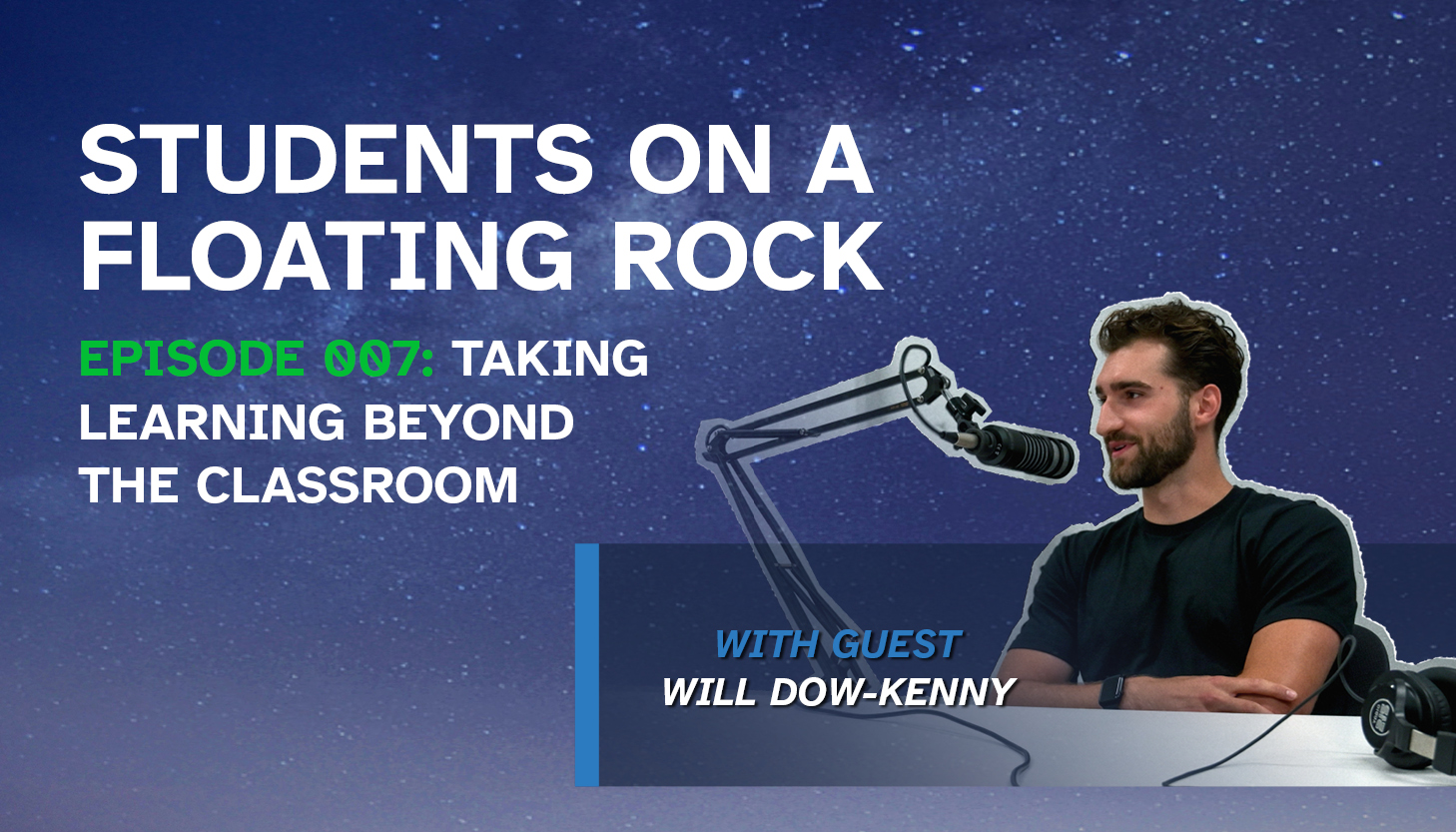
 On today’s episode we have Will Dow-Kenny, a neuroscience graduate from Skidmore College in Saratoga Springs, New York. He’s joining us today to talk about doing applied research, his experience as a student athlete, and his post-graduation plans.
Please note, this episode was recorded in summer 2025 and so minor details may have changed. Since the time of recording, Will has joined the Nijmegen Devils hockey team in the Netherlands.
Students on a Floating Rock is available to stream on your favourite podcast services — including Spotify, Apple Podcasts, Amazon Music/Audible, and more.
Powered by RedCircle
TRANSCRIPT
Students on a Floating Rock voice-over 0:00
From UFV’s changemaking hub, this is Students on a Floating Rock, a student-run podcast dedicated to—
Regan Smith 0:07
—um, I actually think I can take it from here.
Students on a Floating Rock voice-over 0:10
Umm, okay.
Regan Smith 0:11
So if I had to describe it, then it’s basically engaging with changemakers to learn about the skills and mindsets needed to navigate these horrific times on this floating rock, also known as Earth.
Regan Smith 0:25
On today’s episode, we have Will Dow-Kenny, a neuroscience graduate from Skidmore College in Saratoga Springs, New York. He joined us to talk about being a student athlete, doing applied research, and post-graduation plans.
Regan Smith 0:37
It’s our pleasure to have Will here as our guest today. Could you kind of give a little introduction of yourself?
Will Dow-Kenny 0:43
Yeah, absolutely. My name is Will Dow-Kenny. I’m from Abbotsford, and I went to, did my undergrad at Skidmore College in Saratoga Springs. I got to play hockey there as well, and this is kind of my first post-grad summer, so I’m going to play professional hockey in Europe next season, and then hopefully, kind of work towards my PhD in the future.
Regan Smith 1:04
Oh, nice. Okay, did you get a relaxing summer?
Will Dow-Kenny 1:06
Yeah. I mean, lots of training, but, yeah, it was nice.
Regan Smith 1:09
It’s always good to have a break.
Will Dow-Kenny 1:11
Yeah.
Regan Smith 1:12
Yeah, so we start off with an icebreaker. I kind of like this one. So if you could be the lead singer in any band, past or present, which band would you choose?
Will Dow-Kenny 1:20
I mean, there’s a lot of good, lot of good options here. Probably the lead singer AC/DC, always listen to it as a kid. When my mom and I would go to all my hockey games when I was growing up, that was always like “Back in Black” is what we’d be listening to on the way. So I think it’d be fun to experience that for sure.
Regan Smith 1:39
Oh, that’s a good one. I was thinking about mine, and I think mine would be the Jonas Brothers. I don’t know how that would work, just because, you know, not exactly a brother or anything, but yeah, I think it would be so fun, especially because I’ve been getting a lot of, they got a new album coming out, I think? Something like that. I don’t know. They’ve been doing a lot of media press, so I’ve been seeing a lot of it. So why not the JoBros?
Regan Smith 2:03
Okay, so I guess we’ll hop into our questions. Okay, so lots of universities are talking about innovation and changemaking. Do you think your experience at Skidmore prepared you to be a changemaker?
Will Dow-Kenny 2:14
Yeah, I think definitely. I think that was a big focus point at a lot of liberal arts colleges. I think one of the main focuses is being able to not only gain, like a foundational knowledge on whatever subject that you might be interested in, but then also being able to apply that in a real world scenario and kind of improve the environment that you’re in and leave it a better place than you started.
Regan Smith 2:38
Do you have, like, I guess I was looking on the website a little bit, and they talked about having, like, a lot of interdisciplinary sort of stuff. So you’re a neuroscience major, right? Did you, I guess, get a chance to take courses in different fields as well, or was it very like streamlined, focused on neuroscience?
Will Dow-Kenny 2:57
Yeah, absolutely. Especially in freshman/sophomore year, kind of starting out, you got to really kind of expand what you were interested in. I’ve taken, you know, I’ve been in a sociology class, social work. I’ve taken a couple anthropology classes. I mean, for a STEM major, I need to, obviously take biology and chemistry and then neuro and psych as well.
Will Dow-Kenny 3:16
But I got to really explore a bunch of different areas and kind of see different perspectives on the same topics, which is really interesting to me. I think probably my favorite one outside of the neuroscience major was probably my forensic anthropology class. It was very interesting to learn about, kind of how the post-mortem analysis kind of comes together and stuff like that. So, yeah, it was great.
Regan Smith 3:40
Okay, that’s kind of interesting. So through your university, you’re able to get opportunities of applied learning, which is something that’s highly valued here, especially at CHASI. Could you tell us a little bit about what your experience was like and what your future plans are regarding your education?
Will Dow-Kenny 3:57
Yeah, totally. Last, my last year, senior year, I got to go full time in a lab, working under Dr Hassan López, who was my academic advisor, and he was super helpful, kind of, I really wanted to go into behavioural neuroscience. That’s kind of what grew towards my passion as I kind of went through my undergrad years. And so I worked in his lab doing behavioural research with rodents.
Will Dow-Kenny 4:23
For our main project last year, we were working on pheromonal communication, so we were using a synthetic alarm pheromone and kind of investigating how the application of this might influence the sort of empathetic like behaviour of other rodents. So we had a trapped rat paradigm, where we would have one rodent in a kind of trapped thing, where the other rat would have to learn how to open a door to let it escape. And then the couple different variables were just we would use water for our control, and we use the pheromone to see if it would increase their latency to open the door, basically. So that was really cool.
Will Dow-Kenny 5:09
Last summer, just finishing my junior year, I was lucky enough to get an internship at the University of Florida’s neuroscience program, and that was really where I was focusing on addiction research, which was really, really interesting. I got to meet a lot of cool people in my program who I’m still friends with to this day, I still connect with as well. And we were basically focusing on relapse and how we would test these drugs on a couple different animal models and see if it would decrease their addictive behaviour basically.
Regan Smith 5:43
Okay, I have a few questions. So the first one, so rodents, they are, do they typically have a strong feel for like, empathy, like, are they typically empathetic creatures, or anything?
Will Dow-Kenny 5:54
They’re, yeah, I mean, they’re a lot smarter than I think people normally let on. I mean, when you think about rats or mice, like, you don’t necessarily think about using them to kind of influence different behavioural perspectives and things like that, but yeah, they have, they can definitely form bonds through different like neurotransmitters and things like that. And so it was one of my advisors interests of empathy, and it was kind of like a build off of projects of what they had done in previous years. We didn’t necessarily get the results that we wanted to. But there’s a couple different things that we’d hope to improve on and improve in the future, for sure.
Regan Smith 6:31
So you’re using pheromones, right to do that?
Will Dow-Kenny 6:34
Yes.
Regan Smith 6:34
How did you do that? Like, what? What kind of pheromones? And I guess, were they on both rats, or just the one trapped in the cage?
Will Dow-Kenny 6:40
Yeah. So we would actually apply it to a filter paper underneath where the trapped rat was. And basically we found a combination of two different kind of synthetic components, and we would combine them in the lab before testing. And we actually got it from a Japanese lab that was focusing on kind of empathy and altruistic behaviours. So that’s kind of how. It was more straightforward than it sounds. Honestly, you just kind of combine two chemicals and then apply it.
Regan Smith 7:08
Right, okay, so not too difficult.
Will Dow-Kenny 7:10
Yeah.
Regan Smith 7:10
Was this something that, I guess typically you get at Skidmore College, like this opportunity to do this sort of applied research?
Will Dow-Kenny 7:17
Yeah, I mean, it depends on the lab and what you’re focused on. I think for STEM majors, it’s definitely pretty important to kind of apply what you’re learning in a research, in a research way. A lot of the professors at my school did have their own labs. I mean, we had frogs, rats, mice, zebra fish. Fruit flies is a big one for neuroscience. You can do a lot of research with them. So, yeah, if you wanted to, there was definitely a lot of opportunity to do so.
Regan Smith 7:46
Yeah, I know here at UFV especially, I don’t know if you had this, but in first year bio, there’s this huge, like, fruit fly kind of sort of thing that we do where we, like, mix them up and they’re some of them have, like, I did this too long ago, like a gene defect. And, yeah, that was very cool to see, and especially now that I’m actually, like, in this other lab, there’s this big, like massive fridge where they’re all being, like, stored, I think? Actually, I can’t open it, but yeah, there’s definitely just the label of, like, fruit flies.
Will Dow-Kenny 8:18
Yeah, fruit flies are definitely, probably one of the favourites for working on, like, genetic research, because of, well, especially how short their lifespan is, you can kind of breed them to get a certain defect that you want to study, or something like that. So they’re definitely pretty prominent.
Regan Smith 8:34
Yeah, yeah. I think we did our whole research within like six weeks, I think, like, we sorted them too, and then they all mated. And then some of them had the gene defect, and we had to figure out which, if was it attached to the female, male, both. I don’t exactly remember everything, but yeah, it’s definitely, like, very cool to see that, though, in this first year.
Will Dow-Kenny 8:52
Yeah, totally.
Regan Smith 8:54
Okay. So then going on to when you did it, you went to Florida and you did research on mouse there. I guess starting off was that also another thing that was pretty hard to get into or?
Will Dow-Kenny 9:04
Yeah, that was, that was a very competitive process. I think I applied to maybe 12 or 13 different places, and then I had that opportunity to go there, and I was super excited about it. You know, I know a lot of people don’t necessarily get that opportunity because of how small the program size is. I think we had just over 20 people for that program, I think. But yeah, I was very thankful to have that opportunity.
Regan Smith 9:29
What was it the result of that research?
Will Dow-Kenny 9:33
So, yeah, that was an ongoing project in Florida that I was assisting with. I also did my own project. So the addiction research was with rats, and that was, they’re focused on kind of relapse and how to kind of stop that addictive behaviour. So we would, over the summer, we would get a bunch of different compounds from a chemist, and we would test them and then see if it would stop their lever pressing behaviour.
Will Dow-Kenny 9:58
And then I also did my own independent research using mice, and that was using ethanol, kind of with a focus on alcohol studies. Because one of the issues with alcohol rodent studies is that they’re, the validity of it is a little bit challenging to relate to human behaviour, because they don’t necessarily want to drink it on their own. So it’s like I was trying to increase their voluntary consumption to kind of improve the validity of future studies there.
Regan Smith 10:30
Yeah, that’s really interesting, too. Just like, I don’t know, you always see in the movies, too, that they do do scientific research on rats and mice and all that stuff, but you don’t actually know if it’s actually a true thing. But, yeah, that’s super cool. So you do plan, you said you were gonna go on to do, like, your master’s and PhD and all that.
Will Dow-Kenny 10:48
Yeah, I’d definitely like to do my PhD in neuroscience. I don’t necessarily know in what focus at the at the moment, I don’t think I’m in a rush to figure that out right now. I think I want to get a little bit more lab experience. And, I mean, I’m going overseas shortly, and I would love to hopefully get a job over there, kind of working in the lab, kind of gain that experience to prepare myself for graduate studies. But, yeah.
Regan Smith 11:15
Okay, awesome. That’s all really cool. Is neuroscience a hard field to get a master’s and PhD in?
Will Dow-Kenny 11:22
I think if you’re dedicated, it’s really about, like, time management. And if you, for me, it’s not necessarily something I would say is, like, overly challenging, but it is very time consuming. I’m lucky enough to be very passionate about it. So the homework and the external research, I don’t necessarily consider to be work. It’s just, it’s very interesting to me, and I love gaining the knowledge that that provides me. So I think for somebody who would be interested in getting into it, you kind of want to be prepared that it’s going to hit you really hard at first, but you will eventually get into a flow of it, and you’re gonna know pretty quick whether or not it’s something you want to pursue.
Regan Smith 12:06
Yeah, I did my first year in wanting to do neuroscience, but then I took a psychology class, and I decided it wasn’t for me. So now I’m in environmental studies, so bit of a twist. So just kind of like an off question, but so you did, you went to school in the States, do you, I guess, I don’t know if you really know how school universities work here, but I guess you have an idea. Was there much of a difference you notice of anything?
Will Dow-Kenny 12:33
Um, yeah, hard to say, because my personal experience, I haven’t really taken any courses here, although I did take one course with my mom.
Regan Smith 12:41
Oh really?
Will Dow-Kenny 12:42
Yeah, a couple, a couple summers ago, I took a SOC 101 class with her, which is, which is really fun.
Regan Smith 12:47
just for the fun of it?
Will Dow-Kenny 12:49
Yeah. I mean, it was just also just to kind of lighten the load a little bit when I was going into, I think it was my second year, but, yeah, I loved my experience in New York. It was, it was a lot of fun. And there was so many resources that I like if I needed help with anything, like, in the classroom, outside of the classroom, Skidmore was always very welcoming to help. So, yeah.
Regan Smith 13:11
Yeah, I guess that takes us into our third question. So did the campus offer a lot of resources when you’re trying to, like, juggle academic, athletic, and I guess also your lab work, because that was another load added on. Were there many resources? Was that something easy to do?
Will Dow-Kenny 13:28
Yeah, definitely challenging being a student athlete, I think definitely in the freshman/sophomore year, it’s kind of, it’ll kind of come in waves, obviously, with midterms and finals and things like that, but there was always a lot of resources that we could use, I think our or our athletic coordinator, Gail Cummings, she was, I gave her huge praise for being able to juggle everything that she does. And even, I think by my third year, I think she knew everybody by their first names and the whole student athlete body. So she was amazing.
Will Dow-Kenny 14:04
And we also had, we have something called Student Athlete Committee, so SAC, and that is kind of, we have one or two representatives from each team, and they kind of get together on, I think it’s a weekly basis, kind of, kind of talk about what they can improve and how we can kind of help their student athletes. And so that’s something that’s really cool as well. Even if you’re not a student athlete, we have Peer Academic Coaching (PAC), which any student if they want to can get involved with. It basically runs, I believe it’s Sunday through Thursday, every night. It’s every major has their own PAC basically, and go there, and it’s just kind of free tutoring, and it’s, it’s a good way to network and kind of get to know your your fellow classmates in your major as well.
Regan Smith 14:50
Oh, nice. That’s really cool, like just having a space to do that. I think we need that here.
Regan Smith 14:59
So Martha mentioned to us something about, maybe you can correct me if I’m wrong, but getting credits for going to an academic tutor, for being an athlete, like getting, like, academic credits?
Will Dow-Kenny 15:16
Oh, she may be talking about PAC. If you’re—
Regan Smith 15:18
Oh is that PAC?
Will Dow-Kenny 15:19
—if you’re, if you’re a PAC leader, you—
Regan Smith 15:21
Oh okay, okay.
Will Dow-Kenny 15:21
—it’s kind of a part time job. Is also you get an income, okay, but you also get, I think, for your first semester doing it, you get three credits, and then every semester after that, you get an additional credit per semester that you do it.
Regan Smith 15:34
Oh, okay, did that like, really, like, I mean, I don’t know, did you do PAC?
Will Dow-Kenny 15:38
I wasn’t a PAC leader, no, but I definitely took advantage of going there and kind of—
Regan Smith 15:42
Yeah, yeah, yeah, being part of it. Okay, that’s nice.
Will Dow-Kenny 15:45
Yeah.
Regan Smith 15:45
So it looked, seemed, from what you’re telling me, Skidmore seemed like it had a really nice like culture and good campus to be around.
Will Dow-Kenny 15:52
Yeah, definitely.
Regan Smith 15:52
Do you mind if I ask you a few questions about your hockey career and everything?
Will Dow-Kenny 15:56
Yeah, totally.
Regan Smith 15:56
So I guess, how did that, how did hockey go in Skidmore? Was it, how was your team? How’s all that?
Will Dow-Kenny 16:02
Yeah, I loved my experience. I kind of got recruited out through Covid. So it was during, I was playing junior hockey, which the vast majority of college hockey players do. They take a couple years after high school and play juniors, and I got recruited during Covid, so we weren’t necessarily playing games, but I think my coach at Skidmore, got in contact with my coach in Langley. I was playing for the Langley Rivermen at the time, and I ended up committing there. Actually, I ended up convincing my best friend to come with me as well.
Regan Smith 16:36
Oh no way.
Will Dow-Kenny 16:36
So, so yeah, we played together for the last six years, which has been awesome.
Will Dow-Kenny 16:40
Yeah. I mean, when we came in, we were kind of middle of a pack team, and we had 13 freshmen of the basically 30 guys on our team. So we had a huge freshman class just kind of with big changes coming out of Covid, like there was a bunch of changes to basically every team. So my class got very close, very quickly, and we all stayed together, I mean, until senior year, I think we graduated with, with all of us, basically. So it was kind of like our little family away from home, I think. I mean, we had a bunch of Canadians on our team, and then people from all over the states. So it was really nice to kind of come together.
Will Dow-Kenny 17:17
And it was, it was also a great opportunity to, obviously, there’s the workload can be pretty daunting. Doesn’t matter what major you’re in, and just being able to do that together with people on a team, like, if you have, like, a bunch of assignments to do, you can just go do it with, you know, 7/8/9 guys on your team, and you kind of get it, get it all done together, and it makes it a lot easier. So that was great. And I think we finished off making it to the finals three of our four years there. I think our class graduated as the winningest class in Skidmore history for hockey. So, yeah, we’re really proud about kind of what, kind of what we left there.
Regan Smith 17:40
Do you get a banner for that? Like a trophy?
Will Dow-Kenny 17:47
No, yeah, no second place banners unfortunately.
Regan Smith 17:56
Darn! Yeah, I definitely, yeah, I haven’t been able, I didn’t do sports in university, but my brother plays, played football at Western and he definitely says the same thing about, like, how it’s definitely, it’s a hard thing being, like, juggling the both of it. But like, if you have that kind of community, and especially all the resources, they definitely make a difference in, I guess, excelling in your academic career as well as your sports career.
Will Dow-Kenny 18:27
Yeah, absolutely.
Regan Smith 18:29
Okay. So final question, we kind of ask everybody this one. If you were to give a one minute TED Talk on the change that you want to see in regards to university education, what would you say?
Will Dow-Kenny 18:41
That is a good question. Kind of thinking about, like higher education, and whether it’s undergrad or going on to do your your graduate studies, I think probably the biggest difference between that and high school, or at least what it should be, is the less being focused on what your actual grade is, whereas, I think like in high school, like you’re probably just trying to get from grade 10 to grade 11 and grade 11 to grade 12, and, you know, hoping to get A’s so that it’ll help you get to a better college and things like that.
Will Dow-Kenny 19:10
I think when you’re in your undergrad studies, and you get to really kind of take what you want to take and do what you’re passionate about, I think one of the main focuses should really be kind of the knowledge that you’re gaining and how you can apply it to a real world scenario. And after college, rather than just trying to get, like, above 90% or like, get an A or something like that. And I think a lot of schools do a really good job about that, and a lot of schools maybe it’s course to course, it can depend on the professor, but I think the most helpful classes that I’ve been able to take as much from have been the classes that the grades don’t matter as much. It’s more so about the discussions that you’re having in class, and kind of what the knowledge that you’re gaining and how you’re going to be able to use that knowledge to be successful after school.
Regan Smith 20:05
Okay, that’s really wise words. That was a great one minute. So yeah, it was a pleasure having you on.
Will Dow-Kenny 20:10
Yeah. Thank you so much for having me.