
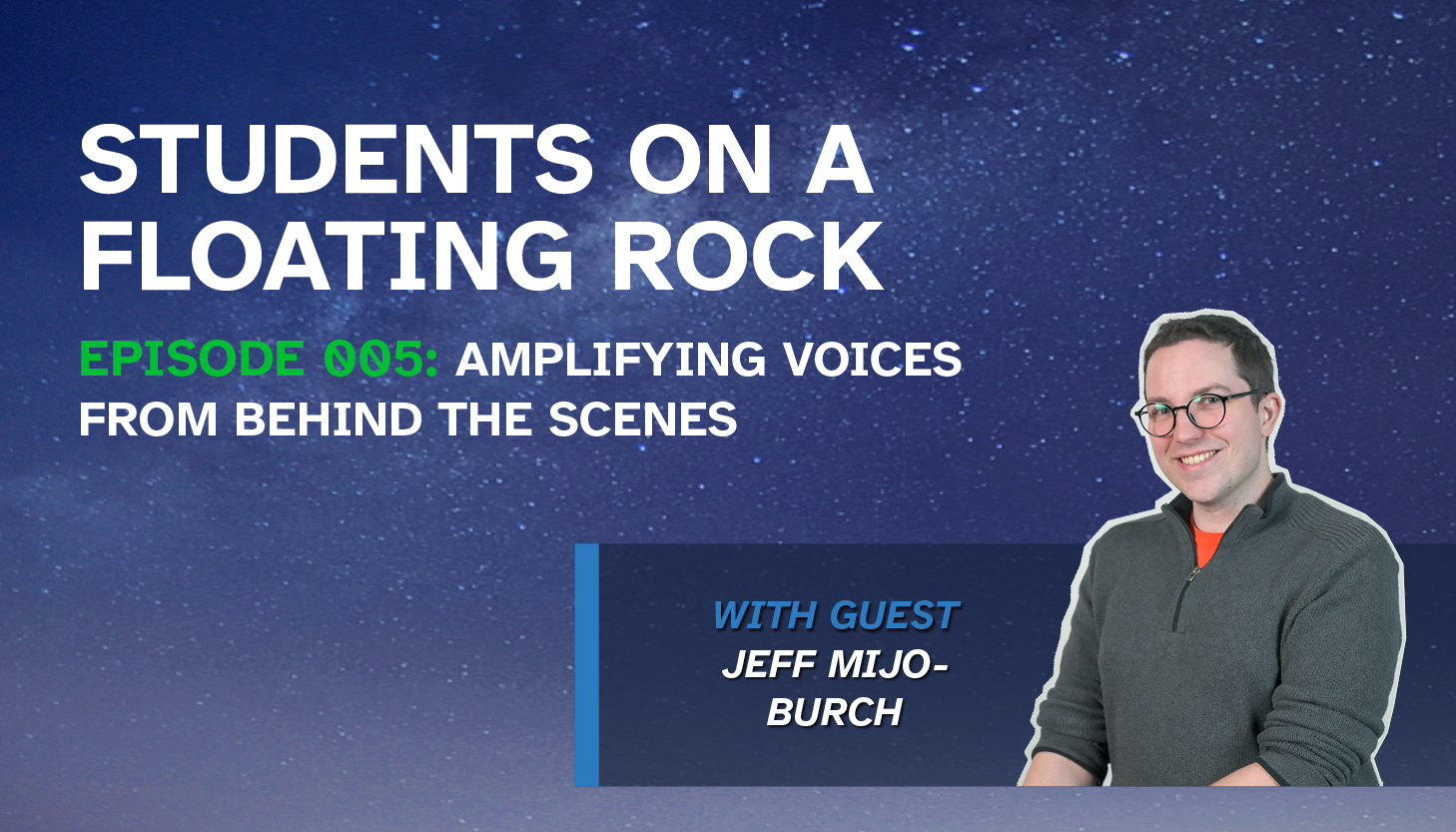
 On today’s episode we have Jeff Mijo-Burch, University of the Fraser Valley alumni and CHASI Communications & Design Specialist. He’s joining us today to talk about his academic and career journeys, amplifying and uplifting marginalized voices through knowledge mobilization, and opportunities for growth by utilizing effective communication.
Please note, this episode was recorded in summer 2025 and so minor details such as dates have changed since the time of recording.
Students on a Floating Rock is available to stream on your favourite podcast services — including Spotify, Apple Podcasts, Amazon Music/Audible, and more.
Powered by RedCircle
TRANSCRIPT:
Students on a Floating Rock voice-over 0:00
From UFV’s changemaking hub, this is Students on a Floating Rock, a student-run podcast dedicated to—
Regan Smith 0:07
—um, I actually think I can take it from here.
Students on a Floating Rock voice-over 0:10
Umm, okay.
Regan Smith 0:11
So if I had to describe it, then it’s basically engaging with changemakers to learn about the skills and mindsets needed to navigate these horrific times on this floating rock, also known as Earth.
Regan Smith 0:21
On today’s episode, we have Jeff Mijo-Burch, a UFV alumni, pug dad, and CHASI Communication and Design Specialist. He’s joining us today to talk about uplifting the voices of activists and advocates from behind the scenes, and how he leads with empathy in the workplace.
Regan Smith 0:42
It’s a pleasure today, we have our infamous Jeff on the podcast, our lead knowledge mobilization guy. Yeah, I guess did you want to introduce yourself a little bit?
Jeff Mijo-Burch 0:53
Yeah, absolutely. So my name is Jeff Mijo-Burch. I’m the Communications and Design Specialist here at CHASI. I’ve been working here for almost five years. So have gotten to have my hands on a whole bunch of different CHASI projects, and have gotten to see as changemaking has kind of evolved and grown alongside CHASI these last few years.
Regan Smith 1:15
Yeah, I’ve worked with you for two, almost two years, I think, yeah, yeah, uh huh. Yeah so I guess we’ll start off with our icebreaker, as I always do. This is a good one. I was, I was really, I had mine right away. So I’m just curious what yours would be, but it’s what’s an underrated kitchen gadget or appliance?
Jeff Mijo-Burch 1:33
Okay, so underrated. I don’t know if it’s something people think about a lot, so maybe it is. I recently got a, one of those stand cheese graters with the crank, because I kept buying, like, pre-shredded cheese, and it’s expensive, and I also kept getting bags with mold in them, and got very frustrated with that, so I just spent $20 and got myself a stand one, and it’s so nice. It can just tread a whole block of cheese in like five minutes. And it is so much easier than trying to, like, rub a piece of cheese on one of the, like, manual graters, yeah, so.
Regan Smith 2:14
Yeah, that’s what I have right now.
Jeff Mijo-Burch 2:16
It’s been life changing.
Regan Smith 2:17
Oh my gosh, okay, well, I guess I might have to invest in that, because I have one of those stand ones right now, and it’s, it hurts eventually, and then your fingers too.
Jeff Mijo-Burch 2:26
Yeah, the end of the brick when you’re just scraping yourself.
Regan Smith 2:28
Uh huh, I mean, at that point I’m just, I’ll just eat it.
Jeff Mijo-Burch 2:31
Yeah.
Regan Smith 2:31
But yeah, mine was, the one that I thought, was an iron pan. Just thinking back to, you ever watch Tangled?
Jeff Mijo-Burch 2:39
It’s been a while.
Regan Smith 2:41
Well, she has, like, an iron pan weapon. So that’s what I’m thinking, underrated, multi purpose kind of tool, great self defense, like, that’s what she uses. And I’m like, I think…
Jeff Mijo-Burch 2:51
That’s very useful.
Regan Smith 2:52
Very heavy.
Jeff Mijo-Burch 2:53
Yeah, it’s good, cast iron.
Regan Smith 2:54
Yeah, hit to the head, done. Okay, so I guess we would start off. So could you tell us a little bit about your journey—you started as a UFV student, and now you’re a staff—and what that has kind of been like?
Jeff Mijo-Burch 3:05
Sure. So I started at UFV, like you said, as a student in September 2016. So I guess I’m coming up on ten years, nine years, I did a Associates Degree in Media and Communication Studies over the course of three years ’til 2019, and that was, it was a really great program, like I learned so much interesting theory. And then I, my original goal was, I want to work in marketing, maybe like social media, something in that kind of realm.
Jeff Mijo-Burch 3:36
And I graduated, and I worked in a full time kind of corporate place for like six months, and I found it was really not right for me, that job, but also like I felt like I wanted to get some more of the practical hands on skills to do creative work. So my graphic design skills for example, I knew the basics. I knew how to use the programs, but I couldn’t make something that actually looked really good.
Jeff Mijo-Burch 4:07
So I decided to come back to UFV in 2020 and the timing worked out great, because I know that job would have ended with Covid anyway. So I came back and did a Bachelor of Media Arts, which laddered nicely from my previous degree. So I was able to do that 2020 to 2023, and that was a lot more hands on, a lot more graphic design, web design, video, all that stuff that I had always enjoyed but now actually had like the language and the proper training to do correctly.
Jeff Mijo-Burch 4:35
Throughout all that, I got a lot of hands on experience. I worked at UFV’s newspaper, The Cascade. I actually interviewed for a job there before my first day of classes, because I knew I wanted to work there. Yeah.
Regan Smith 4:49
Ambitious, nice.
Jeff Mijo-Burch 4:51
And they were short on staff. So I got hired straight to being an editor. So I worked there throughout my whole time as a student, which was amazing, like such a good experience of getting that hands on, practice of building my portfolio. I did a lot of editing. I ran their website for years, social media, so was able to kind of hone those skills, see what I enjoyed, see what I didn’t enjoy.
Jeff Mijo-Burch 5:13
And then around when I started my second program, towards December 2020, I stumbled acrosss CHASI. There was just a posting on social media looking for a social media intern. And I knew some people who knew some people who worked here and had said good things, so I applied, not really knowing too much about it. Within a few weeks, I was working a few hours a week doing social media, and it’s just kind of grown and grown from there.
Jeff Mijo-Burch 5:41
Social media turned into getting to work on some really cool video projects. I started to take on some more design stuff as my classwork started to focus more on design. And then when the person who was in the lead knowledge mobilization role at the time left that role, I was able to step up into it, and Martha, our director, offered that once I graduated, I’d be able to stay on full time, which has been amazing, like to just have this position kind of grow with me and to grow into it and make a lot of really good connections.
Jeff Mijo-Burch 6:14
And it’s been really clarifying as well. I mentioned that I started out looking at marketing and social media. And I’ve really discovered I enjoy more of the visual communications side. Social media, I can do it, but it’s not like, it’s not something I’m a fan of using personally too much. So I don’t think I wouldn’t want to be social media 24/7.
Jeff Mijo-Burch 6:36
So there’s been such a really great diversity of projects, diversity of skill sets I get to use, and then also, as I’ve grown in the position, getting to have something of a leadership role and a mentorship role with so many awesome students who have come in and brought their own different skills, and kind of working with them to shape their projects has been amazing, so.
Regan Smith 6:56
Yeah, so I guess working your time here, you got to work, I know especially since I’ve worked with Martha as well, she’s quite a big like advocate and activist, and you said you really love to, that’s something you’re passionate about, is amplifying those voices, kind of working behind the scenes. Could you tell us a little bit what that has consisted of?
Jeff Mijo-Burch 7:16
Yeah, that’s something I really found working at The Cascade, because so much of my work was editing, so it’s helping people with different experiences kind of tell their stories in a clear way. I was the Opinion Editor for a long time, so it was a lot of people talking about very personal things they’ve gone through or very deeply held beliefs, and trying to help them make a convincing case, explain their situation or their understanding of something in a way that I wasn’t, I wasn’t injecting myself into that opinion.
Jeff Mijo-Burch 7:53
And that’s a tricky balance, especially working in a newspaper, you don’t always agree with all of the opinions you’re editing, but especially when it was people like you mentioned, advocates, activists, people who are passionate about different justice issues, social justice issues, helping those points get across clearly to an audience, to connect them with the audience. That’s something that I find, I find really valuable.
Jeff Mijo-Burch 8:21
And CHASI’s just clarified that. I enjoy being the person who is not the focus. I like to be behind the scenes. I hold my beliefs on, like equity very deeply, but I also understand I’m not the best person to be on the front line speaking about them. Both because I don’t have the same lived experience as a lot of people, but also this podcast is a rare occasion where I am in front of the camera, the microphone, like I’m not someone who puts myself out there to speak.
Jeff Mijo-Burch 8:52
It’s not my go to mode, but I do have communication skills. I enjoy editing other people’s words to help convey that message, but also using videos or graphic design to kind of highlight the key points, draw attention to it, connect that that message with an audience that it might resonate with, and help it resonate.
Regan Smith 9:14
Yeah, that’s really cool. I didn’t, I guess I kind of when I was forming this question, I kind of assumed it would be around CHASI. I had no idea, though, about, like, The Cascade piece, which, I guess it’s something I never thought about too of like, oh, as an editor, you also have to, I guess, that kind of skill of editing people like amplifying their voices, making sure they’re getting it out in the right way, but also just keeping it their own and not injecting yourself too much.
Jeff Mijo-Burch 9:40
Yeah, it’s a delicate balance, like it is a lot of power. And I think if you’re not careful, you can just turn it into the your opinions section, as opposed to collecting other people’s and showing different views of a subject or different subjects.
Regan Smith 9:57
Yeah, no, that’s really cool. So I guess in line with your passion of amplifying voices, you also make a practice of leading with equity, like you mentioned, and empathy. So what does that kind of look like in your academic, professional or personal life?
Jeff Mijo-Burch 10:12
So I have to give a shout out here to my wife, Danielle, who has been around CHASI a few times and is wonderful. So she has a degree in Ethnic, Gender and Labour Studies that she completed before I started at UFV. So a couple of years of talking with her about all of those issues and kind of working through in my early 20s an understanding of social justice and like expanding my fairly narrow experience that I’ve lived through, to how these, all of these issues intersect, and really digging in deeper than just kind of the talking points that get repeated on social media, whatever the topic of the day is. So I think I came into this world of UFV with a good understanding of my privilege and how that like influences my understanding of the world.
Jeff Mijo-Burch 11:11
And I like, people think of privilege, like as a kind of a boogeyman word, sometimes it definitely gets demonized. I am a straight, white, cis male. I have certainly had hardships in my life, but those are not because of those identities, and I know that people that have marginalized identities are going to have additional hardships that are piled on and compound each other because of the way society treats them. So I do try to keep that in mind and be mindful of the space I take, the way I present myself and speak, and I think that feeds into the amplifying, like we talked about. I don’t want to be the one speaking over anyone talking about their experiences.
Jeff Mijo-Burch 12:00
I also think one of my superpowers, for lack of a better word, I think I bring kind of a calm energy, but kind of marry that with a deeply held belief in these social justice issues. So I, like, in a lot of conversations, I can be the person to think or to bring up, how can we frame this strategically for the most impact, but in a way that I’m mindful I’m not muting the point. I’m not like, “ooh, maybe we shouldn’t talk about that. It might be a touchy subject.”
Jeff Mijo-Burch 12:39
I think when I’m talking about like empathy and equity, I try to understand how deeply these injustices cause harm, hurt people, but I also understand I don’t feel that as deeply, because I don’t have that experience. So just leaving space for people to be mad and have those strong emotional reactions and then trying to be that person to say, “okay, how can we channel that into a way that’s going to have an impact without mitigating anything you’re saying?”
Regan Smith 13:17
Yeah, I’ve definitely, I noticed, I mean, just working with you, you do have such a calm energy, and it’s really nice, especially I guess when, like, I guess I’m in my early 20s, so I’m still, like, figuring everything out, and like empathy too, and everything like I get, I guess sometimes I’ll get like, emotions, and I’ll get like, really strong I’m like, oh my gosh, but yeah, that empathy piece is also something I like work on, I guess, of also seeing people from different perspectives and like what they can do. And I just want to say I admire how you do lead with empathy.
Jeff Mijo-Burch 13:53
Thank you.
Regan Smith 13:53
And I definitely notice it.
Jeff Mijo-Burch 13:55
Oh, thank you. No, and I mean, I think I’ve seen like you said, we’ve known each other couple of years now, I feel like you’ve really grown into speaking your values and finding your space, just in that time I’ve known you. So I think, I appreciate the work you’re doing to think about that stuff. And I think like it’s an ongoing thing, you know, I’m in my early 30s now, I absolutely do not have it all figured out, but it is just something you keep working at. And I think as long as you’re putting in that effort and are able to see when you made a mistake, own that you made this mistake, apologize, move on like people will leave have grace for that if they understand you’re truly trying to learn.
Regan Smith 14:37
That’s such a great thing. So I guess last question to wrap it up, we always do this. If you were to give a one minute TED Talk on the change that you want to see in regards to your work and experience, what would you say?
Jeff Mijo-Burch 14:49
That’s a very like there’s so many ways I could go with that. I think about here at UFV, there are so many departments that are doing so much important work. And I know everyone kind of feels like their work is the most critical, because we’re seeing day in and day out, the effects of it, the impact. So we have so many different departments, and it’s tough to know sometimes even exactly what their function is, even though we understand they’re important. But there’s over 1000 people, I think, working here.
Jeff Mijo-Burch 15:22
So I would just love to present some sort of how to communicate what it is you do and why you do it in a way that you’re pulling out all of like, the jargon and buzzwords and just clearly explaining this is the purpose of, you know, this is why CHASI exists. This is why we do what we do. This is who it impacts. This is how we do it, and this is why it matters. And I feel like that’s such a big systemic issue in every organization.
Jeff Mijo-Burch 15:56
I mean, even at The Cascade, it’s a much smaller space, we when I was there had maybe 20 people, but it’s still, you know, you have your graphic designers over here, you’ve got your writers here, you’ve got your business manager over here. And if those people aren’t all talking to each other, aren’t all really understanding each other’s roles, it can be a way that, you know, resentment or tension builds up, or just things don’t get communicated in a way that would be really helpful for everyone to do their jobs better.
Jeff Mijo-Burch 16:27
So, yeah, I think just some clarity of organizational structure and purpose of all of the work that everyone’s doing, because I think 99% of people are trying to do their best, and would be happy to work with you. There’s just missing pieces in the how and the when and the why. So, yeah.
Regan Smith 16:52
Yeah, that’s something I’ve noticed is super important, just, especially just, I guess I’m learning more about all the different departments, and I had different meetings with some of them too, and the stuff that they do sounds really cool and everything, but it’s like, oh, I had no idea you were working on that for like, a year or something. And it’s, I mean, glad to hear it now. But yeah, if the I guess, communication piece would be something that, if that could be, like, airtight, pretty good.
Jeff Mijo-Burch 17:19
Yeah, absolutely. My first program. I think I would have loved to get involved in some sort of research in a CHASI kind of space, or working as a research assistant for a professor, but I just didn’t know how those opportunities existed at that point. And I know that’s still the case with a lot of people throughout their educational journey through their work.
Regan Smith 17:42
Yeah, no, I had, I brought, brought the bumblebee research. I work with two people, and they do bumblebees, we collect them. I brought them into CHASI though, when someone brought their kittens in and when they left, they’re like, “oh, I no idea that was there.” And I’m like, “yeah, it’s been there for around five years”. I’m like, well, yeah, they’re like, “no, that was cool place. Never knew it was there.”
Jeff Mijo-Burch 18:02
Yeah, no, it’s, it’s like, there’s so much awesome stuff happening. And this is maybe a bit of a tangent, but I know there’s the reputation of, like, people talk about it being a commuter campus, or there’s not a lot going on, but there are events almost every day if you know where to look. It’s just getting that awareness, making sure people know that they can look because there is stuff happening.
Regan Smith 18:24
Yeah, I read a really great article that you wrote about that. I think it was, it was based off of, I think you went to a sporting event or something, yes, and then that piece was tied into it. And I’m like, oh, yeah. Actually, that’s true, yeah. So communication.
Jeff Mijo-Burch 18:40
Yeah, yeah. It’s just like, even if, like, I am not a sports person, but a bunch of us at The Cascade went to a basketball game, and it was really fun. And it’s just that building that community and knowing that that’s there, and, oh, as a student, I can just go to basketball games if I want to.
Regan Smith 18:57
Yeah? Why not? Awesome. So, Jeff, it was a pleasure having you on here. Yeah, learning the importance of communication and all these skills, I guess, interpersonal, personal skills, whatever the word is, that you’ve gained and it’s yeah, it’s really cool. Great to have you on.
Jeff Mijo-Burch 19:13
Awesome. Thank you so much for having me.