
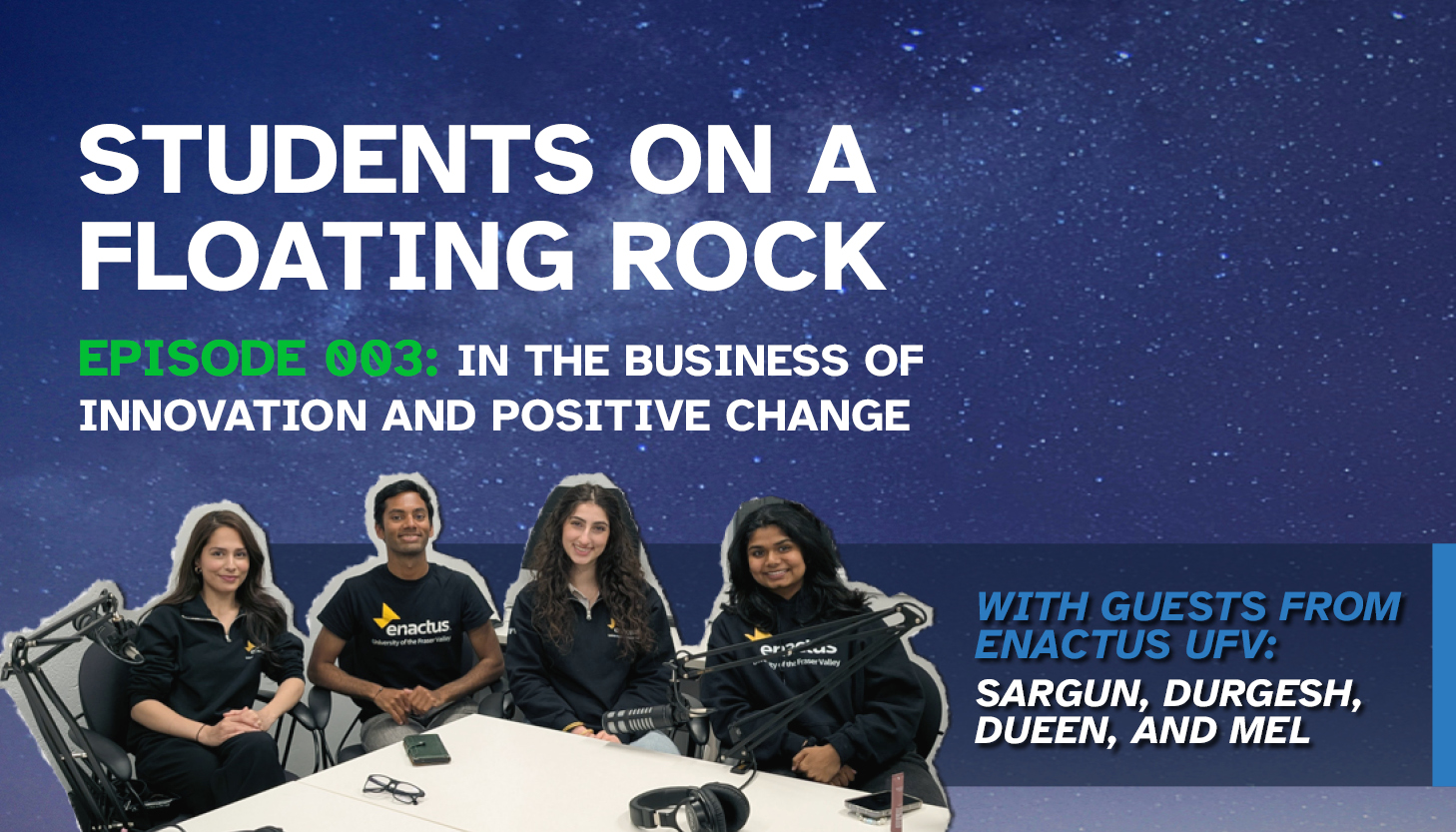
 On today’s episode of Students on a Floating Rock, we are happy to have Durgesh, Dueen, Mel, and Sargun of Enactus UFV as our guests. They joined us to talk about what Enactus is, the variety of projects they’re working on, and their experiences at the 2025 Regional and National competitions.
Learn more about Enactus UFV at ufv.ca/business/enactus-ufv and follow them on Instagram @_enactusufv_
Students on a Floating Rock is available to stream on your favourite podcast services — including Spotify, Apple Podcasts, Amazon Music/Audible, and more.
Powered by RedCircle
TRANSCRIPT:
Students on a Floating Rock voice-over 0:00
From UFV’s changemaking hub, this is Students on a Floating Rock, a student-run podcast dedicated to—
Regan Smith 0:07
—um, I actually think I can take it from here.
Students on a Floating Rock voice-over 0:10
Umm, okay.
Regan Smith 0:10
So if I had to describe it, then it’s basically engaging with changemakers to learn about the skills and mindsets needed to navigate these horrific times on this floating rock, also known as Earth.
Regan Smith 0:25
On today’s episode, we have Durgesh, Sargun, Dueen and Mel of UFV’s Enactus group. This truly is a funny group. They’re joining us today to talk about Enactus and their experience at the 2025 regional and national competition.
Regan Smith 0:40
So it’s a privilege to welcome our four lovely guests here today. We’re pleased to have you. So thank you for joining us, and if you guys could just go around, introduce yourself. So just your name and what you’re studying at UFV.
Dueen Meer 0:52
Thank you for having us. So my name is Dueen and I am in my fourth year now and studying a BBA, majoring in finance.
Sargun Gill 1:02
My name is Sargun. I’m also in my fourth year studying BBA and majoring in HR.
Mel Miskin 1:08
My name is Mel. I recently just graduated from the Bachelors of Arts, and I did my major in psych and minor in business.
Durgesh Chitre 1:19
Hi everyone. I’m Durgesh Chitre, and I’m a post baccalaureate student specializing in international business.
Regan Smith 1:26
Yeah. Okay, so I guess we’re gonna start off with our little icebreaker, which we’ve already talked about a little bit. So you guys are all prepared, but we thought it would be fun if you could just do a fun fact about someone else in the group. So if you just want to say, I guess who the fun fact is about, and then just say the fun fact.
Dueen Meer 1:43
Durgesh has lived in three different continents and four different countries. So I think that’s pretty cool.
Regan Smith 1:49
What are the continents and countries? I’m curious.
Durgesh Chitre 1:52
So I can mention that I’ve lived in the Middle East, I’ve lived in Australia, and I’ve lived in North America, and the countries are Bahrain, Dubai, Australia and Canada.
Regan Smith 2:04
Do you have a favorite? Not to put you on the spot or anything.
Durgesh Chitre 2:08
It’s between Canada and Australia for now.
Durgesh Chitre 2:10
A fun fact I’ve noticed and realized about Dueen, since the moment I’ve met her and we became friends instantly, is that she is the most outgoing and fun person from her family, but at the same time, she’s also very true to her heritage, so she’s like the best of both worlds.
Dueen Meer 2:31
Thank you.
Sargun Gill 2:34
I’ll say a fun fact about Mel, which I think is so, so cool. She has a black belt in Taekwondo, so that’s very, very cool, yeah.
Regan Smith 2:44
I tried to get that. I stopped at the white belt, though, I think that’s the one you’re just given.
Mel Miskin 2:50
It’s okay, it was a struggle.
Regan Smith 2:53
It looks hard.
Mel Miskin 2:54
I’ll go next. My fun fact is about my dear friend Sargun, and her fun fact is that I will say that she is one of my most organized friends ever, but also the fact that she loves Disneyland, and she goes to the one in California, and she’s been there twice in the span of six months and in the best times as well, because she went in December and then she went in the summertime as well. Yeah, and I’m hope—we’re hoping to all go to Disneyland soon together.
Durgesh Chitre 3:33
Manifest it!
Sargun Gill 3:34
Enactus Disneyland, yeah, best trip of my life.
Regan Smith 3:37
Gotta do that for CHASI. Okay, so I guess we’ll start on asking the questions. But I mean, so do you want to first do your positions on what you are in Enactus?
Sargun Gill 3:50
Okay, so I’m the president of Enactus UFV. I’ve been with Enactus for about two years now, over two years, and I started as a general member, then project manager, then Vice President, and now President since September of last year.
Durgesh Chitre 4:02
I started with Enactus since June of last year, I started as a general member, and since then, I’ve been to the competitions this year, both of them at regionals and nationals. And since the competitions, I’ve also become, I was part of the marketing team. I’m the Marketing Coordinator, but additionally, I’ve taken up the responsibility and role of Alumni Relations Manager as well. So yeah.
Dueen Meer 4:27
I’ve been with Enactus for almost a year, and during that time, I’ve been able to take the responsibility of one of our newest projects called Junior dragons.
Mel Miskin 4:40
So my role, I’ve been in my role for around a year, almost. Well, I recently graduated, so I’m now the alumni advisor for Oak and Earth, but I’ve been with Enactus for around two years. I started out as a general member, and then I was the project manager of Oak and Earth. And now that I’m graduated, I’m happy to be with them as an alumni advisor. Yeah.
Regan Smith 5:03
I bet we’re gonna get into probably a little bit of the projects that you guys have spoken upon and all that good stuff. But yeah, I guess I’ll ask the first question. So could you explain to us a little bit about what Enactus UFV is?
Sargun Gill 5:16
Yeah, so Enactus UFV is a student-led organization, and what Enactus essentially is it’s a part of a global network. Enactus is a global organization that really empowers students to contribute towards social, economic and environmental, you know, like creating solutions for those, those aspects through entrepreneurial action. So at Enactus UFV, we have a couple of projects that we run that kind of contribute towards different challenges that the society faces and that our community faces. So from environmental sustainability to financial literacy, you know, we’ll get more into our projects, but that’s, that’s a little bit about what Enactus is and what Enactus UFV is.
Sargun Gill 5:57
Through our competitions and through being part of Enactus, you kind of get to see what real world business looks like, and get more exposure into into real world business. So we go to these competitions. We network with industry professionals. We get to present our businesses. We get to start our businesses. So we manage our businesses, the finance aspects, marketing, stakeholders, partnerships. So you get to have, you get to learn a lot of real world technical skills as well, soft skills through, through being a part of Enactus.
Regan Smith 6:25
Do you also get the ups and downs of what it is like to run a business or be partners with other businesses?
Sargun Gill 6:30
Oh, absolutely, absolutely. I’m sure we’ll get more into it. One of our biggest businesses, biggest projects, Oak and Earth. It’s a candle business. So we have, you know, our own product line, and we have partners, and we have, you know, we run into many, many challenges, financial challenges, or just overall challenges with, like our products or materials and whatnot.
Sargun Gill 6:53
So, yeah, it’s like actually running a real business. So whoever the project manager of Oak and Earth is, for example, they handle the day to day operations of that business. So talking to partners and stakeholders, creating new partnerships and reaching out to new businesses to see if we can have our products kind of be available at their storefront. So, yeah, many, many challenges, but we, we, you know, with a very good support system from our faculty advisor and just, you know, the industry professionals that we have connections with. We tend to tackle them pretty, pretty well. I would say, yeah.
Regan Smith 7:25
Wow. So you guys are, like, full time students, or just even students, at the very least, yeah, and you’re running a business, that’s so cool. Okay, so what are the community outreach programs that Enactus has initiated, or, I guess, like the businesses, yeah.
Durgesh Chitre 7:41
Currently we have three active projects that have been going on since last year, and our youngest or newest project, JD, Junior dragons, has just started from mainly this year onwards, I believe?
Dueen Meer 7:54
Yeah, like we are trying to actively launch it, and we’re in touch with different schools.
Durgesh Chitre 7:59
We’re navigating, but we’re trying to make it equally as successful as well, and basically, with all of our four projects, what we’re trying to do is that, in terms of our community outreach, we’re trying to definitely empower today’s youth, and we’re trying to support local businesses and Indigenous businesses, and also give back to the community in every which way possible. And to help us with doing that, we do it in accordance and guidance with the 17 UNSDGs, which are, the United Nations let out Sustainable Development Goals.
Durgesh Chitre 8:34
And so, for instance, for with some of our projects, like with BBLP, which is the Big Brain Literacy Program, we’ve managed to, and with Junior Dragons as well, we’ve managed to come up with like solutions which have catered towards achieving, say quality education or even good health and wellbeing. And with AgroConnect, which is another project of ours, which deals with agriculture related products and stuff like that.
Durgesh Chitre 9:02
So it’s the agriculture industry, for sure, that helps with, you know, sustainable cities and communities and stuff like that as well. We’re definitely focused on all of these 17 SDGs, and we’re hoping that through our volunteering and through our unwavering commitment and dedication, we are gonna be able to tackle a lot more development goals as well. And, you know, give out as much more than we actually are at the moment, but it’s moreso with, you know, youth empowerment and support and stuff like that. So, yeah.
Regan Smith 9:36
So you have the 17—
Durgesh Chitre 9:38
—UNSDGs.
Regan Smith 9:38
UNSDGs. Do you try and find like a business or organization or something, start an operation with each one?
Durgesh Chitre 9:49
So what we’re essentially trying to do is that we’re trying to bridge gaps between issues in our environment and our communities and our lifestyle, or anywhere else as well with our education or factors like that. And then we’re using the UNSDGs as a guideline to see, okay, where do these fall? What categories do they come under, and how can we tackle them? How can we improve the quality of life for everyone and the SDGs, the goal is to acquire and meet these goals by 2030 as laid out by United Nations. So that’s exactly what we’re trying to achieve as well.
Dueen Meer 10:29
And I think it’s not a checklist for us at then and day, we are volunteers, and this is our time volunteering, and we don’t have that many students. So it’s like, whatever we do, we want to do it well, and we want to look into our community and see, okay, what is it the problems that we’re seeing in our community, and how can we bridge a gap? And how can we address that gap through our entrepreneurial businesses? And that’s just something we want to do. So we look at those gaps and see how they align with the UNSDG goals from there.
Sargun Gill 11:00
Just to add on to that, and get a little bit more into detail about what Enactus UFV does. And to, you know, give a bit of an overview about our projects. We have Oak and Earth, which is our candle business. We make these candles based out of soy wax, sustainable candles, environmentally sustainable alternatives for other types of candles in the market. And we also partner with Indigenous organizations. So our artwork and our labels and our candles, we collaborate with Indigenous artists, and that’s our way of kind of, you know, educating our customers in Indigenous medicinal values and traditions.
Sargun Gill 11:35
Then we have, as Durgesh mentioned, Fraser Valley AgroConnect, which through that project we tackle the food and agriculture industry. So we have a couple of products. They’re called biochar and binchōtan. And they’re like, sustainable alternatives to charcoal. So we partner with restaurants and and barbecue supply stores, and then we use agricultural waste and and wood waste to create biochar and binchōtan.
Sargun Gill 12:02
And then we also are looking into, you know, expanding that into agriculture, and collaborating with farmers and having them use biochar in soil health, and seeing how that kind of decreases the use of fertilizers, I believe.
Sargun Gill 12:15
And then we also have BBLP, which is with the big brain literacy program that tackles financial literacy. We educate mainly high school students, but also Indigenous students, newcomers to Canada, international students, on how to, you know, to be more financially savvy and more stable. So teaching them about credit cards and taxes and saving and all those things. So that’s, that’s kind of our way to, those are the gaps that we identified in our community, and that’s our way of, kind of giving back, and, you know, aligning those gaps with the with the UN Sustainable Development Goals, yeah.
Sargun Gill 12:47
And JD, which is under Junior dragons. Junior dragons is under BBLP, but it’s a new, new project that we’re starting. So what we’re doing is we, when we were doing these financial literacy workshops, BBLP, we realized that there’s also a gap for entrepreneurial education in high school students. So we’re starting this new project. It’s called Junior dragons. It’s inspired by Canada’s Dragons Den.
Sargun Gill 13:14
So what we’re going to do is we are going to be collaborating with high schools and inviting high school students to take part in this entrepreneurial competition. So it’s very similar to Enactus competitions, how we go and present our business projects and our ideas, and we get funding from that, and then, you know, kind of put that funding towards our projects to expand and grow them even further. So that’s what we’ll be doing. We’ll be giving those students kind of a platform to bring their ideas, their business ideas, to life, and giving them the opportunity to collaborate with industry professionals, get training from our Enactus team and also from like faculty at UFV.
Mel Miskin 13:52
I was just going to say that these projects are also always changing to the needs of what we’re addressing. So what we do is we always come back as a team, and we make sure that we fulfilled what we can, and then we always make sure that we will try to fulfill as much need, not even needs, but like as much as we can based off of circumstances and based off of what’s happening with the projects and what each project needs.
Durgesh Chitre 14:18
Absolutely. So as you can see, it is about deriving and bringing about that positive impact and change, not just for now, but it’s for the long term. And it is about, you know, collaborating and doing it together in unison, and bringing about that change today, especially, which is all the more so important.
Regan Smith 14:39
I mean, those all sound really great and so cool. I’m just kind of curious. So how did they all get started?
Sargun Gill 14:45
Well, we started Enactus just to talk about Enactus specifically, as I said, Enactus is a global organization. Exists in 30, I believe, 30 countries around the world. So we reach out to Enactus Canada, and I believe that’s how the partnership kind of started in 2019 that’s when we started Enactus UFV, and from there on, we, I think, with the support from Enactus Canada and our team back then, we kind of did some, you know, identified, went out to the community, took some interviews, from what I know, because I wasn’t a member back then, and kind of really identified that gap between, gap in our community.
Sargun Gill 15:26
And the first project we started was BBLP, so the financial literacy project, a lot of our members at that time were newer members who had just graduated high school, so also listening to their experiences, knowing that there’s not a lot of financial education accessible to high school students. So that’s how we kind of, you know, talking to high school students, or just even our own members with their personal experiences. That’s how we kind of, you know, identify these gaps, and then so on and so forth. And we started Oak and Earth in 2020 and then we started AgroConnect in last year 2024 and now we’re starting Junior dragons. So yeah.
Regan Smith 15:26
So you guys recently went to Nationals, so I’m just wondering if you could take us through the process of going to Enactus competition, what the preparation looked like.
Dueen Meer 16:13
Yeah, I think going to Enactus competitions is full of excitement, but also there is definitely nervousness too, because at the end of the day, it’s a competition, all throughout Canada, and like different universities. And you know, like you hear universities like UBC or SFU, and you’re like, well, those are bigger schools, and they have more funding, and you get a bit nervous about it, and they have bigger teams, and they’re more established than we are.
Dueen Meer 16:40
But I think the first step, getting prepared is, we have an audition, and it’s an audition to see who is going to present and what topic we’re going to give to them, and based off their presentation of like a minute or two. It could be absolutely anything, and then pick out what students we’re going to go and take with us to the competition of regionals and then national and then from there, we select the candidates that we’re going to be taking, and have a lots of meetings all throughout, until competition.
Dueen Meer 17:12
There are many, many, many meetings, a lot of big time commitment and like setting up the expectations what’s going to look like what we did put last year, and we just want to prepare everybody for success. And then from there, there are different challenges, and we group them up.
Dueen Meer 17:12
For example, for regionals there we grouped up. So there was four different challenges that we presented for and there was two people for each challenge, and then we had someone helping out for each different challenge as well, and make sure that they’re ready. Yeah, so there’s script writing, making sure. So you would write the scripts, get it approved by our president over here. And then after that—
Durgesh Chitre 17:55
—the presenters work closely with the project managers.
Dueen Meer 17:57
Yeah, absolutely, that too. That’s really important. Then after that, would get checked through by Sargun. And then after Sargun, it would be checked through by Saeed [Rahman], our faculty advisor. And from there, lots of practice sessions in person without the script in your hand and how you’re going to present and making sure you’re matching up with the presentation behind you. Yeah, so that’s what it looks like getting ready to go to competition.
Dueen Meer 18:20
Then when you’re in competitions it’s, for me, because it was my first competition. I was excited, but I was also really nervous. I was excited to see like so many different students, and you have the opportunity to meet so many different people like that. They’re really passionate about these projects, and it’s so inspiring to see people really love what they’re doing and really see a difference in the community.
Dueen Meer 18:49
It’s a really good experience, and I really, I would highly recommend it to absolutely anyone, and not just like business students, like any other student, like you have your specialties, that you have your like strengths, and it is valuable, and it could really make that difference to our team to like, prepare us for success and win a couple awards.
Regan Smith 19:12
Yeah, do you have a lot of people from different programs?
Dueen Meer 19:16
We have a decent amount I know primarily it is business students. I know Mel right here is one of them.
Mel Miskin 19:23
I would have to say that there’s more like a cross pollination of different programs that we have. We have chemistry, I’m psychology major. We have a sociology major as well. We have kinesiology in there as well. It’s a big mix of a lot of people and but like Dueen mentioned before, it’s primarily business.
Mel Miskin 19:48
I guess it’s a lot about teaching people as well, like teaching each other as well, of what we know. Like I, even though my minor is business, I have a lot of Enactus, my fellow Enactus members here and friends, who would always teach me stuff about the business and sort of teach me along the way as well. And that’s how we kind of go about it a lot of time.
Sargun Gill 20:08
Just to add on to that as well. I know that, you know, Enactus, when you look at Enactus, it’s a very business focused. You think it’s just for business majors, but, you know, and our team is mostly a lot of business students, but we are kind of, you know, this year we are trying to expand and kind of expand our outreach, collaborate with more faculties like chemistry, kinesiology, psychology, agriculture, because we have a project that is, you know, focused on that food and agriculture industry. So we’d love to collaborate with, you know, have agricultural major students on our team, and then IT, design, computer science, like every like every major is welcome to Enactus.
Sargun Gill 20:10
So I think this year we’re trying to do a better job of, kind of getting the word out to, around UFV, so that, you know, regardless of your major, you can obviously be a part of the team. You don’t have to be business major. I think that’s one, that’s one that’s one thing that about Enactus, so whoever’s listening, I want to clarify that you can be any major and be a part of our team.
Sargun Gill 20:31
And to add on to what Sargon and Mel just said, Duen too, what we’re looking for is moreso variety and consultation, so that we can collaboratively work together towards achieving these solutions. And our major focus for the next year, moving forward, especially for the competitions, but also for Enactus UFV, is that we want to see more progress.
Durgesh Chitre 21:31
We want to see more growth. We want to see a bigger, profound impact. And in saying that it’s the right amount of impact, we want to see how, you know, not just our business is progressing, but also how much of a positive impact it’s having upon people’s everyday lives and how it improves their quality of life. For instance, we’re all about, you know, making it easier. But again, we’re just us, and so we’re looking for more students with more expertise to come in and help us achieve our goals. Yeah.
Regan Smith 22:04
I just wanted to say, you said you were going up against, like, UBC, SFU. I guess do you have a number? Did they have more people on their team, or more, like, how much more money compared to you guys?
All 22:16
A lot.
Sargun Gill 22:17
Okay, one thing I will say, though these schools have had some of the I know SFU for sure. I think they’ve had Enactus for twenty, thirty years, like we started, what, five, six years ago. So we’re relatively a very, very new team. And they’re, I think their entire team is, they brought, I think, up around 60 students to the competitions, but their entire team is, like 120 people or something. So it’s intimidating. And they’ve done this for years, for decades. They’ve had these projects for decades, and they’ve had so much impact. And so it’s definitely intimidating for a smaller team like us to really compete against, and go against these teams.
Dueen Meer 22:53
I remember counting UBC students, from the second floor looking down into the lobby, and I stopped at 60, like, I stopped at, yeah, there was more. But it just shows, it’s intimidating, but it’s also pretty cool. And I will say, like, a lot of these people are absolutely lovely, they’re lovely. It looks intimidating, but it’s like, at the end of day, we’re in Enactus, and it’s like, the reason why we’re here is to make a positive impact, yes, but it’s like, yeah, we want to win, but it’s also, it’s like, what we’re doing is more important, yeah.
Durgesh Chitre 23:28
But I think that intimidation is also positive, in a sense, because it makes us want to do a bit better. It makes us want to achieve a lot more for Enactus UFV. And we didn’t let our flame flicker this time. So we did let people know from across Canada that, hey, we do exist, and we are putting in the right amount of, you know, energy and dedication, hard work, commitment and our expertise as well, and with that attitude and grit, I guess, we went through the competitions and we could, you know, achieve whatever we could for Enactus UFV this year. So moving forward and ahead, we would obviously want to multiply that tenfold, you know, yeah.
Regan Smith 24:11
Yeah, so UBC brought 60. And how many did you guys bring? I don’t know if you said the number.
Sargun Gill 24:16
Twelve. You thought that was a lot? Wait till you see other teams, twelve for us. I was like, oh, that’s, that’s, that’s more than enough. That’s a big number. But, yeah, no, twelve, small but mighty.
Dueen Meer 24:28
Each and every person of these twelve people had a job to do there. Absolutely everybody, like, they’re presenting, running around, making sure everything’s good tech team. It’s like everyone had something to do.
Durgesh Chitre 24:39
Absolutely a perfect dozen that worked in harmony, so, yeah.
Regan Smith 24:44
And what did you guys place in both regionals and nationals?
All 24:47
I love this question.
Sargun Gill 24:50
So we competed. There were four challenges in total, and we competed in all of them. So we placed. So the first one was the Desjardins Youth Empowerment Challenge, which we presented our BBLP project and JD project, and Durgesh and Dueen actually were the presenters for that project, and we placed second runner up, so third place in that.
Sargun Gill 25:08
And then we had our TD Entrepreneurship Challenge, which we presented Oak and Earth. Mel was kind of like overlooking, you know that challenge because she was the project manager of Oak and Earth, and we placed third in that one.
Sargun Gill 25:19
Then we have our Innovation and Impact Challenge, which we presented our food and agriculture based project, AgroConnect, we placed second in that one. And then we have Canadian Tire Environmental Sustainability Challenge. We presented Oak and Earth and AgroConnect both projects, and we placed first in that one. So regional champions for that one, pretty cool. We placed all top in all four for the first time ever since we started Enactus at UFV. So that’s pretty cool. We made history as a team. Yeah, big year.
Mel Miskin 25:51
Yeah. And then once we hit nationals, we hit top five, which was really cool for us.
Regan Smith 25:55
Yeah, yeah. Last question, so how is joining Enactus taught you skills to create positive change out in the world.
Mel Miskin 26:02
Oh, okay, so I would have to say I’m an alumni now, so I’m graduated. The skills that I’ve learned is like I was the project manager, and like Sargun has mentioned before, all these skills are transferable, and you learn a lot of soft skills as well, which helped me to actually work here at UFV. So everything that I learned as being project manager of open Earth literally got transferred over to my job, which has been amazing, and also working as a group, working together, innovating together, and learning how to run things and have a pace for each other. Have patience as well. When it comes to certain things, a lot of ideas can get put out, but also test running the ideas, making sure that everything goes well. A lot of discussions.
Mel Miskin 26:55
You know, we learn a lot of things as we go along. Each project holds a dear place in our heart, and each project, there were things that we learned and moving forward when it comes to like national and regional competition as well, we learned a lot of skills, like how to answer questions on our toes, which literally is one of the best things you can ever do, is because when it comes to job interviews, when it comes to people asking about projects as something we always have to prep for, and just being confident overall is the biggest key to get to where we are.
Sargun Gill 27:20
Personally, for me as well, I’ve been with Enactus for over two years now, and I’ve learned, as Mel said, so many skills that have transferred over to, you know, the real world, the job market, and I’ve done a couple of co-ops. And I will say, being in Enactus has kind of prepared me to do well in these internships, and even for, you know, a job in the future when I graduate. So very, very grateful to be a part of Enactus.
Sargun Gill 27:52
I know I was a very, completely different person when I first joined Enactus. I wasn’t as confident. I didn’t really have that much belief in myself, but, like, really, you know, getting to put myself out there and in kind of stepping out of your comfort zone, presenting these projects, presenting in front of a big group, like 100 people, 200 people, meeting these industrial industry professionals, meeting people from all over the country. And, you know, like we said, like answering questions when we have our Q and A round, it’s not easy. So it really builds your confidence. It really helps you step out of your comfort zone and learn these skills, not only for your professional growth, but personal growth as well. So I give that credit a lot to Enactus.
Mel Miskin 28:16
I would have to also add that being a part of Enactus, and in your resume, it’s such a notable thing. It’s something that a lot of people, especially if you’re going towards like the business side of your career, it’s very notable, and a lot of people actually know about it, so it will, whoever is listening, and if you will really like to join, it will benefit you a lot in your career that you’re choosing to go to, not only are you learning the skills and building upon them, but you get to also be a part of something amazing in the future.
Durgesh Chitre 29:05
That’s a wonderful point, Mel, I was just about to say that too, like it replicates the real world. It mirrors it in terms of, like, you know your business, like when you’re seeking investors, or you’re trying to sell your products, even to your customers, with what we do it, for instance, with our Oak and Earth projects, candle sales, or what we will be doing with our AgroConnect’s biochar, the agricultural industrial product. So it definitely helps you build and gain that exposure and confidence as well.
Durgesh Chitre 29:37
And I think even if you have zero understanding about it, the more you volunteer, the more you get involved, the more you do it on an everyday basis, you actually learn a lot more. So there’s a lot to walk away with. So professionally it does translate well. Yeah, it’s a lot of lifelong skills that you’re taking away. For sure.
Mel Miskin 29:55
It also teaches you to become a leader as well. That’s one of the biggest things, it’s you gain a lot of knowledge, and you gain a lot of appreciation of who you’re working with, and at the end of the day, it really helps you become who you are, and also a good leader, because a lot of us here are alumni, project managers, the president, like we’ve all gone through becoming general members, going through the whole process, and then taking that initiative to want to help out and make a change. So that’s how a lot of us actually got to our positions, is taking initiative and wanting to bring ideas to life. Taking that initiative to create candles for sustainability. Make something different for AgroConnect, go out there and create a plan and reach out to schools for JD and also promote financial literacy for schools.
Sargun Gill 30:42
Yes, and if you’re currently listening and would like to join Enactus, you’re currently recruiting. So check us out on our Instagram page and on the UFV website. So yeah, we’re recruiting for executive team and finance roles, marketing roles, sales, project management, all this fun stuff.
Regan Smith 31:08
So that’s all the questions I got for you guys today. I mean, is there anything else you want to add?
Durgesh Chitre 31:14
I think one last thing I would like to say is that beyond developing personally and professionally, you also walk away with a lot of, you know, personal and professional relationships as well, the amount of time that you spend with, say, faculty or advisors or industry professionals who are trying to make your business ideas work in order to improve lives, but also, like with your colleagues itself, you’re working with people you’ve never met, and you become friends, and even beyond the projects like once you graduate, you stay friends for a lifetime because you’ve shared this experience where you’re team building and collaboratively innovating to derive solutions. So it’s not just your resume that’s going to look good, but it’s also like your friend circle, that’s gonna look good as well.
Mel Miskin 32:04
Touching base on resume, I will, I will say, though, one of the biggest things, like, the biggest personal gain that you can get out of Enactus, like, is that you grow yourself, but you also gain a relationship with your faculty advisor, and also that will help you in the future, in case you’re looking for references, in case you’re looking for an opportunity to work elsewhere, whichever career you that you decide to do, you always have a place at Enactus, just sort of like fall back on and ask for a reference letter.
Durgesh Chitre 32:36
You see, it’s a win-win situation from every angle. Why wouldn’t you want to join right now?
Regan Smith 32:42
Yeah, so, I mean, thank you everyone for coming. It was a pleasure having you guys. You guys are hilarious and fun. I can definitely see the family environment over here.
All 32:52
Thank you for having us. Thank you