

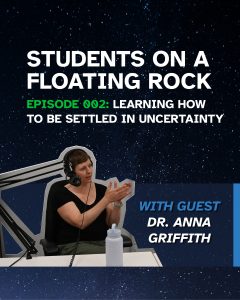
 Students on a Floating Rock is happy to have Dr. Anna Griffith, an associate professor of Theatre, and Changemaker Curriculum developer as our guest for the second episode. She’s joining us today to talk about how changemaking is already woven into the fabric of UFV, an introduction to UFV’s new social innovation certificate, and how students can benefit from changemaking-informed curriculum. And did we mention that Innovation 100 is being taught as a scenario-based roleplaying game?
Students on a Floating Rock is available to stream on your favourite podcast services — including Spotify, Apple Podcasts, Amazon Music/Audible, and more.
Powered by RedCircle
TRANSCRIPT:
Students on a Floating Rock voice-over 0:00
From UFV’s changemaking hub, this is Students on a Floating Rock, a student-run podcast dedicated to—
Students on a Floating Rock voice-over 0:07
—um, I actually think I can take it from here.
Students on a Floating Rock voice-over 0:09
Umm, okay.
Students on a Floating Rock voice-over 0:11
So if I had to describe it, then it’s basically engaging with changemakers to learn about the skills and mindsets needed to navigate these horrific times on this floating rock, also known as Earth.
Regan Smith 0:25
On today’s episode, we have Dr. Anna Griffith, an associate professor of theater and Changemaking Curriculum Developer. She’s joining us today to talk about changemaking at UFV and UFV’s new social innovation certificate. You’re gonna love the way she’s teaching this course.
Regan Smith 0:41
Welcome everybody. It’s a pleasure that we got Anna Griffith with us today. Would you just like to introduce yourself real quickly?
Anna Griffith 0:49
Sure. So I’m Anna Griffith. I’m an associate professor at UFV, and I work in the School of Creative Arts, doing a lot of teaching around interdisciplinary courses, also practice based courses. I’m also a Changemaker Curriculum Developer in the Teaching and Learning Centre right now.
Regan Smith 1:07
Yeah, I just wanted to point out, we’ve heard a lot of great things about you and your teaching is, I’ve heard, one of the best.
Anna Griffith 1:14
Amazing, thanks.
Regan Smith 1:15
Okay, so first, we always like to start off with an icebreaker question. So this one is kind of fun. I’m really excited for it. So it’s: zombie apocalypse is coming. Who are three people you want on your team?
Anna Griffith 1:28
So I’ve been thinking about this since you sent this question, and it’s so hard. So one, I want my partner, Brendan, because he has such a good logical brain. He’s a problem solver. He’s also really strong. He like so I think that we work really well together. And then, for the other two, I know I’m supposed to say probably my two kids, but I also want my dog and so, yeah, so I think so my partner, and then I’m going to just kind of go with the idea that one of our kids is really small. She’s 10, and so she’s only like half a person. So I’m gonna put her and our dog Charlie together, that animals in an apocalypse would actually be mostly helpful. Yeah. And so then my other son, who’s also yeah, he’s pretty inventive. He’s pretty creative. He watches a lot of movies. He’s a great gamer, so I feel like all those skills come in really handy.
Regan Smith 2:25
Oh, okay. I love it. I love how you took the dog—half the dog—and child. Put them together. One person.
Regan Smith 2:33
I know for me, the first off of my head would be Chloe, because she took survival, emergency survival training. So I just feel like she’d be great to have, because she’d know what to do. Oh, I don’t know. I would probably take my sister, because I think we work well together when we want to. Yeah, definitely understands me. I’m gonna go what you did for my third I’m gonna take my two dogs. They don’t have much survival instincts right now, but I think they’ll kick in.
Anna Griffith 3:03
And if not, we use them as bait. That’s the other thing that I was thinking, just a terrible, terrible thought, Sorry, Charlie.
Regan Smith 3:11
Okay, so let’s start on our question. So the first one, can you tell us a little bit about what changemaking is and how it started at UFV.
Anna Griffith 3:19
So I actually think that change making is something that has, it’s foundational to UFV. It just wasn’t called changemaking. It wasn’t packaged as that. But I think that forever UFV was like, it was designed to make a difference in our communities, and it wanted to bring change to the Fraser Valley, and that really is what changemaking is. It’s when you when you want to create positive change in the world through various policies or practices or projects. So this is sort of like a huge changemaking project. And then as as the university has developed, and it’s really taken up this idea of decolonizing through Indigenization. I think again, that is something that is hugely foundational to change making in how I understand it.
Anna Griffith 4:09
And so I feel like changemaking is really woven into the fabric of UFV, and now we’re in this moment where we want to make it even more overt, more obvious, and think about the projects that can really contribute to these really big, complex challenges that we’re facing right now. And so I feel like in how I imagine it change making is really this kind of foundational thing, and then we have these projects that kind of pop up, whether that’s One Health, or CHASI is a great example, or the Social Innovation certificate, these are sort of the how’s, like, how we get to creating really fundamental change that’s more systemic.
Regan Smith 4:51
Yeah, so you mentioned talking about, like, policy change, system change, like, those are really big and intimidating things. How do you see students kind of engaging with this sort of thing?
Anna Griffith 5:01
Yeah, so part of it is learning to see all of the interconnections, to really think holistically. And I actually think that as humans, we’re pretty skilled at that, and then we go through this educational system that kind of funnels us, and it requires us to think just in compartments, or we are really kind of compartmentalizing in how we look at the world. We narrow things into disciplines or fields that really give us a more narrow view, and it’s designed so that we can have kind of this expertise that runs really deeply and that, and I’m not disparaging that at all. I think that’s important too, but I feel like just remembering that we are interconnected, that we can think in much more holistic ways, and that’s that’s how we got here as humans.
Anna Griffith 5:48
So I feel like it’s really this innate thing. So I think that it’s kind of unlearning and giving us opportunities to really think about things in more complex ways that don’t have to be intimidating. Like, I totally agree when you see some of these systems thinking diagrams, for example, there’s the feedback loops, and there’s a lot, but if we think about, okay, I understand how seasons kind of work, and how they affect how I behave in the world. That’s kind of understanding things more from a systems perspective. And so we, I think that it’s about finding ways for us to really think about systems from a different perspective. So I think students are really, actually good at this.
Regan Smith 6:33
Okay, so you kind of talked, you mentioned before about, like, an innovative certificate. So is that going to be part of this course, like, that’s coming to UFV? Innovation 100, if nobody’s heard about it. Like unlearning, yeah. So is it going to be a lot of just unlearning or?
Anna Griffith 6:50
So, yeah. Okay, so I’m going to kind of expand for a second. The Social Innovation certificate. It’s actually four courses, 100, 200, 300, 400 of these innovation courses that really help to learn the mindsets, the skills, all of the things that you need to create social change. And then it’s paired with 15 electives, so five different kind of elective courses, and we have 250 electives, over 250 electives, actually, that are in the Social Innovation certificate kind of program. And so most students probably already have a lot of the electives done. So they just need to take these four innovation courses. Sounds really like an ad, take these four innovation courses, but we take these four innovation courses that really teach us the skills of, and mindsets, of social innovation, and then they can take that into their disciplines or into their the areas of interest, and think about how social innovation could actually live in every discipline, in every field and in every area that you might want to go in in your future careers.
Anna Griffith 7:56
And so Innovation 100 is the first of these courses, and it’s Foundations for Innovative Thinking, and it’s really helping us to unlearn, to unlock our minds, to think about the basics of systems thinking, but also start to scale ourselves in futures thinking, where we actually are thinking about like, these are the trajectories that we are on with all these big problems. This is where we might be headed, and how do we work back from there? We sort of think about working along trajectories and then nudging our choices now to see the more preferable futures that we’re heading toward. In answer to your question, Innovation 100 is really about unlearning.
Anna Griffith 8:35
And just a spoiler alert, it’s going to be taught through a game. The entire semester is a game. It’s a scenario based role playing kind of game. It comes out of future thinking. And there’s a lot of deep, you know, rigorous academics around game theory and how that can really, it’s a really useful way of learning. And so through this game, we’re going to be able to actually practice navigating uncertainty and making choices. You know when things are really stressful, seeing what happens when unintended consequences, things, you know, things that we are facing as humans, but we don’t really practice them outside of game worlds. But that’s the approach that we’re taking with Innovation 100 anyway.
Regan Smith 9:16
That’s so cool. When you said, like, it’s going to be a game, like, a light bulb off in my head. I’m like, oh my gosh.
Anna Griffith 9:21
Yeah, it’s going to be really fun. It’s going to be really fun. And through the game, like, as you know, if you play games in any kind of capacity, you learn really important skills, and you get to practice these really important skills, and it takes a little bit of the despair and dread and anxiety out of it, because it’s a game. And so through that, we can practice innovative thinking.
Regan Smith 9:42
Yeah, that’s so cool. Because also sometimes I know when I’m in class and stuff, or, like, in the real world and things like start to get intense, I get like, freaked out, yeah, and I don’t realize we’re all kind of just on a floating rock. It’s okay.
Anna Griffith 9:57
Exactly, exactly. And then thinking about, like, how you decompress. Lots of people, they say they play video games, or they play games of some kind, right? Because that’s one place we’re allowed to be free a little bit with our thinking and our creativity. We’re allowed to act out some of the things that we might want to, but we constrain ourselves from doing it every day, which is good, you know, unless it’s a zombie apocalypse, you don’t want to be out there doing terrible things to each other, but I feel like there’s a lot of real validity for game based learning.
Regan Smith 10:29
You probably already mentioned a little bit, but if there’s anything else you want to touch on, what can students really gain by taking this course?
Anna Griffith 10:35
Yeah, so some of the skills, like hard kind of practiced skills are things around systems thinking and futures thinking, and then the, I guess, the deliverables that come out of that. So how to actually map a system? So you can see where there are levers for change that you can get to right? And so sometimes it’s not, we don’t necessarily have individual, huge spheres of influence as individuals. But when we can see a system, we can say, okay, well, I know that things have to change on various levels for it for a system to actually change. And so who do I need to talk to? Who do we need to partner with? And so to be able to see that is really important. So some hard mapping skills and understanding like systems and drivers of change. There’s a lot of futures thinking skills that people gain, and that’s really the ability to see small signals that might be happening in the contemporary moment that show us where things could be going in the future. And then it’s also about looking at the trends that are happening, and those are more like the big tides of change and seeing how those two work together to to give us ideas of where we might be headed in the future.
Anna Griffith 11:46
And it’s not about predicting the future, but it’s about these kind of observational skills so we can kind of pre-experience what might be coming, which gives us a little bit more resilience in terms of just how we can cope in the world. But it also gives us kind of like opportunity detection, so we can think about how to create really innovative, you know, projects or products even, that might be really useful in the world before it’s starting to happen, kind of on a larger scale. So those, I think, are some really important, kind of harder skills that people learn also, because the 300 and 400 level innovation courses are really taught through work integrated learning. People are getting actual experience working in community organizations and building their CVs and building their networks.
Anna Griffith 12:32
So the first two courses are really about skill building and trying these things out. And, you know, in the world of the game, making these choices, seeing what happens, but 300 and 400 level extends that into the real world. So you’re not only just thinking about social innovation, you’re not understanding it through just theory and case studies, but you’re actually going out into a community organization that you want to work with, and you’re saying, I have this, you know, this skill set, these capacities, how can I help you to create this change you want to see?
Anna Griffith 13:05
So by the 400 level, students are actually co-leading those projects. So they’ll be working with the organization, they’ll be developing, implementing, and then kind of designing this change that they want to see. And to me, that’s one of the most powerful things about the certificate, is that it’s applied. You’re doing social innovation, you’re not just thinking about it. So those are some of the more skill based things that students will get out of the certificate.
Anna Griffith 13:33
But then there’s this huge, I think, kind of area of inner capacity that the certificate really helps us to develop and that’s things like empathy, really deep empathy, especially when you’re designing projects that are going out into the world, you need to understand how this could possibly affect other people. So empathy is one, collaboration across disciplines, across differences, across different community organizations, is another, which we talk about it all the time, but practicing it is really different. I think probably you get a different experience of that through CHASI. But not all students do. So this is a way that more students can actually gain those kinds of skills and then really, and this is maybe just more personal. It’s about being able to navigate uncertainty, right?
Anna Griffith 14:25
We’re in such a wild time, and nothing is certain. Everything seems like it’s falling apart. And so to have some skills and capacities, really, I think of more of them as capacities and mindsets of how to be able to handle that without just falling into despair, I think is really critical. And so those, those kinds of things, are built into every course, because we’re trying to teach with the future in mind, rather than, you know, a future that doesn’t exist anymore. On that gloomy note, sorry.
Regan Smith 14:54
I love how you’re kind of talking about being able to be settled in uncertainty. How did you, I guess, get to that place of like, oh, this is something like, how do you feel unsettled and or settled in uncertainty?
Anna Griffith 15:10
Yeah, it’s such a good question, and I’m still working on it, but part of it is, and I don’t really like the word resilience, but there is something having gone through so much trial and tribulation in my life, that I do have this belief that, you know, even if, even in really terrible situations like a zombie apocalypse, I do think that I would at least try, I would be okay, and but then I see younger generations of people without that, and so it’s really me struggling to figure out, what kind of things can I do to help students or my kids who are also like going through this—they’re younger, they’re in, you know, middle school and elementary school—how can we foster that and and part of it is spending time thinking about all of these future possibilities of how things could go really, really bad, how things might go really, really well. And probably none of those things will happen in real life.
Anna Griffith 16:14
But being able to kind of pre-experience and think about: this is the one of the worst case scenarios. This is what would happen, and how would I handle that? What could I still contribute, even in that terrible situation? How could I be working to make the world better? And so it’s in that, in thinking about how you can contribute, where you can still see that there will be opportunity to thrive, even if you know these more kind of collapse based futures were to come to pass. It’s about seeing that you can still do something and you still have agency. It will look different. It’s not maybe where we want to go, but pre-experiencing that. And this is some of the benefits of futures thinking is you kind of pre-experience emotionally what that would look like, and then what you can still do.
Anna Griffith 17:02
And so to me, I do that a lot, and it’s like, maybe, like doom thinking in some ways, but I try to, you know, do the whole spectrum and like, what would actually if we were to be able to transform? Like, where do we want to get to? And I feel like that’s also kind of a missing piece, because we think about all of the the terrible things in these, you know, huge complex problems that we’re facing, if we, if we can actually think about where we want to get to, there’s so much power there, and we don’t spend enough time with that kind of 10 years in the future, this is what it could look like. And then working backwards, what do we need to do now to make that a reality.
Regan Smith 17:42
So, yeah, I like that. I always feel like, I think about, I guess, the worst case scenario, and then just kind of stay there, instead of, like, going, I guess, kind of bringing it back in on myself and being like, okay, what can I do in my corner of the world? And then, and how do we get to the better positive, I guess, future, yeah,
Anna Griffith 18:01
And you raise, you raise a really important point, and it’s something about academia, because it’s sort of based on this tradition of critique and pulling things apart and analyzing the past and maybe the present. But we don’t spend very much time in the future, and it’s sometimes even I feel like if you do spend time in the future, it requires your imagination. And not that academia is anti-imagination, but in some ways it kind of is. It’s, you know, the realm of the creative arts, or things that aren’t seen as as rigorous, as something that kind of analyzes and deconstructs. But I feel like this is one of the reasons that we’re not solving, quote, unquote, solving these problems yet is because we have a crisis of imagination. We actually don’t see where we’re going. And so this is what I really hope the certificate will do, and it helps me to be able to settle in uncertainty. And I suck at it too. But I’m trying.
Regan Smith 18:02
Yeah, for sure. So also, bringing us back to, I guess, changemaking in a different sense. You talked a lot about the mapping and deconstructing everything, I guess, do you have an example of something where there was a system change, you mapped it out? Or, I don’t know, something a little bit tangible, I guess.
Anna Griffith 18:02
So UFV is in the process of trying to become an Ashoka U designated changemaker campus. And so part of that work is to really think about systemically how changemaking is embedded and resourced at the university. So it started as a, you know, an exercise, basically in mapping where are we at currently, and then seeing where all of the gaps are, I guess, in resourcing to actually fully support change making across all areas, from the registrar’s office to what kind of research gets funded to the types of policies we have in place that just kind of, are the operations of a system, or operations of the university.
Anna Griffith 18:45
And so seeing that, then there was some recommendations made by the people who went through the ecosystem scan of where we could resource things. And so that all of that mapping helps us to see where we’re at and then where we might need to go to, in this case, to make enough change that we were able to get this Ashoka designation. But in the process, we have started to really resource changemaking across lots of different areas of the institution. And even if we weren’t, even if we’re not successful with the Ashoka designation, it’s made some really good change in how we’re imagining ourselves and what we can do at the institution in a way that we didn’t look at in the same sort of way before.
Anna Griffith 20:46
So it’s really becoming now about the institution’s identity as a house of transformation. And maybe before that was just more like the nice motto, the slogan. But now we’re really thinking like, if we are a house of transformation, what does that look like in terms of academics, in terms of our procedures and how we interface with students, thinking about being student ready. Are we actually meeting the students we have in the world right now in a way that supports them, or is it really about the kind of the comfort and the processes at the institution and saying, okay, students, are you are you college ready, or are you university ready? So I don’t know if that answers your question. I hope it does. Maybe.
Regan Smith 21:26
Yes it does. I think so. It was a good example.
Anna Griffith 21:29
It’s an in process example.
Regan Smith 21:31
Yes, it is. I mean, it’s a big thing, yeah, yeah. Well, Anna, thank you for coming, and it was lovely to hear everything that you had to say. Definitely feel better after having our conversation about crisis and everything. Yeah, where are other places that people can find you if they wanted to?
Anna Griffith 21:46
Well, first of all, thank you so much. This is such a fun conversation, and you’re doing such important work, so I really want to, yeah, however I can contribute to elevating that. Maybe I should have you on my podcast, because I have a podcast too. It’s a research based podcast called Creative Praxis. And I interview guests from all over the world who are really working at the intersections of social innovation and sustainability in a lot of different ways, with a focus on regeneration. So like, what does it look like? What does regenerative education look like, which is sort of an undercurrent in all the work that I do, yeah, or at UFV. Come check out Innovation 100. Starts in September.