
Making connections: UFV researcher takes wireless innovation to London
Wireless technology is all around us. From smartphones that help us navigate to smartwatches that track our activity and devices that control our homes, wireless technology has become indispensable.
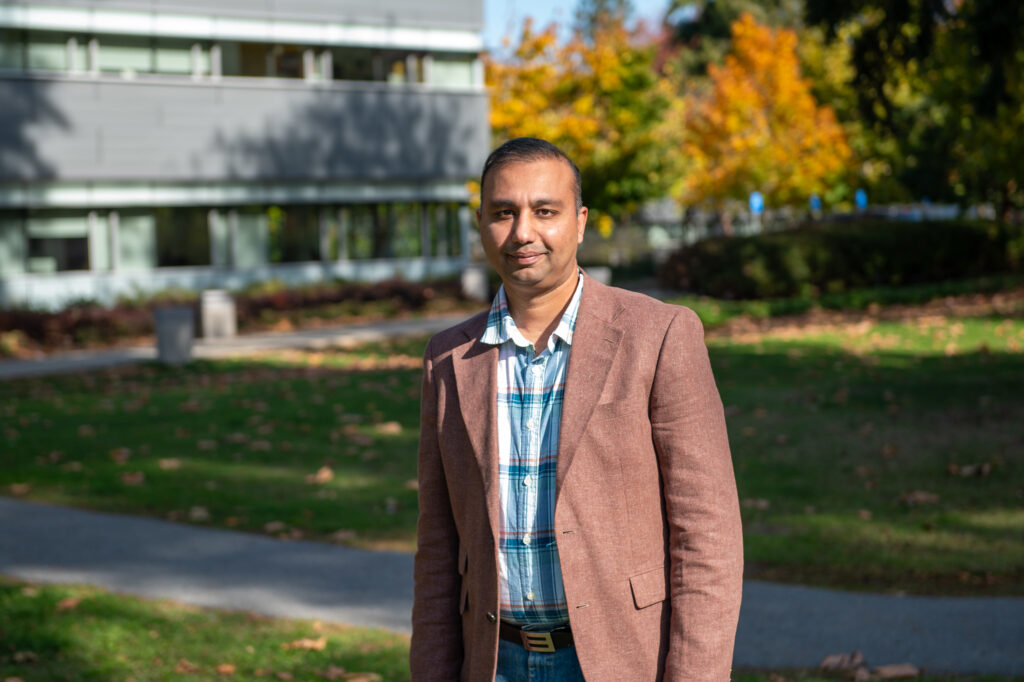
Omer Waqar, an assistant professor in the University of the Fraser Valley’s School of Computing, is working to make wireless networks faster, more sustainable, and more efficient.
Every wireless network has a limited amount of capacity to share among its users. Omer and his research team develop advanced mathematical algorithms that help networks make fast, effective decisions about how best to allocate resources and improve performance. More recently, he’s begun exploring how artificial intelligence can help.
“When you think about Google Maps, that service is optimizing a driving route based on traffic and the driver’s objective, which may be to get to a destination as fast as possible, or may be to get there using as little fuel as possible,” Omer explains. “This is just one example, and as networks like this grow in complexity, there can be millions of parameters that need to be optimized within microseconds.
“It’s vital that we keep adapting and upgrading, because our old algorithms eventually can’t keep up with modern networks. If they take two or three minutes to make decisions, everything has already changed.”
It’s this pursuit of faster, more efficient wireless networks that recently took Omer to the University of West London (UWL), where he presented his team’s work to the Industrial Internet of Things Research Group.
Led by professor Nagham Saeed, the group focuses on intelligent systems, automation, and smart infrastructure, making it a natural audience for Omer’s research.
“I started by explaining where I come from, the Fraser Valley, the university, and how it’s been growing as a research institution over the last few years,” he says. “And then, I talked about my work, and I got very positive feedback. In fact, after the seminar ended, I had discussions that continued for another two hours. They were quite excited.”
Omer believes those discussions could lead to future collaboration. UWL’s research intersects naturally with his own, and agriculture offers one example of what that collaboration could look like.
With climate change putting increasing pressure on global food security, agriculture offers enormous potential for smarter wireless technology. Omer envisions farms equipped with thousands, perhaps even millions, of wireless sensors beneath the soil, collecting information about crop health to help farmers improve yields.
Managing the enormous volume of information generated by those sensors would require fast, reliable, and efficient wireless networks capable of making decisions in real time.
An increasingly connected future will also include technologies such as self-driving cars and autonomous robots, which depend on fast, reliable wireless communication. Omer and his London connections are now exploring funding opportunities that could support collaborative research with the potential for global impact.
“Research is teamwork, and it’s always beneficial to have as much collaboration as possible. That’s why I always try to build strong connections,” Omer says. “I see London as a technological hub, with a lot of talented people. In computer science, people can work together from anywhere in the world, and I see a great opportunity to work together on research that is mutually beneficial.”
For now, Omer’s algorithms are being tested through computer simulations. He hopes to eventually partner with industry to develop the technology further and explore opportunities for commercialization.
The possibilities are exciting, but it’s the challenge of solving complex problems that keeps Omer motivated.
“When I try to solve some problem, it creates curiosity in me, just like watching a movie or watching a series, and wanting to see what happens in the next episode,” he says. “They start watching and they keep watching, watching, watching. The same thing happens to me when I start thinking about a problem.
“I just want to keep going until it’s solved.”
Story by Eric Welsh — eric.welsh@ufv.ca