
The missing middle: UFV researcher tackles B.C.’s farmland affordability challenge
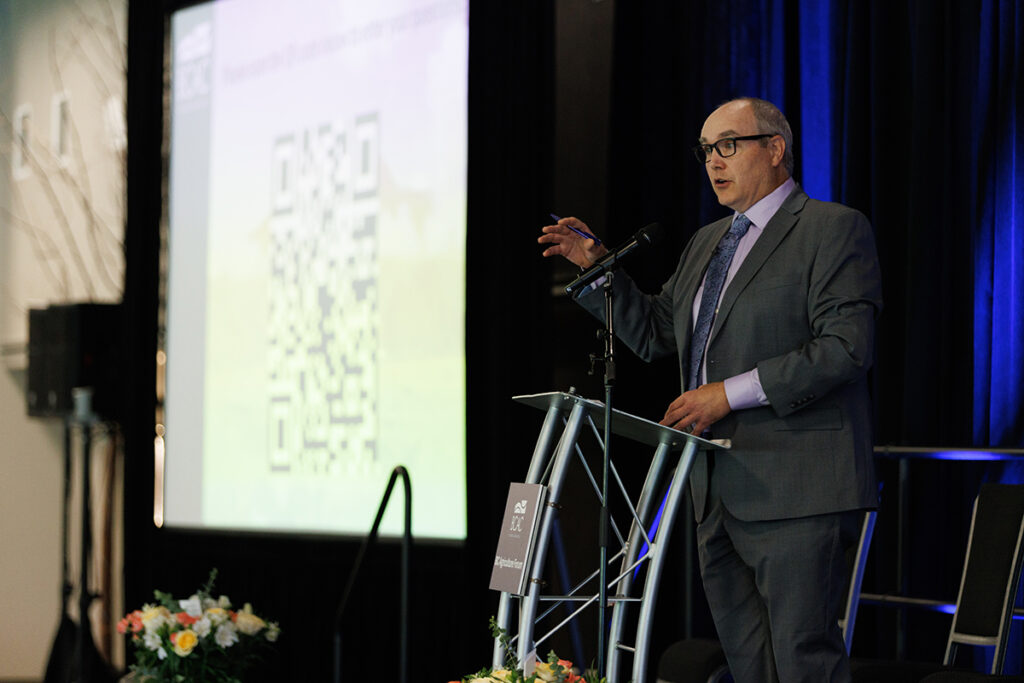
Chris Bodnar knows what it is to watch a bottom line as closely as a crop. Until recently he was a farmer, and he now teaches the next generation of growers through the University of the Fraser Valley’s Agriculture programs. It is that double vantage, from the field and from the classroom, that has him playing a key supporting role in establishing a trust designed to keep B.C.’s farmland in the hands of farmers.
Chris has spent the past 18 months working with the BC Agriculture Council (BCAC) to develop this trust, which would acquire farmland, through either donation or strategic purchase, hold land in perpetuity, and lease it to farmers at an affordable rate. His in-depth research is helping to inform BCAC’s decision making.
“Right now, unless someone is taking over a family business, nobody can get into farming without an investor behind them, or some other source of independent wealth,” Chris says. “That makes growth in the sector really challenging.”
Across the province, Chris counts approximately 620 farms operating at a larger scale, generating $2 million or more in annual revenue, and another 1,100 generating between $500,000 and $2 million. It is this second group he calls “the missing middle,” and it is being slowly eroded by the prohibitive price of land.
He laid out the case in a new report titled Farming at the Edge.
“In the rest of the country, we see about 30 per cent growth in the number of operators at the mid-scale, but it’s been stagnant in B.C. for around 20 years,” he explains. “We see people trying to get into farming and make it work, but they end up leaving. And if people can’t enter the sector and make a go of it, then that’s a red flag for the future of agriculture in B.C.”
The math is unforgiving for anyone starting out, and the question that drives his work is straight-forward: how can we make affordable land available to a new generation of farmers?
Chris has studied land-trust models that already work elsewhere. Ontario, for instance, has run a farmland trust for 20 years, using a legal tool called an easement, or a right that ensures land stays in its intended use no matter who owns it.
The response, he says, has already outrun expectations. Donating land is a big ask, yet farmers are already telling the group they will be ready for the moment the trust is established. Reaching charitable status will take about two years, at which point donors can receive tax receipts that can help in estate-planning decisions.
“We were blown away by the response,” Chris says. “You need buy-in from the sector, and this initiative is coming from the sector. The BCAC’s board is made up of people in the agriculture industry, and the BCAC represents around 98 per cent of farm receipts in the province.”
The pressure to find solutions is immediate.
Over the past 20 years, Chris notes, Canada has lost farmland equivalent to the entire size of Nova Scotia. In the Fraser Valley, the pressure is acute as cities like Chilliwack and Abbotsford face growth pressures on a limited land base.
“When we lose farmland, we can’t create more. When we make the choice to not use it for farming, it’s not recoverable.”
He points to B.C.’s Agricultural Land Reserve (ALR), established in 1973 to protect about 4.6 million hectares through zoning, policy, and regulation, which is often mistaken for a land trust.
“A lot of people assume the ALR is a land trust, but the one piece that was never carried out when the ALR was established was developing a land bank,” he explains. Land was purchased for that purpose in the 1970s, then sold off when a new government took power. So this initiative is about the agriculture sector looking at what it can do to support land access in the long term.”
Opportunity for B.C.’s agriculture sector, Chris suggests, rests on the missing middle. The largest commercial operations have the scale to absorb cost shocks; the mid-sized ones do not. But given the right conditions, they are also the operations best poised for growth and innovation.
Their success or failure will define the next decade of BC food production.
“I got into this because I want to see a pathway for people who want to farm,” he says. “If we get this right, that door can stay open.”
Story by Eric Welsh – eric.welsh@ufv.ca