
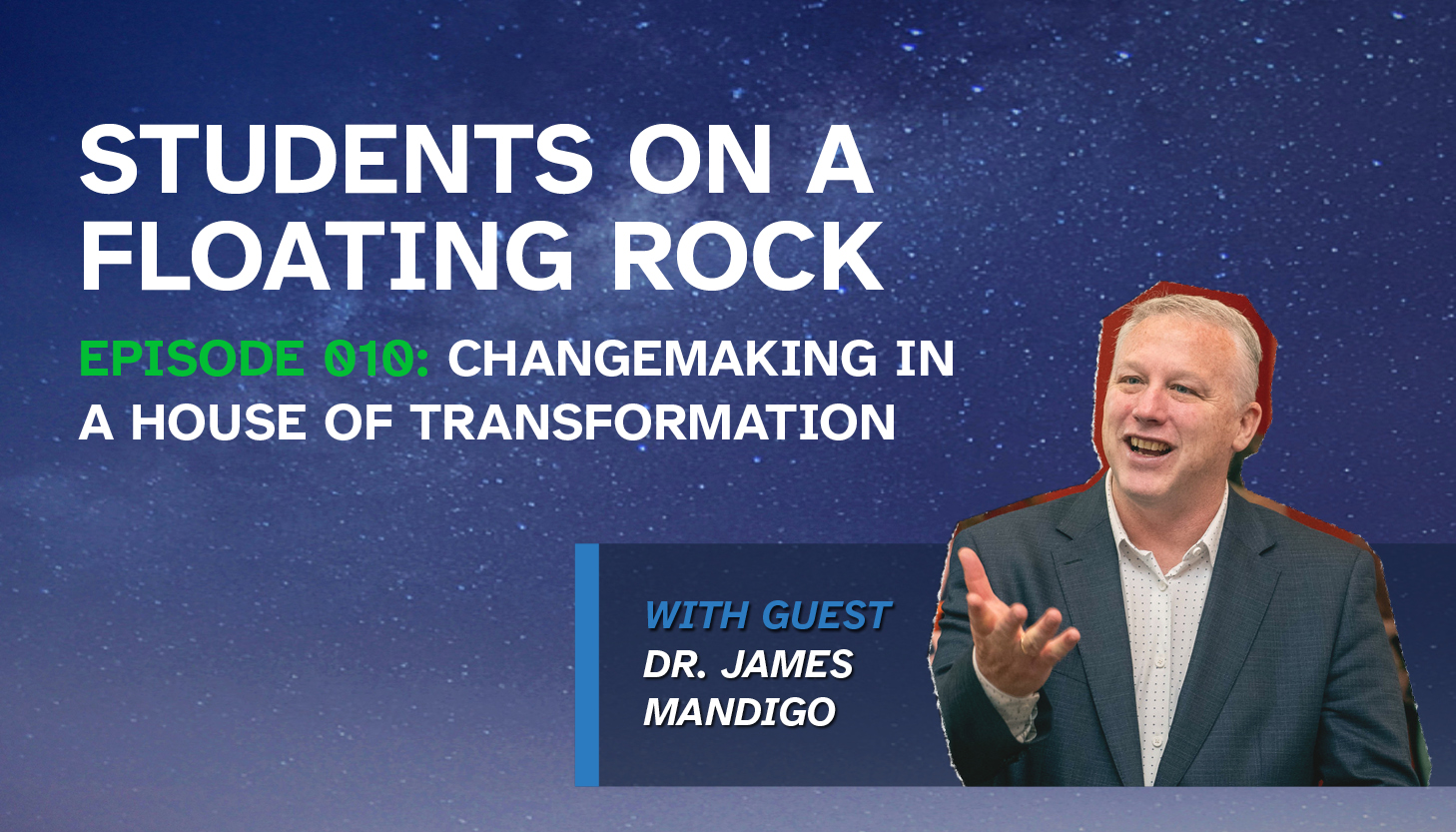
 On today’s episode we have Dr. James Mandigo, our own President and Vice-Chancellor of the University of the Fraser Valley. He’s joining us today to talk about how UFV embodies changemaking, the nuances of measuring impact, and how students can practice changemaking during their studies.
Please note, this episode was recorded Fall 2025 and so minor details may have changed since the time of recording.
Students on a Floating Rock is available to stream on your favourite podcast services — including Spotify, Apple Podcasts, Amazon Music/Audible, and more.
Powered by RedCircle
TRANSCRIPT
Students on a Floating Rock voice-over 0:01
From UFV’s changemaking hub, this is Students on a Floating Rock, a student-run podcast dedicated to—
Regan Smith 0:07
—um, I actually think I can take it from here.I actually think I can take it from here.
Students on a Floating Rock voice-over 0:10
Umm, okay.
Regan Smith 0:11
So if I had to describe it, then it’s basically engaging with changemakers to learn about the skills and mindsets needed to navigate these horrific times on this floating rock, also known as Earth.
Amrit Mahal 0:25
I’m your host for today’s episode, Amrit Mahal, and it’s a pleasure to have Dr. James Mandigo, UFV President and Vice-Chancellor, joining us today. Thank you for taking the time out of your day to be here with us.
Amrit Mahal 0:39
Good morning.
Dr. James Mandigo 0:39
Good morning, Amrit.
Amrit Mahal 0:40
So, an icebreaker question for you to start off this podcast. If the Boston Bruins and Montreal Canadiens were in the Stanley Cup Final, who would win that championship?
Dr. James Mandigo 0:51
Wow, great, great question. And, like any good researcher, it’s important to outline your biases up front, and so I have been a lifelong Habs fan, but like any good scientist, you have to tackle this question objectively, right? So, if you look at the history of Boston and Montreal and the Stanley Cup finals, I believe Montreal has won all six series, six to zero, so you know when we talk about statistical error. There is no statistical error in this one. It’s 100% Montreal Canadiens would win. Go Haps, go!
Amrit Mahal 1:28
Well, yeah, if we look at it from that angle, I’ll definitely have to agree with you. As a Vancouver Canucks fan, I would try to argue it out, but I don’t have the evidence to support it. So maybe, maybe in a few years, we’ll revisit that.
Dr. James Mandigo 1:40
Well, Boston has beaten Montreal the same number of times in the final as Vancouver has.
Amrit Mahal 1:44
Okay, okay, fair. All right, jumping into some of the, some of the questions. How does UFV define changemaking within its academic and community engagement framework, and why is it so important?
Dr. James Mandigo 1:58
Yeah, you know, a changemaker is someone who identifies an issue that our communities are dealing with that are important to them and tries to make a difference in helping to address that, and I think that this has been something that since UFV became a college in 1974 and throughout its entire history has really embraced as part of our DNA. It’s part of our culture here, and so when you look at the types of programs that we offer, academic courses that we offer, you know, and the way we deliver those courses, I think you know, that’s been infused since day one of UFV history, and so I think that it just comes naturally I think to people here at UFV, because it’s who we are, and our vision statement for the university is we will be known as a gathering place for learners, leaders, and seekers.
Dr. James Mandigo 2:53
And I think that what we’re known for goes back to what our university’s motto is, and it’s Íyáqáwtxw, which is a “house of transformation,” and that inspires us to be changemakers, and, and so I think that it’s, it’s hard to, to just say, well, to point to one or two examples, because it really is infused throughout, you know, the moment you walk into a classroom, or the moment that a student is engaged in our community, it goes with them.
Dr. James Mandigo 3:23
For me, it’s about, and I think for the university, it’s always been about, you know, how can we help support the social, the economic, the cultural development of the communities that we serve? And there are just so many amazing examples that happen every single day across our university, but across our various communities as well.
Amrit Mahal 3:44
Fantastic, and as someone who has has recently been embedded into this changemaking work, and as a UFV grad, I can definitely, I can definitely say that it’s something that you feel right when you walk in the door. And in my, in my four five years here now, yeah, no, I totally agree, and I’m so excited to see that it’s taking it’s, it’s now in a, it’s now a cross-campus initiative.
Dr. James Mandigo 4:06
Yeah.
Amrit Mahal 4:06
How does UFV collaborate with local communities, organizations, and students to lead changemaking initiatives?
Dr. James Mandigo 4:13
Yeah, I think one of the ways that we, I think we’ve been trying to do this, and the way we’ve done it in the past is, is, and we’ll continue to do this in the future, is you know, we’re not imposing something on our communities, we’re not going into communities and saying “you need to do this, you can do this better, you can do this better,” it’s about a relationship that we have with our communities, and often it’s communities coming to us and saying, “you know what, I’m struggling with this issue, and I, you know, it’s a really complex, wicked problem that, that we’ve been trying to figure out, but we need some help, and how can you help us with this?” and, and so that’s where, you know, CHASI, for example, does an amazing job of letting the community know that we’re here, and then working side by side with community on addressing really critical issues.
Dr. James Mandigo 4:13
And then, of course, we’ve got, you know, such talented individuals in our faculty and our students and our staff that we’re able to bring in to help with those conversations, to help address those critical issues, to help identify real solutions, sustainable solutions that are going to make our communities thrive, so I think it’s about that symbiotic relationship that we have with community, and a lot of that has to do with trust.
Dr. James Mandigo 4:39
The community, I think you know, since this has been part of who we’ve been since we started in 1974 you know, we’ve we’ve been intentional about being in community, fostering relationships, building trust, so that our community has that trust, that we’re an ally, we’re a partner, we’re here to support the work that they do, and in turn that also has rich benefits for our students who get to be part of that as part of their learning journey, and and share their gifts, as well as faculty and staff who you know, you know, just exceptional professionals who also have a multitude of talents and gifts that they want to us in turn share back with our communities.
Amrit Mahal 6:17
I love that. And how can UFV measure success and impact of its changemaking efforts, and the development of the students as changemakers? And this is something that we’ve been thoroughly discussing in the student club, it’s something that we’ve been talking about as students on the changemaking project here at CHASI so, would love to hear your input on that.
Dr. James Mandigo 6:37
You know, that’s a great question, because impact doesn’t often happen right away, you don’t see, you know, sometimes we’re dealing with systemic kinds of issues that could take months, years, decades to try and change, and so seeing results right away can often be really challenging, right? To see, you know, if we look at the number of people who are unsheltered being, there’s a comp—that’s a complex issue in our communities, and that’s, you know, that’s going to take a lot of concerted effort and resources to try and ensure that people who are often the most vulnerable in our communities have the supports they need to thrive like any other citizen and human being in our communities as well, and so you know, but the important part is that there’s work being done on it, right?
Dr. James Mandigo 7:37
And so I think some of the, some of the metrics that we can use, and we have, we use some of these key performance indicators in our integration plan. For example, we look at, you know, how many students do a research project as part of their journey here at UFV as part of their credential? How many, you know, do we offer credit, course credit for those types of research opportunities? How many students are involved in working to get learning opportunities as part of their courses, as well, through co-ops or internships and placements? So we can monitor those kinds of things, and making sure that we’re providing more opportunities for students, that students are engaged. We call these high-impact practices, and so there’s indicators along the way, but it doesn’t always measure the true impact at that moment in time.
Dr. James Mandigo 8:28
And so you know, we monitor these things, we do things like student surveys, there’s there’s the NSS survey and the CUSC survey that students, I know students feel surveyed to death sometimes, but those, those, those types of getting feedback from our students is really important, because we can identify, okay, are we on the right track? Are we providing sufficient and opportunities for students to be engaged in in research as part of their credentials here, their programs here? Are students doing placements and internships, and working alongside community to learn alongside community leaders, and also, you know, bringing the ideas and the gifts that students have into our community as well, in that sort of symbolic relationship?
Dr. James Mandigo 9:14
So I would say it’s it’s often hard to know the true impact of something, but I think I’ve been, my research has been around looking at the prevention of youth violence through sport and physical activity, and you know, you can go in and you can measure incidents of violence or students’ behavior on a short-term basis, but how do we know long term that that’s going to have an impact? And so it’s about continually to monitoring and showing up and still being engaged in community to see whether or not the changes you’re trying to work with community members are having that long impact.
Dr. James Mandigo 9:50
And that’s really I think the true measure of impact, is whether or not it’s sustainable and in our in our work in in Central America around youth violence, our goal was to work ourselves out of a job, you know. We started off working with a university and a university program there, and eventually they didn’t, we just got in the way, right? Like, they got it right? And that’s the true.. I think for me that was the true measure of changemaking: when the gifts that you were asked to share, that you shared, and that they’ve been passed on to the next, to the leaders that are going to lead this. You can, you can sort of back away and know that that’s going to be sustainable. So, in often cases, it’s about getting to a point where an initiative or a program or a movement is sustainable on its own, because that means that people in the community have made it their own, and the community has invested time and resources and capacity to be able to continue with that on a long-term basis.
Amrit Mahal 10:54
I love that. That was, that’s great. And as a student changemaker, I think it’s really important to consider those things, because at times sometimes we think about, okay, you know, like you said, how do we measure impact? and sometimes it’s one of those things where, it can’t be, but there, and you got to be patient with it, and see what the long, what the long term goal is.
Dr. James Mandigo 11:16
Yeah.
Amrit Mahal 11:16
So I think all those things are really important to consider, and we’ll definitely be considering them moving forward.
Dr. James Mandigo 11:21
They say the best time to plant a tree is 50 years ago, and the next best time is right now. And so you know, if you start planting those trees now, right, it’s going to have an impact, it’s going to reduce, you know, benefit our environment and support climate change, but it’s going to take a long time for that tree to mature, but knowing that you help plant that seed, plant that tree to help that grow, and have that impact, you know, is really important. And so I think for students, you know, it’s really important to recognize that you may not see the immediate long-term sustainable impact, but looking back and knowing that, “hey, I was a part of that,” I think that is just the biggest reward you can get from your educational journey.
Amrit Mahal 11:44
Yeah, I couldn’t agree more, and I feel that way with a lot of my work here at CHASI. So, I agree. So, moving on to some of a couple more questions that we have, what are you most excited about for UFV’s future?
Dr. James Mandigo 12:17
Yeah, I mean—
Amrit Mahal 12:18
—big question, I know.
Dr. James Mandigo 12:20
—no, no, big, but I’m, I’m just so excited to see where our students’ journey goes. I am so proud of our faculty and staff, who are committed to, you know, working with our students in a way that sees themselves and develops those global citizenship skills, and you know the world needs more good global citizens right now, and we turn to our young generation and our students and saying there’s hope here, right? Our students are very aware of issues around things like climate change and geopolitical tensions, and equity, diversity, and inclusion, indigenization, truth and reconciliation.
Dr. James Mandigo 13:06
I mean, these are big issues that our students are, you know, lifting up and embracing and demonstrating the strength of these issues, and that’s going to make our, not our communities better, but our world better, and so I know that through that lens, and through this, the skills that our students are acquiring through their courses, and through programs, and through initiatives like CHASI, for example, and being engaged, that I’m just so, I’m so optimistic around what the future holds, with you know, students, with changemaker students, you know, like yourself and like your peers who have really embraced this and want to be, make a difference in our communities, and yeah, I think that’s what I’m really excited to, to see how our students, you know, and our alumni are going to make make a difference in our communities, because I think the world needs you, and our communities need you, and you’ve got the gifts and the skills that society needs right now, and so you know having opportunities to share those with our communities is what I’m most excited about.
Amrit Mahal 14:20
And continuing to talk a little bit more about the student experience. Myself here, I’ve been at CHASI for a year, and I’ve had the privilege of meeting you several times, and being able to have really meaningful conversations, and I think it really speaks to your commitment and support to the UFV student experience. Why is that so important to you?
Dr. James Mandigo 14:40
This is why I got into this gig in the first place, right? I mean, you know, I’ve been a faculty member for a majority of my career, you know, and I got to work alongside just some amazing students in my journey who have now gone on to do just really impactful kinds of things in a lot of different areas around the world, and so you know, when we support students, our communities are better, our, you know, our institution, first of all, is better, and our communities, and then you know, our world is better, and so I think it’s providing those opportunities that not just in the classroom, and obviously in the classroom, is really important to gain some of those really critical skills, but also provides opportunities outside the classroom as well.
Dr. James Mandigo 15:32
I mean, you know, we talk here at UFV that learning can take place anywhere, and CHASI is an amazing example of that, of where such a dedicated, talented group of individuals who, you know, are taking what they’ve been learning throughout, you know, their educational journey and, you know, applying it in a way that is going to help with different community projects and different community issues, and so I think that it’s, it’s important for students to get involved, to get engaged.
Dr. James Mandigo 16:01
There are so many opportunities for students to use and share their gifts, and you know, CHASI is an amazing example of that. And there’s other research centers at UFV that really thrive on students, students coming and being a part of that. And I think at UFV that’s one thing that’s really unique to Canadian universities, and you know, I’ve been at other universities, and you know that are perhaps more focused on on the research side of things, and graduate programming, and you know, I’ve enjoyed my time there, but, but what often happened was undergraduate students were left out of the research opportunities, but not at UFV, you know, our undergraduate students have the opportunity to be engaged to work alongside amazing people like Dr. Martha Dow and others across the university who are researchers, and students get to learn side by side in real time, you know, from these amazing leaders that we have and researchers that we have.
Dr. James Mandigo 17:01
And so I would just really encourage students to just lean into, embrace these opportunities. If you’re here for two years, four years, six years, eight years, whatever it is, right, that time is going to fly by, believe me, right? I mean, you’re going to look back and go, oh, I mean, I look back, and I go, wow, I wish I could just spend a day reading course material in a course that I really love, right? Like, those, those days are far removed for me. I’m spending a lot of my days, you know, reading spreadsheets and everything, and those are important, that’s important work to do, but I look back at my time of being a student, and you’re grumbling “I gotta get this reading done, this project done,” but to be able to spend a day on something that you’re passionate about, lean into that, embrace that, enjoy that, celebrate that, and because this time is going to really fly by. So I would just say, make, make the most out of your experience here.
Dr. James Mandigo 17:58
At the end of the day, you know, when you walk across that stage, you know everyone has that same piece of paper that says you’re a graduate of UFV, but it’s what you did during that time that’s going to really make a difference, and it’s going to open doors for you, and it’s going to be the things you’re most proud about when you eventually take that next step in your journey, and move on from from UFV, but it’s those experiences that you have that are going to make a difference, and not only in our communities, but in your own personal lives as well. So lean into it, embrace it, find something you’re passionate about, you know, and just, just go for it, right? I mean, this is this is the time where you can do that, so it’s, you know, I just encourage everyone to, you know, lean into the journey, right? To embrace the adventure.
Amrit Mahal 18:48
And I couldn’t agree more, and yeah, as a student, and having these amazing opportunities, reflecting back on those experiences now, it’s, I don’t even have the words to describe how it’s impacted my academic journey, and even just my life.
Dr. James Mandigo 18:50
Yeah.
Amrit Mahal 18:50
So, yeah, so there’s great opportunities at UFV, and how can students get involved and support changemaking initiatives on campus?
Dr. James Mandigo 19:14
Yeah, I mean, I think that there’s, you know, there’s obviously the change, the student changemaker Club, which I would really encourage students to be a part of, but, but you don’t have it, doesn’t have to be official, you don’t need, like, you know, the changemaker secret handshake or decoder ring, right, like, anyone can be a changemaker, and so I would just encourage students that if you’re looking for, you know, a peer group to work alongside with, obviously, the changemaker student group is a way to start, you know, I think, you know, even in your courses, like, start asking, think about the type when you’re given an option to do assignments and write a paper, like, find something you’re passionate about, and write about that, or explore that a bit more. If you’re doing a thesis project, or if there’s a faculty member that you’re really, you know, that’s, you know, that’s really cool kind of research they’re doing. How can I get involved? Have a conversation with them, see how you, there’s opportunities for you to get involved with their research, you know.
Dr. James Mandigo 20:20
So I think there’s, there’s a lot of different ways you can get involved, both formally and informally, you know, because, because really being a changemaker is about identifying an issue that you’re, you care about, you’re passionate about, and helping to find answer important questions around that initiative, so you know, I would just encourage students to reach out, you know, there’s amazing clubs and groups, in your courses, with our research centers and institutes. You know, find something you’re passionate about, get involved, and share your gifts when you can.
Amrit Mahal 20:54
I love that. And moving on to our last question, if you were to give a one minute TED Talk on the change that you want to see in regard to your work, what would you say?
Dr. James Mandigo 21:06
In a one minute TED Talk, I would use 10 seconds to introduce a student, and I’d let it.. I would want a student to share that, because I think that that’s really what changemaking is about. I think it’s hearing about the work that our students are doing to be changemakers, and I’ve often said, you know, to some of my, the folks that I work with, if you have a choice between inviting me to give a talk or a student to give a talk, that’s an easy choice, like you invite the student, right, because every single time, and again, you know, I’ve been at different institutions, and amazing students there too, but I can’t quite put my finger on what it is, but there’s something just so special about our students here, and I’m not just saying this, I’ve said this many, many times to people, you know.
Dr. James Mandigo 21:57
Whenever I hear a student speak and share their story and share their journey. I just leave so inspired by that, and of course, you know, behind a lot of students are our faculty and staff who’ve been there to mentor and support them. So I think it speaks a lot to, maybe that’s the secret sauce, maybe it’s our, it’s the commitment and dedication of our faculty and staff who take time to mentor, inspire, encourage, educate, celebrate in their courses, because every time, and I mean, I’ve been here now over six years, and every time, without fail, a student speaks, I get shivers down my back because of the story that they tell about their journey and the impact that they’re making, so if I ever had an opportunity to do a one minute TED Talk, I want the rest of the world to hear from a student as well and be as inspired as I am.
Amrit Mahal 22:50
Thank you so much for your time today.
Dr. James Mandigo 22:53
Yeah, my pleasure. Thank you so much for your work.
Amrit Mahal 22:55
and thank you for coming in and talking to us about about changemaking and just overall student involvement, and like always, we appreciate your time and your commitment to changemaking, and all the work you do. So, thank you so much.
Dr. James Mandigo 23:05
My pleasure. Thanks so much for having me.
Amrit Mahal 23:06
Yeah, thank you.
Dr. James Mandigo 23:07
Take care.